Chapter 1: The Erasing
My name is Ingred Fairbanks-Webb. I am thirty-four years old, and four years ago, on the humid, suffocating night before Mother’s Day, I discovered I had been deleted.
I didn’t find out through a scream-filled argument or a tearful goodbye. It happened in the cold, blue light of a smartphone screen, with a digital silence that was louder than any door slam. I had been removed from the “Fairbanks Family Dinner” WhatsApp group—exiled like a stranger, like a glitch in the system that had finally been patched.
The notification was brief: You have been removed.
But it was the message preceding the removal—a screenshot forwarded to me by the only cousin who still possessed a conscience—that shattered the world as I knew it. My mother’s text to my siblings was crystal clear, written with the clinical detachment of a bank manager closing a non-performing account:
Reminder: All my children are successful except Ingred. She chose to be a lowly teacher. I no longer see her as my daughter. Do not mention her name tomorrow.
I didn’t scream. I didn’t call her, begging for an explanation. I sat on the edge of my bed in my cramped apartment, listening to the hum of the refrigerator, and simply… disappeared. I gave her exactly what she wanted.
What my mother, Margaret Fairbanks, didn’t know was that four years later, I would be standing on a stage in front of five hundred people, with the Governor of Virginia shaking my hand. She didn’t know that she would be sitting in the audience, uninvited, wearing her best Chanel suit, waiting for a moment in the spotlight that would never come.
But to understand the sweetness of that victory, you have to understand the architecture of the cage I grew up in.
The Fairbanks family was what the neighbors in our affluent Virginia suburb called “picture perfect.” We were a brand, not a family. My mother retired from her position as a regional bank manager at fifty-five, not because she needed rest, but because she had finally secured her seat at the Westbrook Country Club. The membership initiation fee alone cost more than my current annual salary. She wore her Hermès scarves like armor, always draped just so over her shoulders, in muted tones that whispered “old money,” even though our wealth was barely a generation deep.
My sister, Victoria, was the crown jewel of the portfolio. Thirty-eight years old, a plastic surgeon in Richmond with a clientele list that read like a Who’s Who of local news anchors and politicians’ wives. She curated her life on Instagram with surgical precision: photos of her Rolex Datejust casually resting on white tablecloths, her manicured nails wrapped around champagne flutes at charity galas. Every Thanksgiving, she would update us on her latest “subtle work,” as if we couldn’t see the unnatural tightening around her eyes or the lips that seemed to inflate with every passing fiscal quarter.
Then there was Bradley, forty, a corporate lawyer in D.C. who drove a Mercedes G-Wagon that he made sure to park in the most visible spot at every family gathering. He had a wife named Carolyn who collected designer handbags the way some people collect stamps—methodically, obsessively, always hunting for the next limited edition to prove her worth.
And then there was me. Ingred. The youngest. The bad investment.
I was a fourth-grade teacher at Maple Creek Elementary, a small, underfunded school tucked into the rolling farmland about ninety miles from my mother’s pristine Colonial Revival mansion. My Honda Civic was twelve years old and made a rattling sound when I idled. My apartment could fit inside Victoria’s walk-in closet.
But here is the secret no one ever mentioned at those country club brunches: My mother had two successful children, a doctor and a lawyer. Not three. Never three.
I didn’t choose teaching because I lacked the intellect for anything else. When I graduated high school, I had a 4.1 GPA and a full scholarship offer to pursue Pre-Med at UVA—the same golden path Victoria had walked a decade prior. My mother had already ordered the “Future Doctor” bumper sticker. She had already told the ladies at the bridge club. The narrative was set.
But I had spent that summer volunteering at a literacy camp for underprivileged kids in our county. There was a boy named Marcus Jr., eight years old, who couldn’t read past a first-grade level. He had been told his whole life he was “slow.” By August, after weeks of us sitting together under a tree sounding out syllables, he was devouring chapter books. The day he finished Charlotte’s Web on his own, he hugged me so tight I thought my ribs would crack.
That was the moment I knew. I wasn’t a doctor. I was a teacher.
I called my mother that night to tell her I was declining the Pre-Med scholarship to study Education. The silence on the other end lasted seventeen seconds. I counted.
“You’re throwing your life away,” she finally said, her voice ice-cold. “For what? A government salary and ungrateful children? You are choosing poverty, Ingred.”
She didn’t come to my college graduation. She claimed a “conflict”—a garden party at the club. Victoria sent a card with a check for fifty dollars and a note that read: Good luck with your little career.
I cashed the check because I needed groceries, but I never forgot the venom beneath the ink. You chose wrong. You chose less. And we will never let you forget it.
To my mother, being poor and being worthless were exactly the same thing.
The exclusion didn’t happen all at once. It crept in slowly, like black mold in the grout. Thanksgiving 2019, I arrived with a homemade sweet potato casserole, Grandma Ruth’s recipe. I found my place card at a small folding table in the corner, set up for Victoria’s stepchildren and Bradley’s toddler nephew.
“Oh, honey, we just ran out of room at the main table,” my mother said, adjusting her pearl earrings, not making eye contact. “You don’t mind, do you? You’re so good with children.”
I was thirty years old.
But the final blow, the one that led to the WhatsApp deletion, came from my cousin Rachel. She was the only person in my family who saw me.
Rachel called me late that night, her voice trembling. “Ingred, I need to tell you something. Check the group chat. I… I took screenshots before Victoria kicked me out for asking why you weren’t invited.”
I looked at the image. I no longer see her as my daughter.
Below it, Victoria had replied with a single red heart emoji. Just a heart. No protest. No hesitation.
Bradley’s response was two words: Understood, Mom.
That was my value. Two words and a heart emoji.
I sat there, the phone screen blurring through my tears. I wanted to scream. I wanted to drive to her house and demand an explanation. But then, a cold clarity washed over me. She had made her decision. She had announced it to the board of directors that was our family. Ingred is a liability. Divest.
By sunrise, I had made a decision of my own. If my mother wanted me gone, I would be gone. Completely. On my own terms. But I would not forget. And I would not delete those screenshots.
Some receipts you keep forever.
Chapter 2: The Ghost and the Gardener
Mother’s Day morning, I woke up to silence. No calls. No texts. Not even an awkward “We miss you” from my father, who had long ago learned that crossing Margaret Fairbanks resulted in a silent treatment that could last months.
For the first time in thirty years, I didn’t send flowers. I didn’t call. I didn’t drive ninety miles to sit at a corner table while they pretended I didn’t exist. I made coffee. I graded papers on the history of Virginia. I went for a walk along the creek.
I blocked her number that afternoon. Then Victoria’s. Then Bradley’s. I deleted Instagram so I wouldn’t have to see the curated photos of their “perfect” brunch.
I didn’t know then that my silence would last four years. I didn’t know those four years would reconstruct my entire soul.
Six months later, Rachel called. “Thanksgiving photos are up,” she whispered. “Victoria posted them. The caption says, ‘Grateful for my amazing family. Mom, you raised us right.’ There are only three people in the photo.”
I laughed, a bitter, jagged sound. “They just reconfigured the table, didn’t they?”
“Yes,” Rachel said. “But Ingred… there’s something else. Your mom is telling everyone at the club that you’re in Africa.”
“Africa?”
“She says you’re doing volunteer work for an education non-profit. Very prestigious. She says you can’t come home because you’re ‘changing lives overseas.’ She told Mrs. Patterson you were nominated for a teaching award in Kenya.”
I stood in my kitchen, staring at the cornfields out my window. I hadn’t left Virginia in three years.
That’s when I understood the depth of her sickness. My mother didn’t hate me. She hated what my existence said about her. So, she killed the real Ingred—the “lowly” teacher with the Honda Civic—and invented a version she could brag about. A humanitarian hero, conveniently unreachable.
I was already a ghost.
I met Marcus Webb on a Tuesday in October, surrounded by pumpkins and giggling nine-year-olds.
His farm, Webb Family Organics, was a local legend. Fifty acres of rolling hills, heritage vegetables, and an apple orchard that looked like a painting. I had brought my fourth graders on a field trip.
Marcus was waiting by the tractor. He was tall, broad-shouldered, with kind eyes crinkling at the corners and soil permanently embedded in his fingerprints. He shook my hand, his grip warm and rough.
“You must be Ms. Fairbanks,” he said. “My daughter hasn’t stopped talking about you.”
His daughter was Lily, five years old, with golden curls and a smile that could melt glaciers. She was in my colleague’s kindergarten class, but I tutored her twice a week. Her mother had passed away from cancer the year before, and Lily was struggling to find her voice.
“Lily is an incredible kid,” I told him. “Smart as a whip.”
Something shifted in his face—gratitude, raw and unguarded. “She says you’re her favorite teacher, even though you aren’t technically her teacher.”
That field trip turned into a phone call. The phone call turned into coffee. Coffee turned into a picnic under the old oak tree on his property, where Marcus asked about my family, and I told him the truth.
“I don’t have one,” I said. “Or rather, they decided they don’t have me.”
He didn’t ask for details. He didn’t push. He just handed me a slice of apple pie and said, “Family isn’t always blood, Ingred. Sometimes it’s just the people who show up when it rains.”
Two years passed like pages turning in a book I was finally writing for myself.
In 2022, Marcus and I got married. Not at a country club. We exchanged vows under that oak tree, with Lily as our flower girl and a handful of friends who had become family. I officially adopted Lily that same year. The day the paperwork came through, she handed me a crayon drawing: three stick figures holding hands under a yellow sun.
My Mom. My Dad. Me.
I finished my Master’s degree in Educational Leadership through night classes, typing papers at 11:00 p.m. after Lily was asleep. When the position for Assistant Principal opened up, I got it. Then, quietly, diligently, I kept climbing.
Through all of it, I stayed invisible to the Fairbanks dynasty. Somewhere in Richmond, my mother was still accepting praise for her daughter “in Kenya.”
Then came the phone call. March 2024.
“Mrs. Fairbanks-Webb?” The voice was formal. “This is Diana Morrison from the Virginia Department of Education. The Board has reviewed your application. We are pleased to inform you that you have been selected as the new Superintendent of Schools for Clark County.”
I sat down on the edge of my desk. Superintendent. Overseeing twelve schools, four thousand students, two hundred teachers.
“Are you certain?” I managed to whisper.
“Your track record speaks for itself,” Diana said. “Literacy rates up 18%. Teacher retention the highest in the region. Dr. Eleanor Hart specifically recommended you.”
The announcement hit the local papers two weeks later. Local Teacher Rises to Superintendent. A small headline, complete with my photo.
I didn’t think my family would see it. I was wrong.
Rachel called that evening, breathless. “Ingred. Victoria just posted the article in the family group chat. Caption: Isn’t this our Ingred?“
My stomach tightened. “What did Mom say?”
“She called Victoria immediately. She was furious. Furious that you got the job. Furious that she didn’t know. But mostly, furious that she’s been telling everyone you’re in Africa, and now there’s proof you’ve been ninety miles away the whole time.”
Three days later, the email arrived.
Subject: From your Mother.
My Dearest Ingred, it began. I saw the wonderful news about your promotion. I always knew you had it in you. We should meet for lunch soon. Mother’s Day is coming up. It would mean so much to have the whole family together again.
No apology. No acknowledgement of the four years of silence. Just an invitation, as if I had simply been on a long vacation.
I didn’t respond.
Two weeks later, my phone rang. An unknown number.
“Ing? It’s Victoria.” Her voice was honeyed, warm. “Mom hasn’t been feeling well. She’s been asking about you. She really wants to see you. Just stress, you know how she gets. But she misses you.”
I almost caved. I sat at my kitchen table that night, Marcus washing dishes behind me. “What if I’m wrong, Marcus? What if she’s really sick? Everyone forgives family, right? That’s what you’re supposed to do.”
Marcus stopped. He dried his hands, walked to his office, and returned with his laptop.
“I want to show you something,” he said. “I’ve been saving this.”
He opened a folder labeled Ingred – DO NOT DELETE.
Inside were files I had forgotten. The screenshot of the “lowly teacher” text. The Thanksgiving photo with the reconfigured table. But then, he opened a new screenshot. One Rachel had sent him just yesterday.
It was from the current family group chat.
Margaret Fairbanks: Wonderful news. Ingred is being honored at the State Teacher of the Year ceremony next month. It will be televised. I’ve confirmed our attendance. We’ll arrive early, sit in the family section, and join her on stage for photos. Victoria, wear the red Valentino. Bradley, bring Carolyn. This is an opportunity to show everyone that the Fairbanks family stands together.
Victoria: Already picked the dress. Should I bring flowers?
Bradley: I’ll clear my schedule. Good PR move.
I stared at the screen. Not a single person had asked if I wanted them there. It wasn’t a reconciliation. It was a hostile takeover. They were planning to hijack my ceremony to fix the narrative my mother had lost control of.
“They don’t want me back,” I said, the realization cold and final. “They want the prop back.”
Marcus nodded. “So, what are you going to do?”
I looked at the message again. This is an opportunity.
“I’m going to let them come,” I said quietly. “And then I’m going to tell the truth.”
Chapter 3: The Hijacking
Dr. Eleanor Hart called me three days before the ceremony. She was the State Education Commissioner, my mentor, and a woman who suffered no fools.
“Ingred, we need to talk,” she said. “Someone contacted the ceremony coordinator. A Margaret Fairbanks. Said she was your mother.”
I braced myself. “What did she want?”
“She requested to speak during the ‘Family Remarks’ portion of the program. Wanted to say a few words about raising you.”
My grip tightened on the phone. “She did what?”
“I turned it down,” Eleanor said firmly. “I told her the schedule was locked. Ingred, I don’t know the full story, but I know you. If you wanted your mother involved, you would have asked.”
“Thank you, Eleanor,” I exhaled.
“I’m introducing you,” she continued. “And I’m going to talk about your work. Not your pedigree. Nobody gets to rewrite this story but you.”
The night before the ceremony, I sat with a blank notepad. Who did I thank? The colleagues. The students. Dr. Hart.
And then… the family.
I wrote: I want to thank my family. The family I chose, and the family that chose me back.
The next morning, the Virginia State Capitol looked imposing, its white columns gleaming against a cerulean sky. I stood at the entrance in a navy blue dress, Marcus on my arm, Lily holding my hand.
The House Chamber was packed. Five hundred chairs filled with educators, politicians, and news crews.
“Mom,” Lily whispered, tugging my sleeve as we took our seats in the front row. “Is that your name up there?”
A massive banner stretched across the stage: Virginia State Teacher of the Year 2024: Ingred Fairbanks-Webb.
“Yeah, sweetheart,” I said. “That’s my name.”
Then, I felt the prickle on the back of my neck. I didn’t need to turn around to know they were there.
“Excuse me, that’s my daughter up there. Yes, the honoree. I need to be in the family section.”
My mother’s voice carried with practiced authority. I watched from my peripheral vision as they swept in like a royal delegation. My mother in cream Chanel. Victoria in the red Valentino, camera-ready. Bradley in a Tom Ford suit. They took the second row, directly behind us.
“Ingred, you look well,” Victoria whispered, leaning forward.
I didn’t turn around.
“Aren’t you going to say hello to your family?” Bradley asked, his voice low and entitled.
I turned my head just slightly. “My family is sitting right next to me.”
Then Dr. Hart walked to the podium.
“Ingred Fairbanks-Webb started her career in a rural elementary school with twenty-three students and unlimited determination,” Eleanor began. “She didn’t come from a background that made her path easy. She didn’t have connections handed to her on a silver platter. She built everything herself.”
I felt my mother shift in her seat.
“She built her Master’s degree while teaching full-time. She built a mentorship program adopted statewide. And she built her family—which I have the honor of introducing now. Her husband, Marcus, and her daughter, Lily.”
The camera panned to Marcus and Lily. Not to the woman in Chanel. Not to the red dress.
I heard a sharp intake of breath behind me.
“Please welcome your 2024 Teacher of the Year, Ingred Fairbanks-Webb.”
I walked to the podium. Five hundred faces looked up at me.
“Thank you, Dr. Hart,” I began. I spoke about the teachers who stay late, the principals who care, the value of education. And then, I reached the end.
“Teaching isn’t about proving anything to anyone. It’s about showing up. Which brings me to my thank yous. To my colleagues at Maple Creek. And to my family.”
I smiled at the front row.
“To my husband, Marcus, who believed in me when I was invisible. And to my daughter, Lily, who reminds me every single day what unconditional love looks like.”
I stopped. That was the list.
Behind me, movement. A rustle of fabric.
“Ingred!”
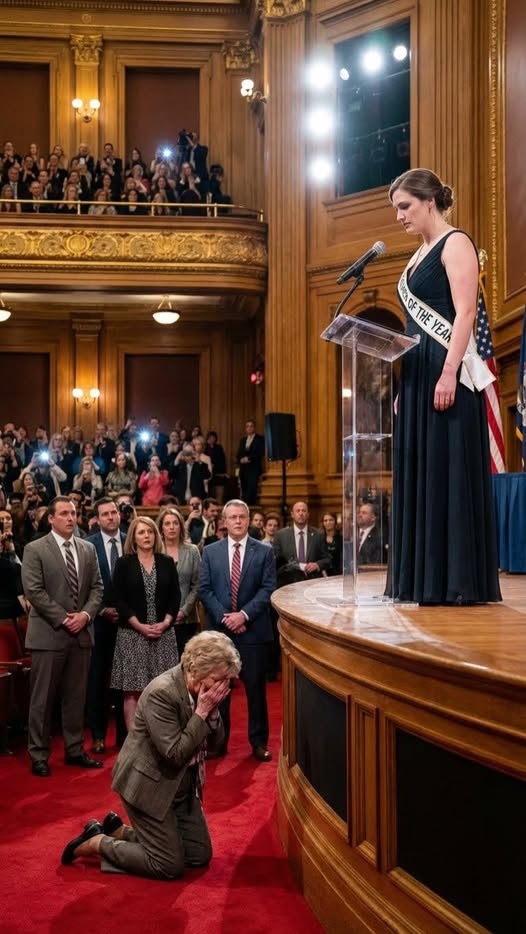
My mother stood up in the second row.
“Ingred, sweetheart, surely you didn’t forget your own mother?”
Her voice rang through the chamber, wounded and commanding. She stepped into the aisle, walking toward the stage stairs. Cameras swiveled. The room held its breath.
She reached the bottom step, her smile fixed. “I’d just like to say a few words about how proud I am—”
“Mrs. Fairbanks.”
My voice boomed over the microphone, stopping her mid-step.
“Thank you for attending,” I said, meeting her eyes for the first time in four years. “But the family portion of my speech has concluded.”
Her smile flickered, a hairline crack in the porcelain. “Ingred, I’m your mother.”
“You said you no longer saw me as your daughter,” I said.
The words fell like heavy stones into a still pond.
“Four years ago, in a group message, you said I chose to be a ‘lowly teacher’ and that I was no longer part of your family.”
Gasps rippled through the audience.
“I have simply honored your decision,” I continued evenly. “The family I thank today is the family that stood by me. The family that didn’t require me to prove my worth through a job title or a salary.”
A security guard stepped forward, gently gesturing for Margaret to return to her seat. She stood frozen. For the first time in her life, she had no script.
Then, from the middle of the chamber, a woman stood up. She started clapping. Slow. Deliberate.
Another person stood. Then five. Then the whole room. Five hundred people rose to their feet, drowning out my mother’s humiliation with a wave of support.
Margaret Fairbanks turned and walked back to her seat, her perfect posture crumbling. Victoria tried to grab her arm, but Margaret shook her off.
As the applause washed over me, I looked at Lily. She was beaming.
Chapter 4: The Context
They cornered me in the hallway outside the chamber.
I had just finished photos with the Governor when I saw them approaching. The Phalanx of Fairbanks.
“Ingred.” My mother’s voice was low, stripped of its performance. “We need to talk privately.”
“If you have something to say, you can say it here,” I replied.
“You humiliated me in front of everyone,” she hissed.
“I stated a fact.” I pulled out my phone and held up the screenshot. “May 9th, 2020. I no longer see her as my daughter. Your words.”
“That was… I was upset!” she stammered. “You know how things get taken out of context!”
“Context?” I pointed to the heart emoji from Victoria. “This was a group consensus to erase me. There is no other context.”
“Ingred, let’s be reasonable,” Bradley interjected, using his lawyer voice. “Think about the PR perspective. People are calling Mom… names. You’re damaging the family reputation.”
“I haven’t had that name in two years,” I said, showing my ring. “I’m a Webb now. And names only mean something if the family behind them is real.”
Victoria stepped closer, furious. “You think you’re better than us, don’t you? Just because you got some award.”
“No,” I said. “I think I’m exactly what I’ve always been. A teacher. The same teacher you called ‘lowly.’ I didn’t become better than you, Victoria. You just decided I wasn’t good enough, and I stopped trying to convince you otherwise.”
I felt Marcus step up behind me, a solid wall of support.
“Mrs. Fairbanks,” I said quietly. “Four years ago, you chose your image over your child. You chose the country club over me. I could hate you for that. But hating you would mean you still controlled me. And you don’t.”
Her lip trembled.
“I’m not doing this to punish you. I’m doing this because I finally learned the difference between forgiveness and self-respect. You didn’t show up for four years. You don’t get to start now just because there are cameras.”
I stepped back. “Goodbye.”
We walked out the doors, and the air outside tasted like freedom.
Chapter 5: The Letter
The fallout was slow and absolute.
Rachel updated me a month later. My mother resigned from the Country Club social committee; the questions from the other ladies about the “lowly teacher” comment were too much to bear. Victoria scrubbed her Instagram. Patients apparently didn’t like knowing their surgeon had a thirty-second response time for family cruelty. Bradley went silent.
One year later, a letter arrived. No return address. Just my name in elegant, familiar cursive.
I sat at my kitchen table, the autumn light filtering through the oak tree outside. Marcus sat across from me.
I opened it.
Ingred,
I’ve written this letter forty-seven times. I tried to justify it. But the truth is simpler and uglier than any explanation. I was afraid. Afraid of what people would think. Afraid that your choices somehow reflected failures in me. I learned early that worth equals performance. When you chose a different path, I felt exposed.
I don’t expect you to forgive me. I just want you to know I was wrong. Not ‘taken out of context.’ Wrong. And I’m sorry.
Your mother.
I read it twice. Then I folded it carefully and put it in the drawer.
“What are you going to do?” Marcus asked.
I looked out at the farm, at the life I had built from the ashes of their rejection.
“Nothing,” I said.
Understanding her didn’t mean I had to let her back in. She had been a mother who saw her child as a liability. Her rejection was never about my worth; it was about her wounds. But I was not responsible for healing the people who broke me.
Boundaries aren’t walls built from anger. They are doors you get to lock.
I walked outside to where Lily was playing in the leaves. She looked up and smiled—a smile that expected nothing, demanded no performance, and offered everything.
“Tell me a story, Mom,” she said.
I kissed her forehead. “Once upon a time,” I said, “there was a teacher who found her family.”