At seventeen, I was erased. Not by a natural disaster or a tragic accident, but by a single, carefully crafted sentence. My family—the people who were supposed to be my fortress—turned into my executioners overnight. My girlfriend, the girl I thought would be my forever, vanished into the mist of societal pressure. I didn’t just leave; I evaporated.
Ten years later, the truth crawled out of the dark, gasping for air. They showed up at my door, their faces mapped with regret and their eyes leaking tears I no longer had the capacity to dry. I didn’t answer the door. I’m not writing this for your pity. I’m writing this because after a decade of silence, I finally have a voice again. This is how Jackson Winter was born from the ashes of Jackson Smith.
My life ended on a Saturday in late October. It was one of those sprawling family dinners my parents, Martha and Thomas Smith, loved to host. The house was a stage, and they were the lead actors in a play called The Perfect American Family. My mother was in her element, her laughter ringing through the hallways like expensive crystal, bragging about our “unbreakable bond.” My father was at the grill, the scent of searing meat masking the rot that was about to be exposed.
Then there was Anne. My parents had adopted her when she was eight. She was the sister I had always protected. I taught her how to ride a bike; I was the one who stood up to the bullies who teased her about her origins. To me, she wasn’t “adopted”; she was just mine.
That night, she was a ghost at the table. Her eyes were red-rimmed, her hands trembling as she toyed with her peas. I thought she was sick. I actually felt sorry for her.
After dinner, in the heavy silence of the living room, she stood up. The air seemed to thin out.
“Jackson,” she whispered, her voice cracking like thin ice. “He forced me. I’m pregnant.”
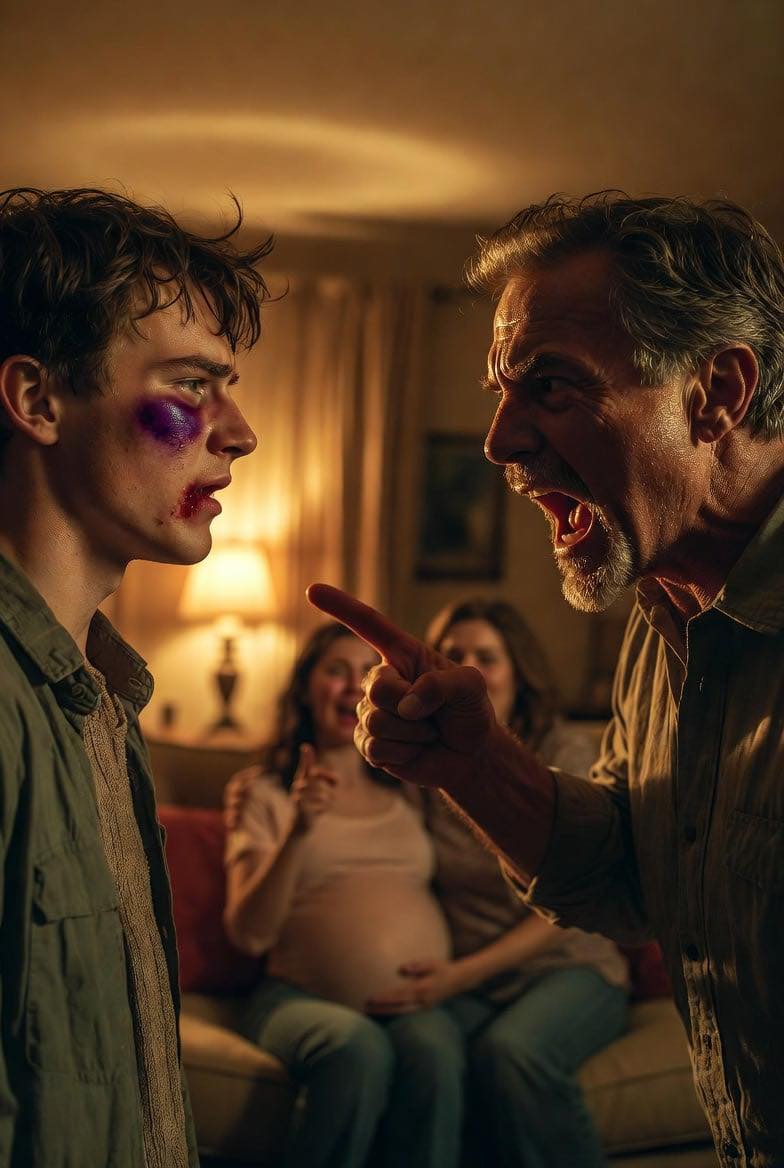
The world didn’t stop. It shattered. I remember the rhythmic ticking of the grandfather clock in the hallway—tick, tick, tick—before the physical roar of my father’s rage drowned out the universe. His fist connected with my jaw before the words had even fully registered in my brain. My vision exploded into a kaleidoscope of white and red. I hit the floor, the metallic taste of blood filling my mouth.
“You sick bastard!” my father screamed, his face a distorted mask of fury. “You brought shame to this roof!”
My mother didn’t ask questions. She didn’t look for logic. She simply wailed, a primal, jagged sound, and gathered Anne into her arms as if I were a plague-ridden animal. My brother, Jake, stepped over my bleeding form, his eyes cold.
“Get out,” he hissed. “You don’t deserve to breathe the same air as us.”
I tried to speak. I tried to scream that she was lying, that I had never touched her, but another hit came. Then the police were there. I remember sitting on the porch in the biting autumn air, my face swelling, watching the blue and red lights dance against the windows of the house I used to call home.
I realized then that a lie doesn’t need proof to be a conviction; it only needs an audience that wants to believe the worst of you.
The police let me go the next morning. There was no evidence—no DNA, no struggle, nothing but the word of a distraught sixteen-year-old girl against a seventeen-year-old boy. But in a small town, the law is secondary to the court of public opinion. By sunrise, I was a pariah.
I returned to the house one last time. My belongings were piled on the lawn like trash—school books, clothes, my favorite hoodie. My father stood at the threshold, a silent sentinel of hatred.
“Don’t call me Dad,” he said, his voice terrifyingly calm. “You’re not my son anymore.”
That night, my girlfriend, Emma, called me. I expected her to be my lifeline. Instead, her voice was a strangled sob. “I believe you, Jack… but my parents… they said they’ll call the cops if I ever see you again. I can’t lose them.”
The line went dead. That was the last time I heard the name “Jack” spoken with any shred of affection.
I drove until the gas light flickered red, ending up in a place called Maplewood. I was a hollowed-out shell of a human being. I found a diner, the Silver Lining, and walked in looking like a car crash victim. The owner, a man named Andy, looked at my bruised face and my shaking hands.
“Can I help you, kid?” he asked, his voice like gravel.
“I can wash dishes,” I said. “I can do anything.”
Andy didn’t ask for a background check. He didn’t ask why a kid with a busted lip was looking for work at 2 AM. He just pointed toward the back. “Sinks are in there. There’s a room upstairs with a bed and a lock. You work, you eat, you stay. Deal?”
“Deal.”
The room was small, the wallpaper peeling like sunburnt skin, but it had a lock. For the first time in forty-eight hours, I felt safe. I collapsed onto the stained mattress and slept the sleep of the dead.
I spent the next two years scrubbing grease off pans until my knuckles bled. Andy became the father my biological one never was. He taught me how to fix things—leaky faucets, broken heaters, the inner workings of a world that didn’t care about your feelings.
“Learn a trade, kid,” he told me one night over a beer. “People will always need heat and air. A skill is the only thing a lie can’t take from you.”
I listened. I enrolled in night classes for HVAC (Heating, Ventilation, and Air Conditioning) at a nearby community college. I changed my name legally to Jackson Winter, taking my grandmother’s maiden name. I burned my old ID in a trash can behind the diner. Jackson Smith was dead.
But even as I built a new life, I couldn’t stop the haunting question: Why did she do it?
Ten years passed. I wasn’t a kid anymore. I was a man with calloused hands and a successful business, Winter Heating & Air. I had three vans, a small office, and a reputation for being the most reliable tech in the county. I lived a quiet life, one built on the architecture of silence.
The silence broke on a Tuesday afternoon.
My phone buzzed. An unknown number with my old area code. I usually ignored them, but something—some instinctual dread—made me pick up.
“Jackson?”
The voice was older, but I knew it. It was Emma. My heart did a slow, painful roll in my chest.
“It’s been ten years, Emma. Why now?”
“Anne’s been arrested,” she whispered. “She tried to do it again, Jackson. She accused another man—a teacher at the high school. But he had security footage. He fought back. They investigated her, Jack… and she broke. She confessed to everything. She told them about you. She told them about Vernon.”
“Who is Vernon?” I asked, my voice sounding like it belonged to someone else.
“The drug dealer she was actually seeing back then. He threatened her, so she blamed you because you were ‘safe.’ The police have cleared your name. It’s all over the news here.”
I hung up. I didn’t feel happy. I didn’t feel vindicated. I felt an overwhelming sense of exhaustion. The ten years I had spent in exile, the nights I had shivered in my truck, the birthdays I had spent alone—all of it was because of a whim. A panic.
Then the emails started. The voicemails. My mother, crying about how “we just didn’t know.” My brother, claiming he was “young and stupid.” My father, calling me “son” as if he hadn’t broken my jaw a decade ago.
They didn’t want me back. They wanted their own guilt silenced.
I ignored them all until a letter arrived from Maple Ridge Correctional Facility. Anne wanted to see me.
I didn’t go to the prison for her. I went for the boy who had his life stolen on a Saturday night in October.
The visiting room smelled of floor wax and despair. When Anne walked in, I barely recognized the girl I once protected. She was gaunt, her eyes sunken into deep hollows of misery. She sat across from me, her hands shackled to the table.
“You look different,” she said, her voice a ghost of the one that had ruined me.
“I’m a different person,” I replied coldly. “Why did you call me here?”
“I wanted to say I’m sorry,” she sobbed. “I was scared. Vernon told me he’d kill me if I said his name. You were always so nice, so quiet… I knew Mom and Dad would believe me if I said it was you.”
“You used my kindness as a weapon against me,” I said, leaning forward. “You watched me get beaten. You watched me get thrown out like garbage. You let me live as a monster in everyone’s eyes for ten years. For what?”
“I thought they’d forget!” she shrieked, drawing looks from the guards. “I didn’t think you’d actually vanish!”
Then she dropped the final bomb. “There’s something else. My daughter… she’s ten now. They never told her the truth, Jackson. Mom and Dad… even after my confession, they told her it was still you. They said it would ‘confuse’ her to change the story now. They’d rather keep the lie alive than admit they raised a daughter who could do this.”
I stood up so fast my chair screeched against the concrete. They were still doing it. Even with the truth screaming in their faces, they were protecting the “family image” by sacrificing my soul.
“I hope you never find peace,” I said quietly. “Because I’m done being your ghost.”
I walked out of that prison and didn’t look back. But the past wasn’t done with me. A few days later, a man named David Kenderson contacted me. He was the teacher Anne had tried to ruin.
“I’m filing a civil suit for defamation and emotional distress,” he told me over coffee. “I’ve seen the files on your case. You’ve suffered more than anyone. Will you testify?”
“Not just testify,” I said, my voice hardening. “I want to finish this.”
The legal battle was a symphony of exposure. For the first time, the “Perfect Smith Family” was dragged into the light. The deposition rooms were cold, filled with lawyers and the uncomfortable rustle of paper. I saw my parents there. They tried to hug me, to touch my arm, to offer me “favorable settlements.”
I looked through them as if they were made of glass.
We won. The settlement was substantial, but the money meant nothing. The real victory was the court order that forced the truth into the public record, including the mandatory disclosure to Anne’s daughter. The lie was finally, legally dead.
A year later, I was sitting in my new home. I had a woman in my life now, Rachel, who knew every scar on my soul and didn’t flinch. We had a dog, a quiet life, and a future that didn’t feel like a borrowed suit.
My phone buzzed. It was a voicemail from my father.
“Jackson… it’s your dad. I… I have stage four cancer. The doctors say I don’t have long. I just want to see you. I want to make things right before I go. Please, son. We’re family.”
I listened to the message twice. I thought about the night he called me a “sick bastard.” I thought about the blood on the porch. I thought about the ten years of silence they had enforced.
I didn’t feel a surge of hate. I felt a profound sense of closure.
I hit the delete button.
“Who was that?” Rachel asked, walking into the room with two cups of coffee.
“Nobody,” I said, and for the first time in my life, it was the absolute truth. “Just a ghost trying to find a way back into a house that’s been torn down.”
I walked over to the window. Outside, the world was crisp and clear. I had spent a decade learning how to fix broken systems, how to balance the air, how to ensure that the environment was exactly what it needed to be. I had finally fixed my own life.
The Smiths had erased me once, but they forgot one thing: you can’t keep a man in the dark if he knows how to build his own light.
Today, Winter Heating & Air is the largest HVAC firm in the region. I don’t go by Jackson Smith anymore. That boy died in the rain behind a gas station. But Jackson Winter? He’s doing just fine.
Sometimes, I drive past my old town. I hear through the grapevine that my parents’ house is for sale. My father passed away a few months ago; I didn’t attend the funeral. My mother lives in a small apartment, complaining to anyone who will listen about how “abandoned” she is. Jake is divorced, his own family having crumbled under the weight of his anger.
They want me to be the villain of their story now—the “cold-hearted son” who wouldn’t forgive. But they don’t understand. Forgiveness is a luxury for those who didn’t have to build their own bones from scratch.
I am not a victim. I am not a monster. I am a man who found the truth in the silence. And in that silence, I finally found myself.
My story ends here. Not with a tearful reunion, but with a quiet evening, a warm home, and the knowledge that some things are meant to stay broken so that better things can be built in their place.
I am Jackson Winter, and I am finally, irrevocably, home.