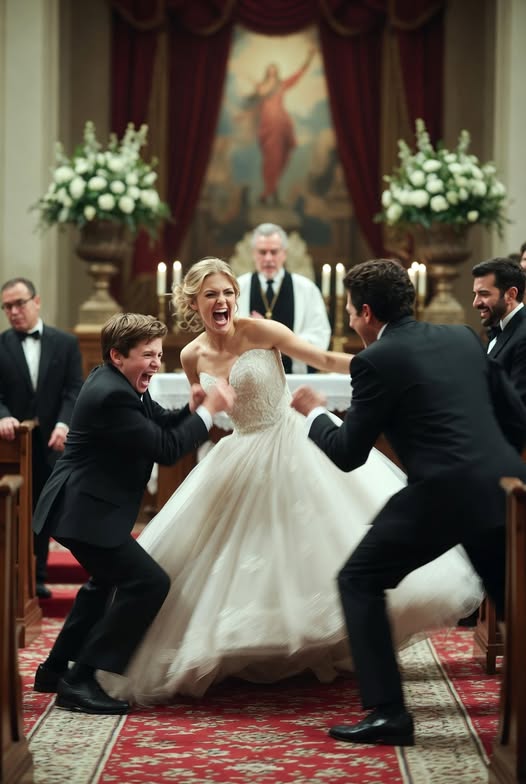
My fourteen-year-old son beat his father’s new wife unconscious at their wedding, and looking back on the wreckage of that day, I have never been prouder of him.
The notification didn’t come through a frantic family text or a weeping voicemail. It came through the rigid, unforgiving chain of command. I was stationed on a base in Stuttgart, Germany, eight months into a deployment that felt like a lifetime. My commanding officer called me into his office, his face unreadable, and delivered the sentence that shattered my world: “Captain, your son has committed felony assault at his father’s wedding. You need to get home. Now.”
I had spent my career training for war, for the chaos of the battlefield, but nothing prepares you for the war at home. My son, Leo, was a boy who had quit the wrestling team the year prior because he couldn’t stomach the sound of another boy’s arm snapping. He was a gentle soul who rescued spiders from the bathtub. Now, I was being told he had brutalized a woman at the altar.
The eighteen-hour journey back to the States was a blur of turbulence and terrified speculation. I rented a car at the airport and drove straight to the suburbs, to the house that used to be my home. When I pulled up, the remnants of the chaos were still visible. The driveway still bore the rust-colored map of violence—dried blood staining the asphalt where the bride had fallen.
I didn’t knock. I rang the doorbell, keeping my finger on the button until the door was wrenched open.
Conrad, my ex-husband, stood there. His face was a roadmap of distorted rage, veins bulging in his neck. “We’re pressing charges,” he spat, blocking the threshold. “He’s an animal, Sarah. He’s done.”
“I’m not taking anyone’s side until I see both,” I said, my voice dropping to that command-tone that usually made privates scatter. I pushed past him into the foyer.
The living room had been transformed into a tribunal. Conrad’s parents sat on the beige sectional like judges at a sentencing hearing. His brother, Potter, leaned against the fireplace, shaking his head. His sister, Fen, huddled in the corner. Standing guard like sentinels were the bride’s parents, their arms crossed, radiating hostility.
And in the center of this mob sat Lauren, the bride. Her face was a ruin. A splint taped over her nose, bandages spanning her cheeks, two eyes swelling shut into painful slits. She was weeping, dabbing carefully at the edges of her injuries.
Across from her, isolated in a high-backed chair, sat Leo.
He didn’t look like a criminal. He looked like a statue. He sat perfectly straight, his chin jutting out like a cliff edge, his knuckles bruised and blooming with purple swelling. He looked me dead in the eyes, and in that gaze, I found zero regret.
“Your son destroyed our family,” Conrad hissed, closing the door behind me. “Look at her face, Sarah. Look at what he did.”
Lauren let out a fresh, jagged sob. “He’s a monster. They’re trying him as an adult, right? Tell me he’s going away.”
Conrad’s father shook his head in disgust, refusing to even look at his grandson. “Unforgivable.”
I walked over to Leo. I didn’t touch him. I just stood in his line of sight. “Leo,” I said softly. “I need your side. Now.”
He didn’t speak immediately. He looked around the room, his eyes lingering on every adult who had failed him. Then, his voice cut through the weeping like a razor blade.
“You want to know the truth? She’s been molesting me for six months. That’s why I did it.”
The air left the room. For a split second, the silence was absolute, a vacuum created by the sheer horror of the accusation. Then, the room exploded.
“Liar!” Lauren’s mother shrieked, lunging forward. “You disgusting little liar! How dare you?”
“He’s making it up to save his skin!” Conrad roared.
Lauren’s face shifted. Amidst the tears, for just a fraction of a second, I saw the panic. “I’ve been nothing but loving to him!” she wailed, louder this time, drowning out the doubt.
Leo didn’t flinch. He reached into his pocket—a movement that made Conrad flinch—and pulled out his phone. He swiped to his hidden folder and held the screen up.
“She said fourteen-year-old boys always want it,” Leo said, his voice trembling now, not with fear, but with the release of a secret that had been poisoning him. “She said I should be grateful.”
I stepped forward and looked over his shoulder. The images on the screen made my stomach turn over. They were undeniable.
Conrad’s hands shook as he stared at the screen. “Those… those could be anyone…” But his voice was hollow. He was reading a script he no longer believed.
Lauren tried to snatch the phone, her movements frantic. “Those are out of context! I was just… we were joking!”
She stopped, the blood draining from her face beneath the bruises. She had just admitted they were real.
Leo stood up then, the chair scraping loudly against the floor. “Dad, I told you three months ago! You said she was just being affectionate!”
Conrad started stuttering, backing away. “I… I didn’t think…”
Leo turned to his grandfather. “Grandpa, you laughed. You said, ‘Lucky boy. Wish I had that problem at fourteen.’”
Conrad’s father went from red to a ghostly, sickly white. He looked at Lauren, then at the boy he had condemned moments ago, and something in his expression crumbled into dust.
“Aunt Fen,” Leo continued, relentless. “You told me, ‘Don’t be dramatic.’”
Fen covered her mouth, backing toward the door, tears streaming down her face. “Oh God. I thought you meant she was strict…”
“Uncle Potter. You said I should be grateful.”
Potter had his head in his hands. “Jesus Christ, Leo. I was joking. I didn’t know she was actually…”
“Grandma, you said boys can’t be raped by women.”
My ex-mother-in-law collapsed into the cushions, clutching her rosary beads, whispering frantic prayers as if God could undo her ignorance.
“Every single one of you told me to shut up about it,” Leo screamed, the tears finally breaking through.
Lauren’s father hissed at his wife, “Not again, Patricia. You said she was better.”
The word again hung in the air like smoke.
“But that’s not why I hit her,” Leo said, his voice dropping to a whisper.
Everyone froze. I felt a cold dread coil in my gut. “What do you mean, that’s not why?” I asked.
“Last week,” Leo said, wiping his nose. “I caught her coming out of Tommy’s room at 2:00 a.m. He’s nine.”
My blood went cold. Tommy was Conrad’s son from his second marriage—my Leo’s half-brother. A sweet, innocent nine-year-old.
Lauren’s mask finally slipped completely. Her face twisted into a snarl of pure venom. “That little brat came on to me!”
Conrad grabbed her by the shoulders, shaking her hard. “What did you just say?”
Real fear finally flashed in her eyes.
Leo was crying now, ugly, gasping sobs that racked his whole body. “The morning of the wedding, I begged you,” he looked at Lauren. “You said, ‘Not today.’ I knew nothing I said would stop you. So I stopped you the only way I could.”
Leo ran upstairs. Moments later, he came down carrying Tommy, who was buried in his big brother’s shoulder. Leo set him down gently.
“Tommy,” I asked, kneeling, though he wasn’t my biological son. “Did Lauren touch you?”
The little boy
nodded, a small, jerky movement that carried the weight of the world. Then, with trembling hands, he pulled up the leg of his pajama shorts.
The room went deathly silent. On the tender skin of his inner thighs, purple and yellow bruises bloomed like dark flowers. They were unmistakably finger marks—grip marks.
Lauren’s mother let out a sound that wasn’t quite a scream; it was more like a vessel popping under pressure. She turned on her daughter, her face contorted with a grief that looked suspiciously like recognition. “You promised!” she shrieked, lunging at Lauren. “You went to therapy! You promised this would never happen again!”
Lauren stood there, stripped of all pretense. The weeping victim act vanished, replaced by a cold, sneering mask of contempt. She looked at her mother, then at my son, and finally at the horrified faces of the in-laws who had defended her minutes ago.
“Oh, grow up,” she spat, her voice dripping with disdain. “That little brat came onto me.”
That was the moment the spell broke. Conrad lunged for her, but my son stepped between them, his voice ringing out with a maturity that aged him ten years in a heartbeat.
“We are children,” Leo said, his voice shaking with a rage that was terrifying in its purity. “And every single adult in this room chose her over us.”
I didn’t wait for another word. I dialed 911.
While the chaos swirled—Lauren’s family begging me to hang up, offering to drop charges, promising to “handle it internally”—I stayed on the line. Lauren, realizing the walls were closing in, suddenly clutched her stomach and announced she was going to be sick. She ran for the bathroom and locked the door.
I didn’t think much of it at the time. I assumed she was panic-vomiting. I didn’t know that in those ten minutes, while the sirens wailed in the distance, she was planting the landmines that would nearly destroy my life.
When she finally emerged, the police were at the door. They handcuffed her without ceremony. I took Leo and Tommy, bundling them into my rental car, and drove straight to my best friend Sarah’s house. I thought the worst was over. I thought the truth had won.
Two hours later, my phone rang. The caller ID was the local precinct.
“Captain, we need you at the station immediately,” the detective said. His voice wasn’t friendly. “Come alone.”
I drove there with my stomach in knots, assuming they needed a formal statement. Instead, they led me past the intake desk, down a hallway that smelled of stale coffee and floor cleaner, and into a sterile interrogation room.
The detective, a man named Miller with tired eyes, slid a manila folder across the metal table.
“Take a look,” he said.
My hands shook as I opened it. Inside were printed screenshots of text messages. They were conversations between “Me” and “Lauren.”
Messages I had never written.
One read: I trust your judgment completely about discipline. Handle him however you need to while I’m deployed.
Another said: Teenage boys need firm boundaries. If you need to get physical to teach him respect, you have my permission.
And the worst one: If you need to use intimacy to control him, I don’t want to know about it. Just fix his behavior.
My brain short-circuited. The timestamps were from three months ago—right when Leo had first tried to tell his father about the abuse.
“I didn’t send these,” I whispered, looking up at Miller. “These are fake.”
“They were found on the suspect’s phone,” Miller said, his gaze hard. “She claims you orchestrated this. That you approved of her… methods… as a way to punish your son.”
I demanded to see my phone records. I offered them my device right then and there. They took it, not as evidence to clear me, but to investigate me as an accomplice. They photographed my hands. They rolled my fingers in ink. I went from a grieving mother protecting her children to a suspect in a child abuse conspiracy in the span of an hour.
Lauren always had a backup plan.
They let me leave, but only after seizing my passport and ordering me not to leave the state. I walked out into the cool night air feeling like the atmosphere had turned to lead. My career, my reputation, my freedom—it was all hanging by a thread spun by a predator.
I drove straight to the law office of Casey Maple Grove, a fierce litigator Sarah had recommended. It was 11:00 PM, but Casey was waiting. She took one look at my face, poured me a cup of black coffee, and told me to start from the beginning.
As I spoke, Casey typed furiously. When I mentioned Lauren’s bathroom break, Casey stopped typing.
“Ten minutes?” she asked sharply. “She was in there for ten minutes before the police took her?”
“Yes. Why?”
“That’s plenty of time to spoof a conversation,” Casey said, her eyes narrowing. “She didn’t just delete evidence; she created it.”
The next morning, the war on my life began on two fronts.
Derek Oakidge from Child Protective Services arrived at Sarah’s house to interview the boys. He was gentle, a stark contrast to the interrogation room. He spoke to Leo first, documenting every threat, every late-night intrusion. Then he spoke to Tommy.
I sat in the kitchen, staring at my hands, while Tommy told a stranger about the things his stepmother did to him in the dark. Derek came out looking grim. He ordered a full forensic medical exam for both boys.
I drove Tommy to the Children’s Hospital that afternoon. I wasn’t allowed in the room. I paced the hallway for three hours, checking my phone every thirty seconds, trying to outrun my own anxiety. When the nurse finally brought him out, he was clutching a teddy bear and refused to look me in the eye.
The doctor’s report was devastatingly clinical. Findings suggestive of chronic trauma. Injuries consistent with reported mechanism of abuse.
It was vindication, but it tasted like ash.
While we were at the hospital, my phone buzzed with a call from a number I knew too well: the JAG office in Germany.
“Captain,” the voice was stiff, formal. “We’ve been notified of an ongoing criminal investigation involving you. Your security clearance is suspended effective immediately. You are placed on administrative hold.”
“I am a witness,” I argued, my voice cracking. “I am the one who called the police.”
“The allegations involve facilitating abuse of a minor,” the officer said. “Until you are cleared, you cannot return to post. Your promotion board packet has been pulled.”
Fifteen years of service. Deployments in sandstorms and snow. Missed birthdays, missed anniversaries. All of it, crumbling because a predator with a smartphone knew how to manipulate the narrative.
Casey was my lifeline. She hired Cory Cedlan, a digital forensics expert who charged more per hour than I made in a week. He went to work on the “screenshots.”
“The font is wrong,” Casey told me a few days later, pointing at her computer screen. “Look at the kerning on the timestamps. It doesn’t match the OS of your phone model. And look here—the spacing between the bubbles is off by two pixels.”
Cory dug deeper. He subpoenaed the raw data from the cell towers. When the report came back, Casey spread the papers across her conference table like a winning royal flush.
“Zero,” she said, circling the dates in red marker. “There were zero text messages exchanged between you and Lauren on these dates. The metadata proves she created these images using a third-party app.”
But the smoking gun came from Lauren’s own device. Cory found a “Calculator” app in a hidden folder on her phone. It wasn’t a calculator. It was a spoofing tool. The installation timestamp?
11:47 PM on the night of the wedding. Exactly when she was locked in the bathroom.
We had her.
But the legal system is a slow, grinding beast. While we waited for the prosecutor to review the new evidence, Lauren—out on bail paid for by her denial-ridden parents—launched her next attack.
Someone leaked my name, photo, and home address to a “Parents Against Abuse” Facebook group, framing me as the abuser and Lauren as the victim.
The harassment was immediate and terrifying. Death threats filled my voicemail. Cars slowed down outside Sarah’s house, strangers snapping photos of my children playing in the yard. I had to change my number twice in a week. We installed security cameras and slept with the lights on.
My ex-husband, Conrad, was unraveling. He showed up at the house one evening, drunk and screaming, pounding on the door and demanding to see Tommy.
“She’s lying!” he yelled, kicking the door frame. “You brainwashed them, Sarah! You did this!”
Sarah called the police. I recorded him from the window, my heart breaking for the man he used to be. He wasn’t a bad father, just a weak man who had let a wolf into the sheep pen because she flattered him.
The turning point came from an unexpected source. Lauren’s father sent a confidential email to Casey.
She had an incident with a neighbor’s child five years ago. We moved states to get away from it. I thought she was better. I thought therapy fixed it.
He wanted immunity before testifying. He was trying to save himself, but he gave us the key to the vault.
Casey successfully petitioned a judge to unseal Lauren’s juvenile and young adult psychiatric records from Michigan. The prosecutor called me into her office a week later. She looked pale.
“We found three other victims,” she said quietly. “Reports that were buried. Therapists who were charmed or manipulated. This wasn’t a lapse in judgment, Captain. This is a pathology.”
With the digital forensics proving the texts were faked and the pattern of prior abuse established, the prosecutor finally moved. They upgraded the charges. Lauren was rearrested, her bail revoked.
The day of the suppression hearing, Lauren’s lawyer tried to argue that the phone evidence was inadmissible. But the judge, looking at Cory’s report, was having none of it. He watched Lauren, who sat at the defense table, no longer crying, just picking at her fingernails with a bored expression.
“Motion denied,” the judge ruled.
With the evidence mounting, Lauren’s team tried to pivot to a plea deal. They offered eighteen months for misdemeanor assault.
“Misdemeanor?” I stared at the prosecutor. “She molested two children. She framed me. She ruined my career.”
“It’s a guaranteed conviction,” the prosecutor said, using that tired tone bureaucrats use when they want to go home. “Trials are risky.”
“No,” I said. “No deal.”
Casey backed me. She sent a counter-proposal: We go to trial on everything. Or, she pleads guilty to felony counts, registers as a sex offender, and serves real time.
We waited. Eight months of waiting.
During those eight months, life had to go on. Leo entered a diversion program for the assault charges. The judge, seeing the evidence of what he had been protecting his brother from, was lenient.
“You saved your brother,” the judge told him quietly. “But violence cannot be the first answer. Do you understand?”
Leo nodded. He spent his weekends cleaning kennels at the animal shelter. The dogs didn’t care about his record. They didn’t care about the rumors. They just wanted love, and Leo, despite everything, still had so much of it to give.
Conrad eventually broke. It happened in therapy, mandated by the custody agreement. He finally admitted to himself what he had allowed to happen. He sent me a letter, not asking for forgiveness, but acknowledging his failure. He started showing up for supervised visits, sober and humble. He listened to Tommy without interrupting. It was a start.
Then came the final blow to my own life.
My commanding officer called. The investigation into me was officially closed—I was cleared of all criminal wrongdoing. But the “conduct unbecoming” charge for the negative publicity, the chaos, the “failure to manage personal affairs” stuck.
I sat in his office as he slid the reprimand across the desk.
“I fought for you,” he said, and I believed him. “But the brass… they don’t like messy.”
I signed the paper. That signature was the death knell of my career. I would never make Major. My security clearance was reinstated, but the black mark was permanent. I was effectively dead in the water.
I walked out of the base gates, stripped of the future I had built for fifteen years. I sat in my car and cried for exactly five minutes. Then I wiped my face, looked in the rearview mirror, and drove to pick up my sons.
Lauren eventually took a plea deal—five years in prison, ten years of probation, and lifetime registration as a sex offender. It wasn’t enough, but it was safety.
The final insult came in the form of a certified letter from her family’s civil lawyers, threatening a defamation suit if we didn’t sign an NDA. They offered $50,000 for our silence.
Casey laughed when she read it. “They’re terrified,” she said.
We sent back a simple response: See you in court. They dropped the suit three days later.
Tonight, the house is quiet. Tommy is asleep in the guest room, clutching the teddy bear he got at the hospital. He still has nightmares, but they are getting fewer and further between. Leo is on the couch, sketching in a notebook. He’s drawing birds again—intricate, beautiful things with wings spread wide, ready to fly.
I am unemployed. My savings are gone, drained by legal fees. My military career is over. I am tired in a way that sleep cannot fix.
But I look at my boys. I look at Leo, who stood up when every adult sat down. I look at Tommy, who is safe because his brother refused to look away.
I lost my rank. I lost my reputation. I lost my retirement.
But I kept my children.
And as I watch Leo turn the page of his sketchbook, glancing up to check on his little brother, I know one thing for certain:
It was a fair trade.