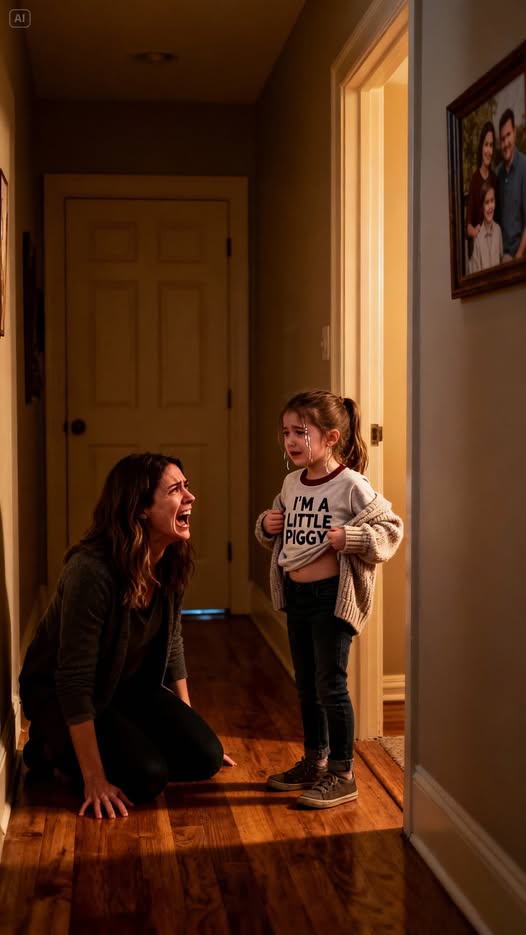
The trash bag wasn’t tied. It sagged on her small frame, a grotesque parody of a garment, shifting with every shallow breath she took. Whisper-thin black plastic stuck to her skin like shame, crinkling in the terrifying silence of our hallway. My daughter, Lily, stood in the doorway, her eyes fixed on the floorboards. She didn’t cry. She didn’t complain. She didn’t make a sound.
She just whispered, her voice trembling like a dried leaf, “Grandma said… Grandma said I’m too fat to wear pretty dresses.”
Then, with a resignation that no seven-year-old should ever possess, she lifted her arms.
The air left the room. It wasn’t just the sight; it was the map of cruelty etched across her soft, innocent skin. Bruises, purple fingerprints darker than the night outside, and red stripes that looked like railings burned across her back. They were angry marks, deliberate marks.
I didn’t scream. I didn’t shake. I didn’t ask questions. The time for confusion had passed; the time for devastation had arrived.
I walked over to her, my movements fluid and cold. I told her to go wash her hands, keeping my voice as steady as a flatline. I kissed her forehead—it was clammy, cold with fear—and watched her walk to the bathroom. Then, I turned around and walked to the hook by the door. I picked up my car keys.
I used to believe in blood loyalty. I married into the Halloway family thinking their cold faces were just their way, a generational stoicism I needed to respect. I thought their harsh words were simply “old school,” a rougher texture of love. My mother-in-law, Victoria, would smile through her teeth, her eyes devoid of warmth. Always watching. Always measuring.
“She’s a bit soft,” she would say, sipping her tea, her gaze drilling into my daughter. “She needs discipline. She eats too much sweet. You’re spoiling her into failure, Elena.”
Seven years of comments disguised as concern. Seven years of control wrapped in fake love. I ignored it. That was my first mistake. It was a sin of omission, a failure of instinct. But as the engine of my car roared to life, drowning out the quiet suburb, I made a vow.
There would be no more mistakes.
Chapter 1: The Lion’s Den
The drive to Victoria’s estate was a blur of streetlights and simmering rage. I didn’t play music. I needed the silence to sharpen my mind. I needed to convert the molten heat in my chest into cold, hard steel. Anger is a fire that burns you out; precision is a blade that cuts forever.
When I arrived, the house loomed against the night sky—a pristine, two-story colonial that screamed perfection. The lawn was manicured to within an inch of its life. The windows glowed with a warm, inviting yellow light that lied about what happened inside.
I knocked. When she opened the door, she smiled.
That smile was muscle memory, a contortion of facial features practiced in mirrors for decades. It was the smile she wore for the church deacons, for the neighbors, for the world. She didn’t expect me. She definitely didn’t expect the silence that hung between us like a guillotine blade.
“Elena?” she asked, a flicker of uncertainty cracking the porcelain mask. “Is everything alright? Where is Lily?”
I stepped inside without asking. I didn’t yell. I didn’t accuse. I didn’t raise my voice. I just looked around. The house hadn’t changed. The air smelled of lavender and judgment. The same plastic-covered couch sat in the living room, a shrine to cleanliness over comfort. The same family photos adorned the mantle, where everyone looked frozen, proud, and religious.
She started talking, her voice pitching up in nervous chatter. “I was just making tea. Did you forget something? You know, Lily was acting up today. Very unruly. I had to—”
I stopped listening because I wasn’t there to explode. I was there to confirm. And I did.
I turned to her and did the unthinkable. I hugged her.
It confused her. I felt her body go stiff, like a mannequin. I smelled her cheap floral perfume, a scent that tried to mask the rot of her soul. I heard her shallow breath hitch in her throat. I felt the fear she tried to bury deep beneath her tweed jacket. She didn’t know how to react to affection she hadn’t coerced.
I pulled back, looking her dead in the eyes, and whispered, “Thank you for loving my daughter.”
Then I turned and walked out.
I heard the door close slowly behind me. That was the moment she lost. She was waiting for the fight, for the hysterical mother she could dismiss as “unstable” to her friends. She was ready to play the victim. But I gave her nothing.
I didn’t need anger anymore. I needed evidence.
Chapter 2: The Silent Wall
That night, back in the safety of my own home, I didn’t sleep. I became a forensic photographer of my own child’s pain. I photographed everything. Every bruise, every mark, every red line that marred her skin. I took photos of the trash bag. I recorded Lily’s voice describing what happened, her small words painting a picture of torture.
“She made me wear it so I would sweat out the fat, Mommy. She said I was sinful.”
The next week, while Victoria was at her bridge club, I visited her house again. I had a key—given to me years ago for “emergencies.” This was an emergency, though not the kind she intended.
I installed small, high-definition cameras in the living room, the kitchen, and the guest room where Lily stayed during visits. They were expensive, almost invisible, blinking with a tiny, silent red eye that promised truth. I didn’t do this because I feared her physically. I did it because I knew who she was. She was a pillar of the community. A saint. Without proof, I was just a jealous daughter-in-law.
I hired a lawyer quietly. Mr. Vance was a shark in a grey suit, a man who specialized in dismantling families. I didn’t tell my spouse, David. David was a good man, but he was her son. He had spent forty years under her thumb, conditioned to believe her harshness was love. If I told him too soon, he would confront her, she would weep, and the cycle would reset.
No. I needed to cut the head off the snake in one strike.
I started collecting.
Her texts came in late at night, vibrating on my phone like threats.
Did she behave today?
You need to control her eating, Elena. She looked swollen.
I’m only trying to help. God hates gluttony.
I saved it all. I backed it up on three different hard drives. I checked school counselors. I checked doctors. I had records built like a slow, silent wall, brick by brick, fact by fact.
Weeks passed. The cameras caught it all. Not just the physical abuse, but the verbal venom.
“You’re disgusting,” the recording played, Victoria’s voice crisp and clear as she snatched a cookie from Lily’s hand. “No man will ever love a pig. You want to end up alone? Like your mother?”
I watched the footage in the dark, tears streaming down my face, my hand clamped over my mouth to stifle the sobs. Every instinct screamed at me to rush over there, to burn her house to the ground. But I waited.
I waited for Christmas Eve.
Chapter 3: The Sanctuary of Lies
The church was her world. St. Jude’s was her pride, her kingdom, the stage upon which she performed her greatest role: The Matriarch.
It was Christmas Eve service. The air was thick with the scent of pine and burning wax. Lights glowed softly, casting long shadows against the high vaulted ceilings. Children were dressed in white, parents looked proud, and the choir hummed a melody of peace.
Victoria sat in the front row, of course. Perfect posture. Perfect hair, sprayed into a helmet of silver. Perfect fake holiness. She wore a red velvet coat, looking every bit the benevolent grandmother. People waved to her. The pastor nodded to her. She absorbed their adoration like a vampire drinking blood.
They called for testimonies. It was a tradition—”Joyful Words,” they called it. A chance for the elders to speak blessings over the congregation.
Victoria had just finished speaking, dabbing a dry eye with a lace handkerchief after a speech about “sacrificial love.” The congregation murmured their approval.
Then, I stood up.
My husband, David, grabbed my wrist gently. “Elena? What are you doing?”
“Testifying,” I whispered.
The room went quiet as I walked to the microphone. My heels clicked on the marble floor, a rhythmic countdown. My hands didn’t shake. My heart beat with a slow, heavy rhythm, like a war drum.
I stood at the lectern. Victoria smiled at me from the front row—a tight, confused smile. She gave a small nod, urging me to play my part.
“I want to speak about family,” I began, my voice amplified, filling the cavernous space. “About trust. About grandparents who claim to protect.”
The crowd smiled. They expected a tribute.
“We are taught that love is kind,” I continued, scanning the faces in the pews. “We are taught that love does not envy, it does not boast, it is not proud. But we often forget that love does not harm.”
I reached into my pocket and pulled out a small remote. I had arranged this with the audio-visual team earlier, telling them I had a “touching family montage” to accompany my speech. They hadn’t checked the file.
“My daughter, Lily, learned a lesson about love this month,” I said, my voice hardening. “She learned it from her grandmother.”
I pressed the button.
The massive projection screen behind the altar, usually reserved for hymns and scripture, flickered to life.
There was no blur. No filter. No soft music.
The first image was the trash bag. The black plastic clinging to Lily’s sobbing form.
The second was the back of her legs, welted and purple.
The third was the video clip. Victoria’s voice boomed through the church’s high-quality sound system, distorted but unmistakable.
“You’re disgusting. No man will ever love a pig.”
Gasps left the room like wind sucked out of a vacuum. It was a physical sound, a collective recoil. A woman in the second row dropped her hymnal.
I didn’t look at the screen. I looked at Victoria.
She tried to stand, but she couldn’t. Her legs were weak. Her mouth opened, a black hole of shock, but no sound came out. She looked around frantically, seeking an ally, seeking a sympathetic eye.
She found none.
“This,” I said, pointing to the screen where a photo of a handprint bruise on Lily’s arm was now displayed, “is what was done in the name of discipline. This is what was hidden behind a smile.”
The silence was absolute. It was heavy, suffocating. The pastor stood frozen off to the side, his Bible clutching to his chest.
“Police?” I said into the mic, answering the question hanging in the air. “No. I didn’t need them yet. The law comes later. Quietly. Cleanly.”
I leaned in closer to the microphone. “But the damage? The truth? That belongs to you. To her community.”
I looked directly at Victoria, whose face had drained of all color, leaving her looking like a wax figure melting in the heat.
“Merry Christmas, Victoria.”
I dropped the mic. It didn’t screech; it landed with a dull thud on the carpeted step. I walked down the aisle. David was staring at the screen, his face a mask of horror and realization. He didn’t look at me. He looked at his mother, and for the first time in his life, he saw a monster.
I walked out the double doors into the cold winter night. The air tasted crisp and clean.
Chapter 4: The Erasure
The aftermath wasn’t a firestorm. It was a freeze.
We didn’t call the police immediately, though my lawyer did file for a restraining order the next morning. But the true punishment wasn’t legal. It was social.
Victoria wasn’t arrested. She was erased.
That was my design. Arrests can be spun. Lawyers can argue context. But shame? Shame in a town like this is a life sentence.
Neighbors stopped visiting her. The mailman stopped making small talk. The church women, her praetorian guard, wouldn’t sit beside her. They formed a new circle, one that didn’t include the woman who beat a child. Her phone stopped ringing. Her respect evaporated like water on hot pavement.
She became a ghost in her own life.
David moved out of his childhood shadow that night. He cried for three days. He apologized to Lily until his voice was hoarse. He wasn’t perfect, but he was finally awake. We cut all ties. No financial support. No visits. No calls.
Weeks later, she tried to speak to me.
I was at the grocery store, in the produce aisle, picking out apples. Lily was with me, wearing a bright yellow sundress, laughing at something on her tablet. She didn’t see her grandmother approaching.
Victoria looked smaller. Thinner. The red velvet coat was gone, replaced by a drab grey cardigan. Her hair wasn’t sprayed; it hung limp around her face. She looked like a building scheduled for demolition.
She stopped her cart next to mine. She didn’t look at Lily. She couldn’t.
“I didn’t mean to hurt her,” she rasped. Her voice was brittle, stripped of its arrogance. “I… I was trying to save her from…”
She trailed off, her hands shaking on the handle of the cart.
I looked right through her. I didn’t see the matriarch anymore. I didn’t see the power. I saw a sad, broken old woman who had used terror to feel tall.
“I know,” I said, my voice calm, devoid of pity. “You meant to break her so you could rebuild her in your image.”
“Elena, please,” she whispered, tears forming in her eyes. “I have no one. The phone… it never rings.”
I smiled. It wasn’t a warm smile. It was the smile of a predator who has finished its meal.
“That’s the point, Victoria.”
I turned to Lily. “Come on, sweetie. Let’s get some ice cream.”
Lily looked up, saw the old woman, and paused. For a second, I thought she might be afraid. But she just looked at Victoria with the indifference of a stranger.
“Okay, Mommy!” Lily chirped.
We walked away. We didn’t look back.
Epilogue: The Architect
Now, my daughter wears dresses she chooses. Sometimes they are mismatched. Sometimes they are tight. Sometimes they are loose. It doesn’t matter.
She eats when she’s hungry. She stops when she’s full. She laughs loudly, mouth open, unashamed.
The trash bag is gone. The bruises have faded into invisible memories, metabolized by her resilience. But the memory is alive inside me. Not as pain, but as a reminder. A totem.
I sit on my porch sometimes, drinking coffee, watching the leaves fall. I hear rumors about Victoria. She’s selling the house. Moving to a smaller town two states over. Running away from the silence she created.
I didn’t swing a belt. I didn’t raise a fist. I didn’t scream until my throat bled.
I took her power, her image, her standing, her world. I took it piece by piece, quietly, legally, perfectly.
When she opened that door all those weeks ago, I hugged her. And when she closed her eyes, thinking she had won, I destroyed her without regret, without mercy, without noise.
I did it just the way monsters deserve.
And I would do it again.