I woke up to the smell of antiseptic and the sterile hum of a heart monitor, but the most terrifying thing in the room was the man holding my hand.
He sat there, the light from the Seattle General hallway casting him in a saintly glow. To anyone else, he was a portrait of a grieving, terrified husband. His eyes were red-rimmed, his hair slightly disheveled, and his voice was a ragged whisper of devotion. But I knew the truth. I knew that the hand currently stroking my knuckles was the same one that had, only hours ago, been wrapped around my throat.
“Stay with me, Sarah,” he murmured, his voice thick with a performance so polished it would have won an Oscar. “The doctors said you had a terrible fall. I thought I’d lost you.”
A fall. That was the script. The stairs. The hardwood. The clumsy wife.
I tried to speak, but the metallic taste of blood was still thick in my mouth, and my jaw felt like it had been wired shut by agony. My left eye was a swollen cavern of darkness. Every breath I took was a jagged reminder of the three ribs he had shattered. I looked at the ceiling, at the flickering fluorescent tiles, and felt a familiar, visceral coldness. This was my life. This was the prison I had built out of “I do” and “I’m sorry.”
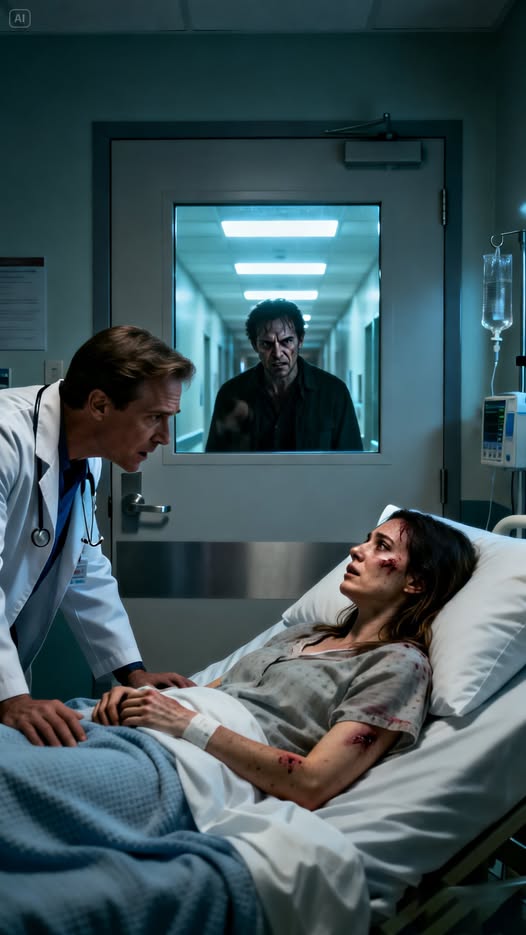
But then, the door swung open. A man in a white coat entered, carrying a tablet and an expression that wasn’t part of the script. Dr. Aris Thorne didn’t look at my husband first. He looked at me. He looked at the bruises that painted my torso in shades of indigo and sickly yellow—bruises that were in various stages of healing, some fresh, some weeks old.
“Mr. Thompson,” the doctor said, his voice as sharp as a scalpel. “I need you to step out for a moment while I conduct a neurological assessment. It’s hospital policy for head trauma victims.”
“I’m not leaving her,” my husband replied, the “charming” mask slipping just enough for me to see the monster beneath. “She needs me.”
“It’s not a request,” Dr. Thorne countered. He didn’t flinch. He signaled to the doorway, where two security guards appeared like sentinels. “Step out. Now.”
As the door clicked shut behind the man I once called my soulmate, the silence in the room felt heavy, like the air before a thunderstorm. Dr. Thorne leaned over my bed, his eyes searching mine.
“Sarah,” he whispered, “I’ve seen the scans. Your ribs aren’t just broken; they were broken at different times. Your nose has been fractured twice. This didn’t happen on the stairs. And I think you know that.”
My heart hammered against the monitor, the beep-beep-beep accelerating into a frantic cacophony. Fear, cold and paralyzing, coiled in my gut. He would kill me. If I spoke, he would finish what he started in the kitchen.
“If you tell me the truth,” the doctor said, placing a steady hand on the railing of the bed, “I can make sure he never touches you again. But I need your voice, Sarah. I need you to be the one to break the lie.”
I looked at the door, expecting him to burst through at any second, and for the first time in three years, I felt a spark of something other than terror. I felt the slow, burning heat of a coup d’état.
To understand how I ended up in that bed, you have to understand the man I met six years ago. Before the bruises, there was the pedestal.
I met Mark Thompson at a mutual friend’s wedding in the lush greenery of Snoqualmie. He was the Regional Director for a medical supply company, a man who spoke in paragraphs and listened like you were the only person in a room of five hundred. He was the kind of handsome that felt safe—broad shoulders, a laugh that sounded like a hearth fire, and eyes that seemed to promise a lifetime of protection.
“You’re far too interesting to be standing by the punch bowl alone,” he had said, handing me a glass of champagne.
I was twenty-six, a high school history teacher who spent my days lecturing about the fall of empires. I thought I knew how to spot the signs of rot from within. I was wrong. Mark didn’t conquer me; he colonized me. He started with the flowers. Two dozen roses on the second date. Three dozen on the third. He texted me “Good morning, beautiful” every day at 6:30 AM. He remembered my favorite flavor of tea and the exact way I liked my steak.
My mother was enchanted. “He’s a provider, Sarah,” she’d say, her eyes gleaming with the traditionalism of her generation. “A man who looks at you like that… you don’t let him go.”
My father, a man of few words and a firm handshake, pulled Mark aside at our engagement party. “Take care of my girl, son,” he had muttered.
Mark had looked him right in the eye—the same eyes that would later turn black with rage—and promised, “With my life, sir.”
The wedding was a cathedral of white lace and lies. We stood under a canopy of lilies, and when I said for better or worse, in sickness and in health, I meant it with every fiber of my being. I thought the love we had was a shield. I didn’t realize it was the blindfold.
The first year was a dream. We bought a house in Queen Anne, a Craftsman with a view of the Space Needle. We talked about children, about names like Oliver and Maya. But slowly, the “protection” began to shift into “possession.”
“Do you really need to go out with the girls tonight?” he’d ask, his lip curling slightly. “I thought we could have a quiet night. Just us. I missed you today.”
It felt sweet at first. Flattering. But then the questions became interrogations. Why was I on the phone with my sister for forty minutes? Why did I need to stay late for a teacher-parent conference? Why was I wearing that dress—the one that was “too short” for a married woman?
He wasn’t just a husband; he was becoming my warden. And the mask hadn’t even slipped yet.
Then came the Tuesday of the Chicken Parmesan. The night the first empire fell.
The air in the kitchen was warm, smelling of basil and simmering tomato sauce. It was six months after our first anniversary. I had spent the afternoon perfecting his favorite meal, a small celebration for his recent promotion.
I set the plate in front of him, waiting for the smile, the “Good job, baby.” Instead, he took one bite, and the room went cold. I watched his jaw hinge, his eyes darkening into a shade of obsidian I’d never seen before.
“It’s dry,” he said. His voice wasn’t loud. It was a low, dangerous vibration.
“Honey, I followed the recipe exactly,” I laughed nervously, thinking he was joking. “Maybe it just stayed in the oven a minute too long while I was—”
He didn’t let me finish. He stood up, the chair screeching against the hardwood floor like a dying animal. He picked up the plate and smashed it against the kitchen island. Shards of white porcelain and red sauce splattered across my white apron.
“I provide everything for you!” he hissed, his face inches from mine. “I give you this house, this life, and you can’t even get a simple meal right? You’re disrespecting me in my own home, Sarah.”
“Mark, I’m sorry! I’ll make something else—”
The slap was so fast I didn’t see it coming. It connected with my left cheek, a sharp, stinging crack that echoed through the house. I fell back against the refrigerator, the cold metal biting into my spine. My ears rang. The world tilted.
Thirty seconds later, he was on his knees.
“Oh God, Sarah! I’m so sorry! Baby, please, look at me!” He was crying—actual, salt-water tears. He grabbed my hands, kissing my palms, his voice a frantic babble of regret. “Work is so stressful… the new territory… I just snapped. I would never hurt you. You know I love you more than anything.”
I stood there, my face burning, my heart thundering, and I made the mistake that would define the next three years. I believed him.
I told myself it was a one-time thing. I told myself he was under pressure. I even told myself that maybe I should have been more careful with the timer. I spent the next morning buying heavy-duty concealer to hide the fingerprint-shaped bruises on my jaw.
When he came home that evening with a diamond bracelet and two dozen lilies, I smiled and thanked him. I allowed the “honeymoon” phase to wash away the memory of the violence. But the honeymoon was just a stay of execution.
Over the next two years, the slaps turned into punches. The apologies turned into threats. And the house in Queen Anne became a fortress where the windows were always locked and the silence was a weapon.
By the third year, I wasn’t Sarah anymore. I was a ghost inhabiting a teacher’s sensible skirts.
The isolation was a slow, agonizing process. Mark had managed to alienate my friends through a series of “misunderstandings.” He’d “forget” to tell me about dinner invitations, or he’d pick a fight right before we were supposed to leave, making sure I was too red-eyed and puffy to go out.
“Your mother is so judgmental,” he’d mutter after a family visit. “She always makes me feel like I’m not good enough for you. Maybe we should take a break from them for a while. For our marriage.”
Eventually, my phone stopped ringing. My sister stopped texting. The people who loved me didn’t stop caring; they just got tired of being pushed away by the woman they didn’t recognize.
Mark took over the finances next. “You’re so stressed with the kids at school,” he’d say, “let me handle the bills. I’ll give you an allowance for groceries.”
I had no access to the savings. I had no credit card in my own name. I was a thirty-year-old woman with a Master’s degree, and I had to ask permission to buy a new bottle of shampoo. If the receipt was off by even a dollar, I paid for it in bruises that he carefully placed on my ribs or my thighs—places where the school district’s dress code would hide them.
“You’re pathetic, Sarah,” he’d scream while I curled into a ball on the bathroom floor. “Who else would want you? You’re weak. You can’t even manage a household. You’re nothing without me.”
And the terrifying part? I believed him. He had stripped away my identity until the only thing left was the role he had written for me: the victim.
I tried to leave once. It was after he had thrown a heavy glass ashtray at my head, missing my temple by an inch. I waited until he was at a territorial meeting in Tacoma, packed a small bag, and drove to a motel in Bellevue. I sat on the edge of that scratchy bed for four hours, clutching my passport and three hundred dollars I’d skimmed from the grocery money over six months.
He found me in five.
I don’t know if he tracked my phone or if he had a friend in the local PD, but when that motel door opened, the look on his face was one of pure, possessive madness. He didn’t hit me there. He didn’t say a word. He just gripped my arm so hard I felt the bone groan and dragged me back to the car.
Once we were inside our house, he locked every door. “If you ever try to run again,” he whispered, his voice as calm as a cemetery, “I won’t just bring you back. I’ll make sure there’s nothing left for anyone to find. Do you understand me? Till death do us part, Sarah. I meant it.”
I never tried to leave again. I stopped fighting. I stopped hoping. I just walked on eggshells and waited for the day the eggshells finally shattered.
The day that nearly killed me was a Thursday.
Thursdays were always the worst. It was the day of his weekly projections meeting, and if the numbers weren’t “up,” the house became a minefield. I had learned to have his favorite scotch poured the moment he walked through the door. I had learned to keep the lighting low and the house silent.
But that night, the steak was medium-well. He liked it medium-rare.
“What is this?” he asked, pointing at the meat with a silver steak knife. His voice was a low, guttural growl that made the hair on my arms stand up.
“Mark, the butcher said it was a thinner cut, so it cooked faster—”
“I don’t care what the butcher said!” he roared, standing up so fast the table jolted. “I care that I come home after a fourteen-hour day to a wife who can’t even perform the most basic task of her existence!”
He grabbed me by the hair and slammed my head into the kitchen counter. The world exploded into a kaleidoscope of white light and agonizing heat. I felt my nose crunch—a sickening, wet sound. Blood poured down my face, hot and thick.
“Please, Mark! Stop!” I begged, my voice a wet gurgle.
He didn’t stop. He dragged me to the floor and began to kick. My ribs, my back, my stomach. I curled into a ball, trying to protect my head, but the pain was a physical weight, a suffocating blanket. I felt a rib snap—a sharp, internal pop followed by a fire that stole the air from my lungs.
Then, he picked me up by the throat. He held me against the refrigerator, my feet dangling inches from the floor. His face was a mask of pure, unadulterated hatred. I looked into the eyes of the man I had married, and for the first time, I saw the end.
“You’re useless,” he spat, his hand tightening until the world began to fade at the edges. “I should have just ended it years ago.”
He punched me in the temple. The last thing I remember was the cold sensation of the linoleum floor against my cheek and the distant sound of him muttering, “Look what you made me do.”
I disappeared into the black.
I don’t know how long I was out. When I drifted back into a hazy, dream-like consciousness, I felt a rhythmic jostling. I was in a car. Mark’s car. I was lying in the backseat, my head throbbing in time with the tires on the asphalt. Through my one working eye, I could see the back of his head. He was muttering to himself, a frantic, rhythmic chant.
“She fell. That’s it. She was carrying the laundry. She slipped on the hardwood. I was in the study. I heard a crash. I found her at the bottom of the stairs. I’m a good husband. I’m a hero. I’m taking her to the hospital.”
He was practicing. He was rehearsing the lie before we even reached the emergency room. He wasn’t worried about my life; he was worried about his liberty.
We pulled under the bright, blue lights of the ER bay. As the orderlies rushed toward the car, Mark’s face transformed instantly into a mask of devastated grief. But as I was lifted onto the gurney, I saw Dr. Thorne standing at the intake desk, his arms crossed, his eyes fixed on the man who was currently sobbing into his hands.
The ER was a blur of motion and white noise. Mark was there, a constant, suffocating presence. Every time a nurse asked a question, he answered before I could even draw a ragged breath.
“She’s so clumsy, poor thing,” he told the triage nurse, his hand stroking my hair with a terrifying gentleness. “She was carrying a heavy basket of laundry and just… lost her footing at the top of the stairs. I found her at the bottom. It was horrific.”
I lay there, a prisoner in my own broken body, screaming behind my teeth. He’s lying! He did this! Look at the fingerprints on my neck! But the fear was a physical weight. If I spoke, and they let him take me home… I wouldn’t survive the night.
They wheeled me into a private bay for an ultrasound and X-rays. Mark tried to follow, but a nurse with a no-nonsense bun stopped him. “Family stays in the waiting area for scans, sir. Hospital policy.”
“I need to be with her,” he argued, his voice rising, the “concerned husband” veneer cracking just a fraction. “She’s terrified.”
“And she’s in excellent hands,” the nurse replied, pushing my gurney through the swinging doors.
That was when Dr. Thorne stepped in. He had spent twenty minutes reviewing my file, comparing the current injuries to my history—a “sprained wrist” eighteen months ago, “migraines” that required ER visits, “bruised ribs” from a “kitchen accident.”
He met me in the radiology wing. He didn’t ask me about the stairs. He asked me about the bruises.
“Sarah,” he said, holding up a tablet showing my CT scan. “You have three broken ribs. One of them has already begun to heal, meaning it was broken at least two weeks ago. You have a concussion and a fractured orbital bone. A fall down the stairs could cause these, yes. But they wouldn’t cause the circular bruising on your upper arms that looks exactly like finger marks.”
I looked at him, tears leaking from my one open eye. I didn’t say a word. I couldn’t.
“I’ve already alerted hospital security,” Thorne continued, leaning in close. “And the SPD is on their way. But without your statement, it’s his word against mine. He’s out there right now, telling everyone you’re ‘unstable’ and ‘accident-prone.’ He’s building a cage of words around you, Sarah. You have to be the one to break it.”
The door to the radiology room opened. A nurse looked in. “Doctor, the husband is getting aggressive in the hallway. He’s demanding to see her.”
I felt the panic surge—a visceral, electric jolt. He was coming. He would find a way in.
“Sarah,” Dr. Thorne said, his voice a low, steady anchor. “This is it. This is the moment you choose. Are you the woman who fell down the stairs, or are you the woman who survives?”
I looked at the doctor, then at the door, and I thought of the history books I used to teach. Every empire falls when someone finally says enough.
“He did it,” I whispered, the words scratching against my throat like broken glass. “He didn’t find me at the bottom of the stairs. He put me there.”
The doctor nodded, a grim, determined look in his eyes. He turned to the nurse. “Call the officers in. And tell security to detain Mr. Thompson. We have a confession.”
I heard the shouting in the hallway—Mark’s voice, roaring in that obsidian rage—and then the heavy, metallic sound of handcuffs clicking into place. For the first time in three years, the doors weren’t closing on me. They were closing on him.
The trial was a slow-motion dissection of a nightmare.
Mark sat at the defense table in a tailored gray suit, looking like the pillar of the community he claimed to be. His lawyer tried to paint me as a “troubled woman with a history of depression and balance issues.” They brought up my lack of contact with my family as proof of my “instability,” never mentioning that he was the one who had severed those ties.
But they couldn’t explain the medical evidence. Dr. Thorne stood on that witness stand for four hours, his testimony a clinical map of my torture. He showed the jury the varying stages of my fractures. He showed them the fingerprints.
And then, it was my turn.
I sat in that witness stand, looking directly at the man who had tried to erase me. He stared back, his eyes still trying to exert that old, possessive power, trying to make me flinch. But I didn’t. I told the jury about the Chicken Parmesan. I told them about the motel in Bellevue. I told them about the whiskey and the steak knife.
“I was a teacher,” I told the courtroom, my voice steady and clear. “I spent my life teaching children about the consequences of history. I’m here today to make sure Mark Thompson finally faces his.”
The jury deliberated for less than three hours.
“On the count of first-degree domestic assault: Guilty. On the count of false imprisonment: Guilty. On the count of witness tampering: Guilty.”
Mark was sentenced to fifteen years in a state penitentiary. As they led him away, handscuffed and stripped of his tailored suit, he didn’t look like a king anymore. He looked like a small, hollow man who had finally run out of lies.
It has been two years since I woke up in that hospital bed.
I don’t live in Queen Anne anymore. I moved to a small town in Eastern Washington, a place where the air smells of pine and the horizons are wide enough to breathe in. I legally changed my name—not back to my maiden name, but to a name I chose for myself: Sarah Phoenix. A bit cliché, perhaps, but it felt earned.
I’m teaching again. I work with at-risk youth, kids who have seen the same rot I did. I tell them that their stories aren’t written in stone. I tell them that the most important empire they will ever govern is themselves.
I still have scars. My ribs ache when it rains, and I still flinch when someone moves too quickly in my peripheral vision. I still see Dr. Chen once a week to navigate the PTSD that lingers like a shadow. But the nightmares are fading.
Last month, I visited Dr. Thorne. I brought him a book—a history of the Pacific Northwest.
“You told me that night that I had to be the one to break the lie,” I said to him. “Thank you for holding the door open until I was ready.”
He smiled, a kind, weary smile. “I just read the scans, Sarah. You’re the one who did the work.”
To anyone reading this, anyone trapped in a house where the doors are locked and the silence is a weapon: the lie only works as long as you help him tell it. There are people waiting to believe you. There are doctors, nurses, and strangers who will hold the door open.
You aren’t the burden. You aren’t the problem. You are the survivor.
And the empire of your life is waiting for you to take back the throne.