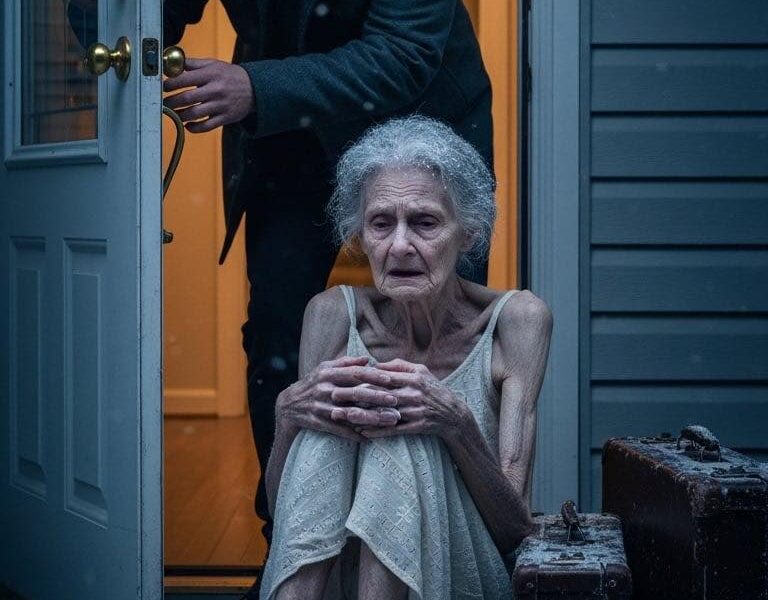
“WE DON’T RUN A NURSING HOME,” my father spat, his voice thick with the cheap beer he’d been nursing since noon. He blocked the doorway with his heavy frame, a barrier of flesh and flannel that looked impenetrable. “Go to the VA. We don’t have space for cripples.”
He didn’t know that the roof he was standing under, and the oak floorboards he was standing on, had been paid for by the very legs I lost overseas.
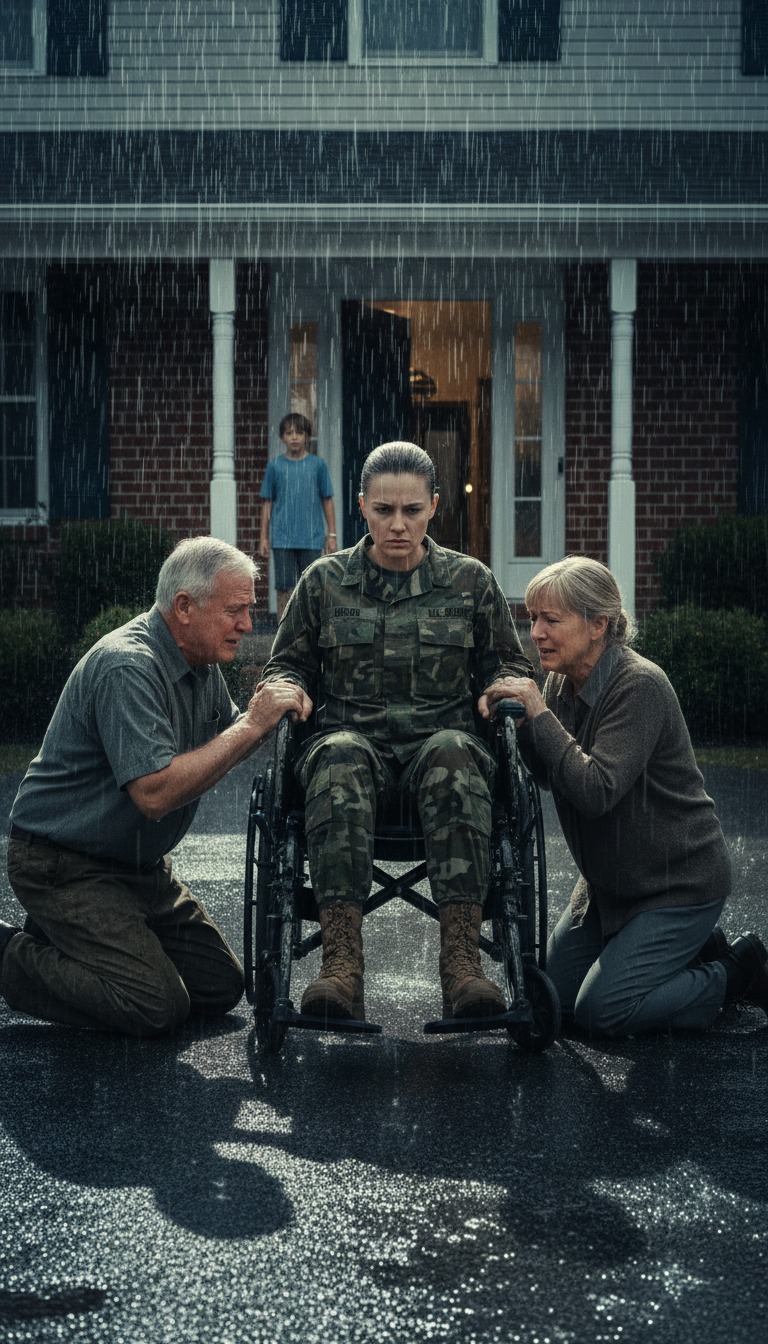
The taxi idled at the curb behind me, its exhaust sputtering into the gray, drizzly afternoon. I gripped the rims of my wheelchair, the cold metal biting into my calloused palms. I had maneuvered myself up the driveway—the same asphalt slope I used to shovel every winter as a child, back when my knees worked and my biggest worry was a math test. Now, the incline felt like a mountain.
I had expected… something. A banner, maybe. A hug. A hesitant smile. I was wearing my dress blues, the fabric stiff and immaculate, medals pinned perfectly to my chest. They caught the dull light, gleaming gold and silver, but Frank—my father—didn’t look at them. He looked at the empty space where my legs used to be, his face twisting into a scowl of inconvenience.
“Dad, it’s me. I’m back,” I said, forcing a smile through the phantom pain that was currently shooting electrical spikes through my missing left calf. “I tried to call, but—”
Frank didn’t move. He leaned against the doorframe, scratching his stomach. “I see that. And I see the chair. We discussed this, Ethan. I told your mother I’m not running a facility here. The VA has beds for people like… you.”
“People like me?” I asked, my voice trembling. It wasn’t fear; it was a cocktail of shock and a deep, rising nausea. “I’m your son.”
“You’re a burden,” Frank replied coldly, taking a swig of his beer. “And I’m not changing diapers at my age. We finally got the house the way we want it. Turn that chair around.”
The cruelty wasn’t hot or fiery; it was cold, practical, and dismissive. It was the way one talks about a broken appliance that is no longer under warranty.
I looked past his legs into the hallway. The house smelled the same—lemon polish and stale cigarette smoke. I saw a “Welcome Home” sign taped to the hallway mirror. For a split second, my heart leaped. Then I saw the dog bed beneath it. It wasn’t for me. It was for Chloe’s new puppy.
Rain began to fall, harder now, soaking into the wool of my uniform. It ran down my neck, cold and sharp. I reached into the inside pocket of my jacket and touched the folded bank letter. I had carried it across the Atlantic. I had planned to present it tonight at dinner—a surprise. The mortgage is gone, Dad. I paid it off. You can retire.
I fingered the crisp edge of the paper. It felt like a weapon now.
“You’re right, Dad,” I whispered to myself, the realization settling over me like a heavy shroud. “You don’t run this house. I do.”
My sister, Chloe, appeared behind Frank, sipping an iced coffee from a plastic cup. She was twenty-two, beautiful in a way that required a lot of maintenance and money. She looked at the wheelchair, then at my face, and her nose wrinkled as if she’d smelled something rotten.
“Seriously?” she laughed, a harsh, brittle sound. “I literally just reorganized. Ethan, I turned your room into a walk-in closet for my shoe collection. The lighting is perfect. Where are you gonna sleep? The hallway?”
My grip on the wheels tightened until my knuckles turned white. My old room. The place where I kept my baseball trophies, my model planes, the letters from my grandfather.
“My room?” I asked, my voice low. “You turned my room into a closet?”
“Well, you weren’t using it,” she said, checking her nails. “And honestly, the chair marks are going to ruin the hardwood. Dad, tell him he can’t bring that thing inside. It’s dirty.”
Suddenly, a small blur of motion burst through the gap between Frank’s hip and the doorframe. Leo, my ten-year-old brother, clutching a faded superhero blanket I had sent him from Germany.
“Ethan!” he screamed, his face lighting up with the pure, unadulterated love that adults seem to forget how to feel. He tried to rush out to hug me, but Frank grabbed him by the collar of his t-shirt and yanked him back.
“He can stay with me!” Leo yelled, struggling against Frank’s grip. “I have a bunk bed! He can have the top!”
Chloe snorted, rolling her eyes. “He can’t climb to the top, you idiot. Look at him.”
“Then he can have the bottom!” Leo cried, tears welling in his eyes. “I’ll sleep on the floor! Please, Dad!”
“Enough!” Frank slammed his hand on the doorframe, the vibration rattling the glass. “Ethan, get off the porch. You’re scaring the neighbors. Go to the motel on Route 9. We’ll… we’ll talk next week. Maybe.”
Frank stepped back. He looked at me one last time, not with regret, but with annoyance. As if I were a solicitor trying to sell him something he didn’t want.
He slammed the door in my face.
The lock clicked—a heavy, metallic sound that echoed like a gunshot in the quiet suburb.
I sat there for a moment, the rain plastering my hair to my forehead. I looked at the wood of the door—the door I had sanded and repainted for him three summers ago. I looked at the flowerbeds I had paid to have landscaped.
I didn’t cry. I had left my tears in a sandbox thousands of miles away. Instead, a cold, hard clarity replaced the hurt.
I spun the chair around. The rubber wheels hissed on the wet concrete as I rolled back down the driveway. The taxi driver was watching me in the rearview mirror, his face a mask of pity.
“Where to, soldier?” he asked softly as I pulled myself into the back seat, collapsing my chair with practiced efficiency.
I pulled out my phone. My hands were shaking, not from cold, but from adrenaline.
“The motel on Route 9,” I said, my voice sounding like grinding stones. “And do me a favor? Pass me that phone book. I need the number for the foreclosure department at First National Bank.”
Three days later, the rain had stopped, but the storm was just beginning.
I sat in a motel room that smelled of mildew and industrial cleaner. The wallpaper was peeling, and the neon sign outside buzzed with a rhythmic, headache-inducing flicker. On the wobbly laminate table sat a microwave dinner—rubbery lasagna—and a stack of legal documents thick enough to choke a horse.
My phone sat next to the fork. I watched the screen.
Across town, inside the house that I had paid for with my blood and bone, a celebration was underway. I knew this because Leo was texting me updates from under his bed covers.
Dad and Chloe are screaming happy screams, Leo’s text read. They got a letter from the bank. Dad says we’re rich.
I closed my eyes and pictured the scene.
Frank would be standing in the kitchen, holding the letter from First National. It would say “Mortgage Satisfaction: Paid in Full.” He would stare at the zero balance.
“It says ‘Paid in Full’,” Frank would mutter, his eyes widening, the greed instantly overwriting any logic. “Must be a computer glitch. Or maybe that class-action lawsuit finally paid out. I knew those bastards owed me.”
“Who cares?” Chloe would squeal, grabbing the paper to post a picture of it on her story—carefully cropping out the account number, of course. “That saves us, what, two grand a month? Daddy, I need that new Louis Vuitton bag. The one with the chain. I mean, we’re basically rich now. We don’t have to pay the bank!”
Frank would grin, that oily, self-satisfied grin I knew so well. “Don’t tell anyone. If the bank made a mistake, we keep our mouths shut. We ride this out. If they don’t catch it in a month, it’s ours legally. That’s how it works.”
That is not how it works. But Frank never let facts get in the way of a free lunch.
Back in the motel, there was a knock on the door.
“Come in,” I called out.
The door opened, and Mr. Henderson, the branch manager from First National, stepped in. He looked out of place in the dingy motel, his gray suit immaculate. He carried a leather briefcase.
“Good evening, Mr. Miller,” Henderson said, taking the unsteady chair opposite me. He looked around the room, his expression pained. “You know… considering the sum you just transferred, you could have bought a penthouse downtown. You didn’t have to stay here.”
“I did buy my own place,” I said, staring at the documents. “I just need to evict the squatters.”
Henderson sighed, opening his briefcase. “You’re sure about this, Ethan? You used your entire deployment bonus, your disability backpay, and the settlement from the injury. This is everything you have.”
“No,” I said, meeting his gaze. My eyes were hard as flint. “It’s the price of admission. I want the deed transferred to my name. Sole ownership. Effective immediately.”
“It’s already done,” Henderson said, sliding a pen across the table. “The wire cleared this morning. The previous mortgage, under the name Frank Miller, is satisfied. The title transfer is in these papers. Technically, you became the legal owner at 9:00 AM today.”
I signed the paper. The scratch of the pen was the only sound in the room.
My phone buzzed again. Another text from Leo.
Mom is crying in her room. She feels bad about you. But Dad and Chloe are throwing a party tonight. They bought a new 85-inch TV with a credit card. They ordered lobster. I miss you.
I picked up the phone. My thumb hovered over the screen.
Pack your backpack, buddy, I typed back. Put your favorite toys in there. Be ready.
I looked up at Mr. Henderson. “What time is the courtesy call scheduled for?”
Henderson checked his watch. “One hour. We usually call to confirm the closing of the account and the transfer of title.”
“Good,” I said, turning my wheelchair toward the door. “I’ll be there to welcome them to reality.”
The driveway was full of cars. Frank hadn’t wasted any time. He’d invited his poker buddies, Chloe’s friends, anyone who would listen to him brag about his sudden “financial savvy.”
I parked the rental van—hand-controlled, expensive, necessary—down the street. I unloaded my chair and rolled toward the house under the cover of darkness.
The living room was loud. Through the bay window, I could see the flicker of the massive new television. Frank was pouring expensive whiskey, his face flushed with alcohol and triumph.
“To the good life!” Frank toasted, raising his glass. “To the system finally working for the little guy!”
“To new bags!” Chloe cheered, clinking her glass against his.
Then, the landline rang.
The sharp, shrill trill cut through the bass of the music. Frank laughed. “Probably a telemarketer. Let’s mess with them.”
He picked up the receiver and hit the speaker button, grinning at his guests. “Talk to me.”
“Hello, is this the Miller residence?” a professional, baritone voice asked. It was Henderson.
“Depends who’s asking,” Frank chuckled, winking at his friends.
“This is Mr. Henderson from First National Bank. I’m calling to confirm the deed transfer details regarding the property at 42 Oak Street.”
The room went quiet. Frank frowned, confused. “Transfer? You mean the payoff? Yes, we got the letter. Paid in full. Thank you very much. You guys finally got something right.”
“Yes, the mortgage was satisfied in full,” Henderson continued, his voice crisp and amplified through the room. “Via a wire transfer from Sergeant Ethan Miller. As per the notarized agreement, the title has been successfully transferred to his name. We just need to know when the current occupants will be vacating the premises, as the new owner has indicated he will be taking possession immediately.”
The silence that followed was absolute. It was a visceral, heavy thing that sucked the air out of the room.
Chloe dropped her glass. It shattered on the floor, splashing red wine onto her new white heels.
Frank turned pale, the blood draining from his face so fast he looked like a corpse. “Ethan? What? No, that’s… that’s not possible. He’s broke. He’s a…”
The front door opened.
I didn’t knock. I didn’t ring the bell. I used my key—the key I still had on my dog tags.
The sound of rubber wheels on the hardwood floor—the floor I paid for—cut through the silence. I rolled into the living room. I was still in my dress blues. I looked every inch the soldier, despite the chair.
Frank stared at me, his mouth opening and closing like a fish out of water. The guests began to shuffle uncomfortably, sensing the violence in the air.
“You…” Frank stammered, purple with rage and confusion. “You… you bought my house?”
I stopped my chair in the dead center of the room, right on the expensive Persian rug. I looked at the shoe collection spilling out of the hallway, the evidence of my displacement.
“Correction, Frank,” I said, my voice steady and cold. “I bought my house. And I have a strict ‘no trespassing’ policy.”
“This is insane!” Chloe screamed, breaking the paralysis. She stomped her foot, looking from me to Frank. “Dad, do something! He can’t just walk in here and—well, roll in here—and say he owns it!”
“I have the deed right here,” I said, pulling the blue folder from my lap. I tossed it onto the coffee table. It landed with a heavy thud next to the whiskey bottle. “Read it and weep. Literally.”
Frank lunged forward, grabbing the folder. He tore it open, his eyes scanning the legal jargon. His hands began to shake. “You… you ungrateful little… I raised you! I put food on your table!”
“And I put a roof over your head,” I countered. “For ten years, I sent money home. Where did it go, Frank? Gambling? Booze? Chloe’s wardrobe? It certainly didn’t go to the mortgage, because I just had to pay the principal in full.”
“You can’t do this!” Chloe shrieked, tears of pure selfishness streaming down her face. “Where am I supposed to go? My friends are here! This is humiliating!”
“You can go to the VA,” I said calmly, mirroring my father’s words from three days ago. “Or maybe sleep in your car with your shoes. I hear they’re very comfortable. Great arch support.”
Frank stepped forward, his fists clenched. The alcohol was doing the thinking now. “I will call the police. I will have you removed for fraud!”
“Please do,” I replied, pointing to his phone. “Officer Miller—no relation—is on patrol tonight. He served in my unit. I’m sure he’d love to help you pack.”
The guests were leaving now. Hurrying out the back door, grabbing their coats, murmuring apologies. The party was over.
I turned my chair toward the stairs. “Leo! You ready?”
Footsteps thundered down the stairs. Leo appeared, wearing a backpack that looked bigger than him. He was holding the superhero blanket. He dodged his stunned father and ran to my side, standing at attention next to the wheel of my chair.
“I’m ready, Captain,” Leo said, his voice brave, though his chin wobbled.
Frank looked at Leo, then at me. “You’re taking my son?”
“I’m taking my brother,” I corrected. “Unless you want to explain to Child Protective Services why you tried to make a disabled veteran sleep in the rain while you bought an 85-inch TV?”
Frank deflated. He looked at the luxury he had surrounded himself with, realizing it was all smoke. He had traded his son for stuff, and now the bill was due.
“Get out,” I said to Frank and Chloe.
“Ethan, please,” my mother’s voice came from the hallway. She had finally come downstairs. She looked small, defeated. “We’re family.”
I looked at her. I saw the woman who had stood silently while her husband called me a cripple.
“Family doesn’t leave family on the porch, Mom,” I said softly. “You have one hour to pack your essentials. I’m changing the locks at midnight.”
Frank and Chloe were on the curb forty-five minutes later. They were surrounded by hastily packed trash bags and the expensive TV, which sat precariously on the wet grass. The neighbors were watching from their windows, the blue glow of televisions flickering in the darkness.
Inside, I locked the door. The deadbolt slid home with a satisfying thunk.
I turned to Leo. He was looking at me with wide eyes.
“So,” I said, forcing a brightness into my tone I didn’t quite feel yet. “How about we order pizza and watch whatever you want on that giant TV?”
Leo smiled, a gap-toothed grin. “Even cartoons?”
“Especially cartoons.”
I watched him run into the living room and jump onto the couch. I rolled past the hallway mirror. I caught my reflection. The uniform was perfect. The medals were shiny. But the eyes… the eyes were older than they should have been. I saw a man who had won the war, secured the objective, and neutralized the threat. But I had lost my family to do it.
Six months later.
The smell of bacon and brewing coffee filled the kitchen. Sunlight streamed through the new, widened windows, warming the slate tiles I had installed to make the floor easier to navigate.
The house looked different now. The clutter was gone. The dark, oppressive furniture Frank favored had been replaced with open, airy minimalism. A ramp, tastefully integrated into the landscaping, led up to the front porch.
I was at the stove, flipping pancakes. It took me a while to learn how to cook from the chair, but I had a system now. Everything had a place.
Leo sat at the kitchen table, chewing on a pencil, wrestling with fourth-grade fractions. He looked healthier. He laughed more.
“Hey Ethan,” Leo asked, looking up. “Mom called again. She wants to know if she can come for Thanksgiving.”
I paused, the spatula hovering over the pan.
I remembered the rain. I remembered the door slamming. I remembered the motel room.
Frank and Chloe were living in a two-bedroom apartment across town. Chloe was working as a receptionist, finally paying for her own shoes. Frank was working security at the mall. They were miserable, according to Leo. They blamed me for everything. They hadn’t learned a damn thing.
But Mom… she was trying. She had left Frank a month ago. She was staying with her sister.
“Tell her she’s welcome to visit,” I said finally. “But just her. And tell her the shoe collection stays in the car.”
Leo giggled. “You’re bad.”
“I’m practical.”
The phone rang again. I glanced at the Caller ID. Frank Miller.
He called once a week. Usually to yell. Sometimes to beg for a loan.
I looked at the screen. I didn’t feel anger anymore. I didn’t feel hurt. I felt… nothing. He was just a ghost of a life I used to have.
I let it ring.
“Aren’t you gonna answer?” Leo asked.
“Nope,” I said, sliding a pancake onto his plate. “Breakfast is more important.”
I rolled out to the front porch with my coffee. The morning air was crisp. I looked at the driveway.
A car pulled up slowly. It wasn’t a taxi. It wasn’t family.
It was a silver sedan. The door opened, and a woman stepped out. She walked with a slight limp, favoring her right leg. She wore a simple jacket and jeans, but her posture was military grade.
Sarah. She had been the medic who tourniquetted my leg in the sand. We hadn’t seen each other since the hospital in Germany.
She looked at the house, then at me. She smiled, holding up a bottle of wine.
“I heard you run a pretty exclusive club here,” she joked, her voice raspy and familiar. “Heard you have to be a hero to get past the gate.”
I smiled, feeling a warmth in my chest that had nothing to do with the coffee. I pressed the button on the automatic door opener I’d installed. The front door swung open wide.
“For the right people,” I said, rolling forward to meet her. “Welcome home, Sarah.”