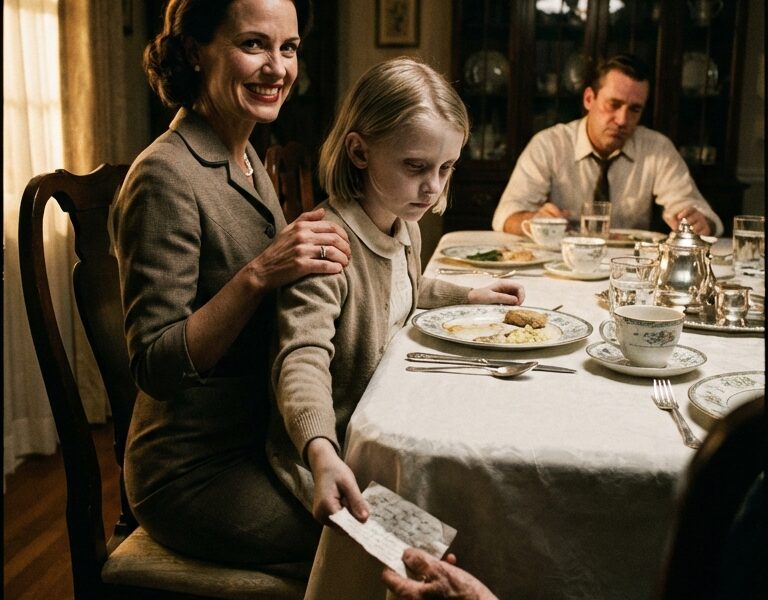
My name is Patricia E-Ryder, and for thirty-four years, I was the ghost in my own family portrait. I wasn’t erased out of malice, exactly, but out of a lazy, habitual neglect that hurts far more than hatred ever could.
At every Thanksgiving dinner, every Christmas gathering, and every milestone celebration, the spotlight didn’t just land on my sister; it was surgically attached to her. She never had to demand attention. It simply gravitated toward her like moths to a porch light. She was the “Golden Girl,” the living, breathing highlight reel my mother broadcast to anyone trapped within earshot. Jessica was the high school cheerleader, the straight-A student, the one who married young to a man with a jawline carved from granite and a boat docked in the marina. Her life was a series of sun-drenched Instagram posts featuring matching golden retrievers and linen outfits. It looked perfect framed on a mantelpiece, and for my parents, that was enough.
And then there was me. Quiet Patricia. The one who moved out at eighteen and rarely came back. The one relatives asked about with a vague, furrowed brow, as if trying to recall a dream they had forgotten upon waking.
I remember one specific Thanksgiving. I was on my hands and knees behind the dusty entertainment center, untangling a nest of cables to reset the Wi-Fi router so my father could watch the game. While I inhaled dust bunnies, I could hear the sound of tearing paper in the living room. Jessica was unwrapping gift bags filled with designer perfume and silk scarves—gifts that cost more than my entire monthly grocery budget.
“Is Patricia still doing that… computer stuff?” an uncle asked, his mouth full of stuffing.
“Oh, you know Patricia,” my mother replied dismissively. “She likes her screens.”
An aunt forgot my birthday two years in a row. I never corrected her. I never corrected any of them. I told myself I didn’t need their applause. I built a fortress out of that indifference.
After college, I took an entry-level job in IT support. It was grueling, thankless, and invisible work—a perfect match for how I saw myself. I answered tickets from angry strangers all day, reset passwords for people who couldn’t be bothered to remember them, and went home to a shoe-box apartment where my server racks took up more square footage than my furniture.
But while the world slept, I was building.
At night, the blue light of my monitors was my only company. I taught myself Python, Rust, and Go. I began freelancing under a pseudonym, taking overseas contracts at 3:00 AM. It wasn’t glamorous. I didn’t post “hustle culture” quotes on social media. Nobody in my family asked what I did, and I didn’t volunteer the information.
I remember once trying to explain a new certification I’d earned—a gateway to high-level systems architecture. My dad cut me off mid-sentence, hand raised, eyes darting to the hallway. “Hold on, Trish. Jessica is telling us about her yoga retreat in Sedona. You have to hear this.”
That certification came with a bonus check larger than my brother-in-law’s annual salary. I swallowed the news, nodded, and listened to a story about chakras. I learned a vital lesson that day: Success doesn’t count to them unless it’s loud enough to be bragged about at a cocktail party.
So, I succeeded in silence.
Promotions came in a torrent. Recruiters began headhunting me aggressively. I moved from support to Systems Architecture, then to Product Management, and finally, I was appointed as the Head of Division at a premier global cybersecurity firm.
I relocated to New York City, leaving the cramped studio in Queens for a penthouse overlooking Central Park—a sanctuary of glass and steel that I never mentioned to a soul. I flew to Singapore for board meetings and London for security summits. I bought a luxury sedan in cash. And through it all, I let my family believe I was still struggling in that tiny apartment, scraping by on IT tickets.
They didn’t care enough to visit, so they never found out.
Then came the catalyst: My grandmother turned eighty.
There was no skipping that. It was a summons, not an invitation. I flew in on a red-eye from a conference in Zurich, exhausted but wired. I didn’t announce my arrival. I simply walked into the country club wearing a black structural dress and stilettos I usually reserved for aggressive boardroom negotiations.
My mother blinked twice when she saw me. It was a look of cognitive dissonance, like she was trying to reconcile the daughter she ignored with the woman standing before her. Jessica hugged me a beat too long, her hands patting my back as if checking for wires—or perhaps checking for signs of disaster.
“You look… different,” Jessica said, her eyes scanning my jewelry.
“I’ve been busy,” I said simply.
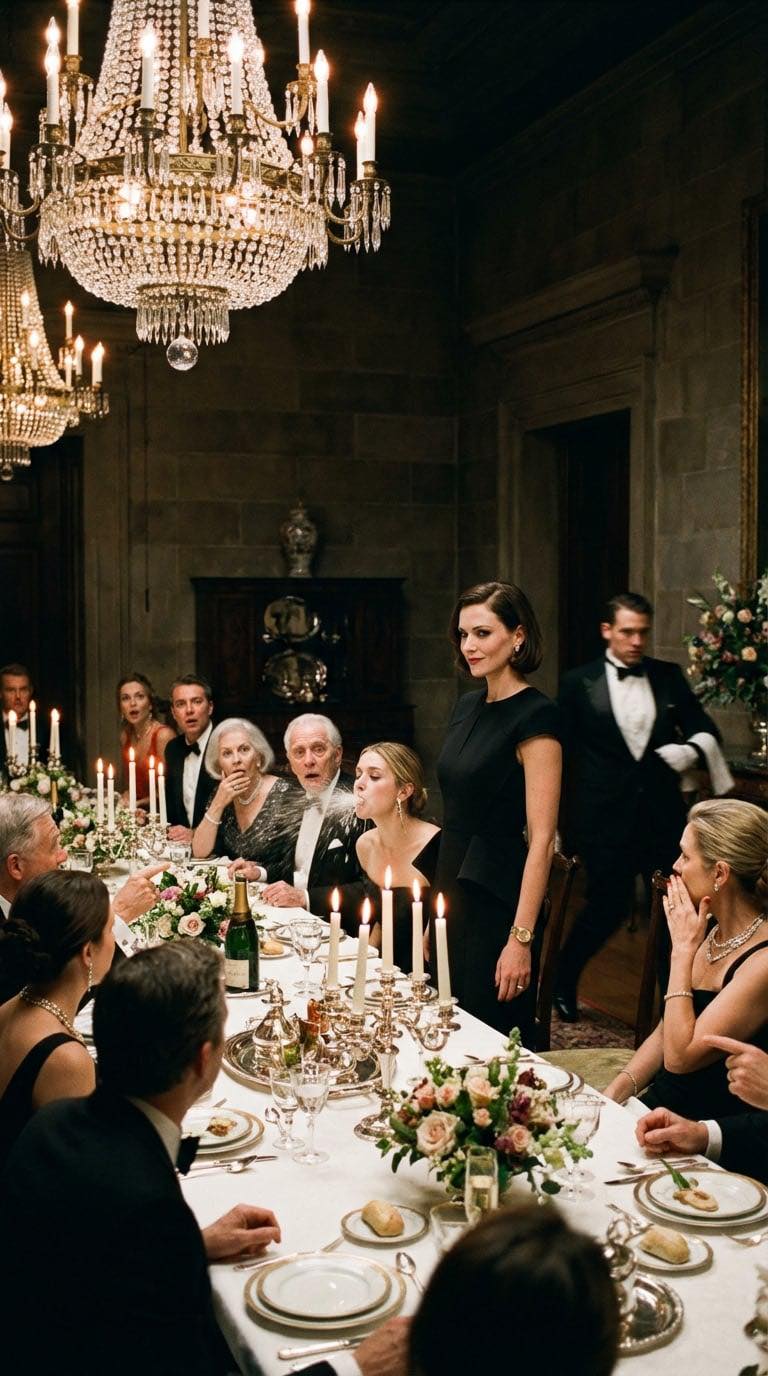
Champagne was poured. The air buzzed with the performative laughter of suburban wealth. We were standing near the buffet table when my grandmother—sharp as a tack and the only person who ever really saw me—turned and asked, loud enough for the table to hear, “So, Patricia, where are you living these days? Still in that little closet in Queens?”
I opened my mouth to speak, but my mother intercepted the question, a reflex born of embarrassment. “Oh, she’s somewhere in Brooklyn or Hoboken, Mom. Somewhere… struggling artists live.” She waved her hand dismissively.
I smiled. It was a cold, sharp thing. I waited for her hand to drop, for the air to settle.
“Actually,” I said, my voice calm, carrying effortlessly over the clinking silverware. “I bought a place in the city. Just a little penthouse overlooking Central Park.”
The silence that followed was absolute. It was the sound of a vacuum sealing.
Jessica choked, spitting a mouthful of vintage champagne onto her salad plate. My mother’s face drained of color, pale as the linen tablecloth. My uncle, the one who mocked my “computer stuff,” let out a low, involuntary whistle.
“Well, well, well,” he muttered.
And just like that, the ghost materialized. Heads turned. Eyes lingered on the cut of my dress, the heavy gold watch on my wrist. They finally saw me.
But as I looked around the circle of stunned faces, I didn’t know yet that being seen would cost me far more than being ignored ever did.
The hunt had begun.
The Currency of Love
After that night at the country club, the atmosphere around me shifted physically. It was as if the air pressure in the room had changed, causing everyone’s ears to pop.
The aunt who once asked me to refill the water pitcher while I was eating dinner now leaned in, desperate to hear my opinion on interest rates. My uncle stopped patting me on the head and started asking about “market trends.” My mother, who for a decade told neighbors I “fixed computers,” began introducing me to strangers as her daughter, the “Cybersecurity Executive for Global Finance.” It wasn’t even my actual title, but accuracy had never been her strong suit—status was.
I was still reeling, trying to calibrate this new reality, when Jessica reached out the next morning.
Her text message was a wall of emojis and exclamation points, overflowing with a warmth that felt theatrical. She asked if we could grab coffee before I flew back to New York. She said she missed me. She said it had been too long.
I stared at the screen in my hotel room. The last time we had spoken “properly,” she had berated me for missing her gender reveal party—an event I hadn’t even been invited to. She had told me I was “emotionally stunted.”
Still, I agreed. Hope is a stubborn, treacherous thing.
We met at Café Lumiere, a spot with overpriced lattes and sunlight that poured in through the windows, trying to soften the sharp edges of our history. Jessica didn’t waste time. She launched straight into a monologue about how difficult her life had become.
“Mark’s startup is bleeding cash,” she sighed, stirring her foam. “The baby has colic. I haven’t slept in three years, Trish. I’m drowning.”
She paused, looking at me with wet, shimmering eyes. She mentioned daycare costs three times in five minutes. Each time, she paused, leaving a gap in the conversation—a space perfectly sized for my credit card.
I nodded, sipped my black coffee, and waited.
Then, she tilted her head, a small, sad smile playing on her lips. “You’re so lucky, Trish. You don’t have to worry about money anymore. You have no idea what this stress feels like.”
It wasn’t a question. It was an invoice.
From that moment, the snowball didn’t just roll; it caused an avalanche. Suddenly, everyone had a catastrophic emergency that only I could solve.
Jessica needed help covering the down payment on a new SUV because of “safety features” for the baby. My mother called about a kitchen renovation she’d been “dreaming of for twenty years,” sobbing about how she wanted to enjoy it while she was still young enough to cook. My dad called about a gap in his health insurance for knee surgery—the kind of vulnerability he would usually die before admitting, yet he laid it at my feet with practiced ease.
I said yes. To all of it.
Not because I was blind. I saw the manipulation. I saw the sudden shifts in tone. But I wanted it to be real. I wanted to believe that my success had finally bought me a seat at the table. I wanted to believe that if I was useful, I would be loved.
For a few months, it worked. We had family group chats again. My name lit up their phones, and they answered on the first ring. My mom called me her “lifesaver.” My dad asked me to explain cryptocurrency to him, feigning interest just to keep me on the line.
I floated on the illusion. I didn’t track the thousands leaving my accounts. I didn’t question how quickly their gratitude curdled into expectation. I told myself this was the cost of admission.
Then, my grandmother called.
She never called unless it was urgent. She was the matriarch, the observer, the only one who had never made me feel small. Her voice wasn’t frail, but it was heavy.
“Patricia,” she said, cutting through the pleasantries. “I need to tell you something. And I don’t think you’re going to like it.”
She told me she had been at my parents’ house for a barbecue the previous weekend—an event I wasn’t invited to because I was “too busy making millions,” as my mother put it. My grandmother had been sitting on the porch, obscured by the trellis, when my parents and Jessica walked out to the patio.
They were laughing.
“They were talking about you, honey,” my grandmother said, her voice trembling with suppressed rage. “Your mother said it was about time you paid back all those years of doing nothing. Your father… he said they should keep you close until the kitchen is finished and the cars are paid off.”
I gripped the phone, my knuckles turning white. “And Jessica?”
“Jessica laughed,” my grandmother whispered. “She said, ‘The best part is, Patricia doesn’t even notice. She actually thinks we care.’”
My chest didn’t hurt. That was the surprise. I didn’t cry. Instead, a cold, clinical clarity washed over me. It was the same feeling I got when I identified a critical vulnerability in a system code—the moment you realize the firewall is breached and you have to shut everything down.
I thanked my grandmother. I told her I loved her. Then I hung up and walked to the window of my penthouse.
The city lights of Manhattan sprawled out beneath me, a grid of electricity and ambition. I placed my hand against the cold glass. Something inside me flipped. A circuit breaker had finally tripped.
I didn’t confront them. Not yet. I smiled. I answered their calls. I stayed warm and present. But I stopped the transfers.
I wanted to see how long their love would last when the subscription expired.
The Silence of the Ledger
The first thing I learned after I cut the financial cord was how quiet exploitation becomes when it’s confused.
No one called to ask if I was okay. No one checked if the market had crashed or if I had lost my job. The tone of their messages remained the same—warm, familiar, performative—but the content shifted.
Jessica stopped sending photos of the baby and started sending narration of her bills. “Daycare raised rates again,” she would text. “Ugh, this car payment is brutal.”
My mother sent glossy photos of Italian marble countertops. “Isn’t it crazy how expensive stone is now? We really want to get this done before the holidays… while we’re still healthy.”
My dad was subtler. He sent articles about friends who had retired early to Florida. “Must be nice,” he’d add.
Before, I would have filled the silence with a wire transfer. I would have offered before they had to ask. This time, I responded with emojis. A “thumbs up” for the marble. A “sad face” for the daycare.
I kept my availability high but my wallet closed. The result was immediate.
Jessica’s replies took hours, then days. My mother’s messages became short, clipped, devoid of affection. My dad stopped calling altogether.
Then came Christmas.
Suddenly, the charm offensive rebooted. My mother insisted I come home. “It won’t be a family without you,” she pleaded. “The baby needs to see her aunt.”
I booked the flight. Not because I believed them, but because I needed to end this chapter face-to-face. I needed to look them in the eye when the checks didn’t clear.
The house smelled of pine and cinnamon. Bing Crosby crooned from the speakers. It was a masterpiece of staging. My mother hugged me so hard I felt her ribs. Jessica touched my arm constantly, a physical performance of intimacy. My dad poured me a scotch—the expensive stuff—and asked about New York with eyes that glittered with calculation.
They were actors, all of them. And for the first time, I could see the strings.
Dinner was loud. Gifts were exchanged. Mine were extravagant—iPads, designer bags—and I watched them take the gifts without hesitation. That used to bother me, the entitlement. Now, it just felt like a severance package.
After dessert, we migrated to the living room. This was the moment. The “Ask.”
My dad loosened his collar. Jessica kicked her feet up. My mom cleared her throat.
“So, Trish,” my dad started, leaning forward. “We were looking at the numbers for the renovation, and…”
“I know about the barbecue,” I said.
I didn’t shout. I didn’t raise my voice. I spoke with the flat, even tone of a judge delivering a sentence.
The room froze. The fire crackled in the hearth, sudden and loud.
“What?” my mother asked, her smile faltering.
“The barbecue,” I repeated, locking eyes with Jessica. “A few months ago. Standing on the patio. Mom, Dad, Jessica. Laughing about how ‘useful’ I’ve finally become. Laughing about how I’m paying back years of ‘doing nothing.’ Laughing about how I actually think you care.”
Jessica went pale. She opened her mouth to speak, but no sound came out.
“Patricia, that’s…” my mother started, her voice rising into that familiar, warning pitch she used to control me. “You’re taking things out of context. We were stressed! Families say things they don’t mean!”
“No,” I said, standing up. “Families do say things they don’t mean. But you meant every word. That’s the problem.”
I looked at them—really looked at them. They looked small. Desperate.
“I understand exactly what this relationship is,” I said. “I’m not angry anymore. I’m just finished. I am not the solution to your financial mismanagement. I am not the venture capital firm for your husband’s failing startup. And I am certainly not buying my way into this family anymore.”
“You can’t just leave,” my dad sputtered, his face reddening. “After everything we’ve done for you?”
“You’ve done nothing,” I said calmly. “And now, I’m returning the favor.”
I walked to the door. My mother called my name—a plea, a command, a beg. I didn’t turn around.
Outside, the winter air was sharp enough to cut glass. My grandmother was waiting on the porch, wrapped in her coat. She didn’t say a word. She just nodded, climbed into my rental car, and we drove away.
I thought that was the end. I thought the silence that followed—weeks of it, absolute and clean—was the resolution.
I was wrong. The silence wasn’t peace. It was them reloading.
The Identity Heist
Two weeks later, back in New York, I received a call from a recruiter I didn’t know.
“Patricia! Great to connect,” the man said, his voice slick with sales charisma. “I have a client extremely interested in the new firm. They’re impressed by your leadership profile at Ryder & Associates.”
I paused, my hand hovering over my keyboard. “I’m sorry? What firm?”
He laughed. “Ryder & Associates. The consulting group? Your profile lists you as a Silent Partner and Chief Strategy Officer. It says you’re leveraging your cybersecurity background to help family-driven enterprises.”
My stomach dropped through the floor. “I have no idea what you’re talking about.”
I hung up and started typing. It took me thirty seconds to find it.
A sleek website. Stock photos of glass handshakes and diverse boardrooms. And there, on the “Our Team” page, was my face. My LinkedIn headshot. My full professional biography, padded with exaggerated titles I had never claimed.
Ryder & Associates.
Partners: Mark Davis, Jessica Davis… and Patricia E-Ryder.
They hadn’t just wanted my money. They wanted my name. They wanted to wear my reputation like a costume to secure investors for Mark’s failing business. They were committing fraud, using my security clearance and industry standing as bait.
I dialed the number listed on the “Contact Us” page.
My father answered. “Ryder & Associates, how can I help you?”
“Dad,” I said. The single word was a weapon.
“Trish?” He stammered. “Look, honey, I can explain. It’s not what it looks like. We’re building something for the family! We thought… well, leveraging our collective success would benefit everyone. You’re a partner! We were going to surprise you with shares!”
“You committed identity fraud,” I said, my voice shaking with a rage I hadn’t felt in years. “You are using my credentials to solicit investment.”
“Don’t be dramatic,” Jessica’s voice chimed in from the background. “You don’t understand how much we needed this credibility to get the loan approved!”
That was it. The final tumbler clicked into place.
They didn’t see me as a person. They didn’t even see me as a bank account anymore. They saw me as a resource to be mined, an asset to be liquidated.
“I am contacting my lawyer,” I said. “The cease and desist will be there in the morning. If that website isn’t down in one hour, I will file a report with the FTC and I will sue you for damages. Do not test me.”
I hung up before they could scream.
I spent the next three hours in a frenzy of damage control. I locked down my credit. I alerted my company’s legal department. I had my lawyer draft the most aggressive cease and desist letter of his career.
By midnight, the website was a 404 Error.
I sat on my couch, my heart hammering against my ribs like a trapped bird. I called my grandmother.
“I warned you, Patricia,” she said softly. “They don’t love people. They love what people can provide for them.”
That was the moment I stopped hoping for redemption. I changed my phone number. I changed my email. I scrubbed my personal address from every database I could find. I went dark.
A week later, a letter arrived at my office. No return address.
Inside was a handwritten note from my mother. It was an apology that never actually used the word “sorry.” It was a tapestry of excuses about fear, insecurity, and “doing what’s best for the legacy.”
Taped to the bottom of the letter was an old photograph. It was me at twelve years old, standing at my grandmother’s kitchen counter, dismantling a broken radio with a screwdriver. In the background, out of focus, my family was laughing at the dinner table.
I stared at the girl in the photo. She looked lonely. But looking closer, I saw something else. She was focused. She was capable. She was fixing something broken while everyone else was just making noise.
I didn’t reply. I folded the letter and put it in the shredder. But I kept the photo.
The Architecture of Peace
It has been over a year now.
I sold the penthouse. It felt too much like a trophy case for a life I was trying to prove I deserved. I bought a brownstone in Brooklyn—a wreck of a place with good bones—and I gutted it. I tore down the walls myself. I chose every tile, every fixture, every beam. I built a home that felt earned, not performed.
My career is thriving, but I work differently now. I stop at 6:00 PM. I take weekends off. I mentor young women in tech, teaching them how to negotiate salaries and, more importantly, how to walk away from tables where respect isn’t on the menu.
I adopted a rescue dog with one ear and a profound distrust of authority. I named him Ghost, because that’s what I had become to my family.
My grandmother visits often. She never asks if I plan to reconcile. She knows better.
Last month, I got a voicemail from a number I didn’t recognize. It was my cousin, Megan. We hadn’t spoken in years. She sounded nervous.
“I’m not asking for anything,” she said quickly. “I just… I thought you should know.”
She told me the fallout was absolute. My dad had abandoned the consulting idea after the investors fled. My mom was volunteering at a shelter, trying to fill the void with public charity. And Jessica? She had gone back to school. Community college, psychology. No announcements, no fanfare. Just quiet work.
Megan told me that my name still comes up sometimes. That my mom cries occasionally—not to guilt anyone, but privately. That my grandmother refuses to let them rewrite history. She tells the truth.
I didn’t call Megan back. Some changes aren’t invitations; they are just proof that growth is possible, even if it comes too late to save the relationship.
One evening, while Ghost snored on the rug, I pulled that photo of my twelve-year-old self out of my desk drawer.
I used to look at her with pity. I used to think she was the invisible girl, the forgotten daughter. Now, I see her differently. She wasn’t invisible. She was just busy building the foundation for the woman who would one day save herself.
I put the photo in a simple black frame and placed it on my desk. Not as an anchor to the past, but as evidence.
They taught me a lot, my family. They taught me what happens when love is conditional. They taught me that success is something to be protected, not extracted.
But most importantly, they taught me that walking away isn’t the end of the story. It’s the moment the story finally becomes yours.