The air inside the reception tent smelled of imported white orchids and old money. It was a cloying, suffocating scent, the kind that masks the rot beneath the floorboards. Diamond’s wedding to Preston Vance was a masterclass in excess—a 1.2 million dollar spectacle set against the manicured dunes of the Hamptons. Crystal chandeliers, rented for the price of a mid-sized sedan, suspended from the silk ceiling like frozen tears.
I sat at Table 19, a designation so far from the head table I was practically dining in the parking lot. The guests around me were eating Lobster Thermidor, the steam rising in buttery ribbons. When the waiter approached me, however, he didn’t hold a porcelain charger. He hesitated, a flicker of professional pity crossing his face, before placing a bright, electric-blue plastic plate in front of me.
It was an assault on the aesthetic. A harsh, childish object sitting on the pristine white linen.
On it sat a single, cold slice of pepperoni pizza, the cheese congealed into a rubbery orange map of my humiliation. Next to it was a lukewarm apple juice box. But the coup de grâce was the note tucked underneath, written on heavy cream cardstock in a script I knew better than my own signature.
Brenda. My mother.
It wasn’t a greeting. It was an invoice.
$500.00 – Last Minute Seating Fee. Payable Immediately.
I looked up. Across the sea of tuxedos and designer gowns, Diamond caught my eye. She raised her flute of vintage Dom Pérignon, the bubbles catching the light, and offered me a slow, conspiratorial wink. It wasn’t a gesture of sisterhood; it was a dominance display. It was a reminder that I existed only because they allowed it.
I didn’t gasp. I didn’t let a single tear compromise my setting spray. Tears are for people who are surprised, for people who still harbor hope. Looking at that sad, greasy triangle of pizza, I realized I had absolutely no hope left. And the vacuum it left behind was instantly filled with something volatile.
I was done.
I reached into my clutch, my fingers brushing against the cool metal of my phone. I didn’t try to hide it. I held the device directly over the plate, switching to portrait mode, high definition. I wanted the forensic details. I wanted the way the grease stained the blue plastic to look like art. I made sure Brenda’s jagged, aggressive handwriting on the invoice was perfectly legible.
$500. Seating fee. As if I were a folding chair rented from a party supply store, not the bride’s sister. Not the architect of her entire life.
I snapped the photo. The flash didn’t fire, but the image uploaded to the cloud instantly. Evidence secured.
I opened my messaging app. There was only one active thread, a digital lifeline I had established three days ago. The recipient was sitting at the head table, looking devastatingly bored in a bespoke tuxedo that cost more than my annual rent. Preston, the groom.
I typed a single word: Now.
I watched him. He didn’t flinch. He didn’t look my way. He simply checked his phone, took a measured sip of his sparkling water, and gave a barely perceptible nod to the sommelier refilling his glass.
That was the signal. The safety was off.
I stood up. My chair scraped against the parquet floor—a harsh, dissonant screech in the hum of polite society conversation. A few heads turned, eyes scanning me with mild disdain before returning to their lobster. To the two hundred influential guests in this tent, I was nobody. I was Charity, the stain in the corner, the “unfortunate” sister Brenda complained about over martinis at the country club.
I smoothed the front of my dress. It was off-the-rack, purchased with the meager allowance I scraped together from freelance editing before Brenda siphoned the rest of my earnings. I picked up my clutch and began to walk.
I didn’t head for the exit. That’s what they expected. They expected me to run to the valet, weep into the steering wheel of my ten-year-old Honda, and fade away like I had for twenty-nine years. They expected the ghost to vanish.
Instead, I walked toward the stage.
As I navigated the maze of tables, I didn’t see guests; I saw price tags. My mind, trained by years of managing their lives from the shadows, began to tally the ledger.
The centerpieces—cascading arrangements of white orchids imported from Thailand—cost six hundred dollars per table. That expense was covered by the advance from Chapter Four of The Gilded Cage, the bestseller Diamond claimed she wrote during a “spiritual retreat” in Bali.
In reality, Diamond had been partying in Vegas. I wrote Chapter Four in the laundry room of our parents’ estate, sitting on a pile of dirty towels, waiting for the dryer to finish so the noise would drown out my sobbing.
The Champagne Tower, a three-thousand-dollar fragility, was paid for by the film option rights. Rights to a story I had bled onto the page while Diamond was getting lip filler and researching which filter made her look most “literary.”
The vintage chandeliers? Ten thousand dollars in rental fees. Paid for by the foreign rights sales in Germany and France.
Every square inch of this 1.2 million dollar fantasy was paved with my keystrokes, my insomnia, my vocabulary. I was the mine they stripped for gold. And in return, they gave me a juice box and a bill.
The irony tasted metallic in my mouth, like biting down on a coin. They were celebrating a career that didn’t exist, honoring a talent Diamond didn’t possess, and spending money that belonged to the woman they had seated next to the kitchen trash.
I reached the edge of the dance floor. Diamond was laughing, throwing her head back so the strobe light would catch the diamond necklace at her throat. She looked radiant. She looked victorious. She thought she had won the war without ever firing a shot. She believed she had successfully erased me from the narrative, reducing me to a prop she could tax for breathing her air.
She didn’t notice me walking past the five-tier cake. She didn’t notice me slip behind the heavy velvet curtains that concealed the audiovisual production team.
The AV tech, a guy named Mike whom I’d spoken to earlier that morning under the guise of a “sound check,” looked up as I entered the dim, cable-strewn booth. He looked nervous, sweat beading on his upper lip. He glanced at the stage, then at me.
“You ready?” he whispered, his voice cracking.
I looked at the laptop connected to the massive LED screens flanking the stage. Currently, they were cycling through a slideshow of Diamond and Preston’s engagement photos. Fake smiles. Fake chemistry. Fake perfection.
I reached into my bag and pulled out a flash drive. It was heavy, cold metal in my palm.
“I’m ready,” I said, my voice steady. “Plug it in.”
As Mike loaded the files, time seemed to stretch, pulling me back into the dark. Not the dim light of the AV booth, but the damp, suffocating darkness of the basement where I spent my twenties.
You have to understand, I didn’t just wake up one day and decide to let them use me. I was groomed for it. Brenda named us like she was writing a prophecy. Diamond: hard, brilliant, unbreakable, valuable. And me, Charity: a virtue, an act of giving to those in need, a tax write-off.
From the time I could hold a pencil, Brenda taught me the physics of our universe. Diamond was the sun, and I was the gravity that held her in place. Invisible, heavy, and necessary only so she didn’t float away.
Psychologists call it the “trap of normalized cruelty.” It is a cage without bars. Brenda didn’t lock me in that basement. She did something far more effective. She convinced me that living in the dark was my noble purpose. She would stroke my hair and say, “You are the roots, Charity. Roots have to live in the dirt so the flower can bloom. Without you, your sister would wither.”
I believed her. God help me, I believed that my suffering was the price of her success and that paying it made me good.
So while Diamond was networking in Manhattan, I was underground. My “office” was a converted storage room under my parents’ house. It smelled of mildew and old paper. The only window was a thin slit at the top of the wall that looked out onto the driveway. I learned to tell time by the sound of Diamond’s tires crunching on the gravel—coming home at 4:00 AM, leaving at noon for brunch.
I wrote The Gilded Cage in nineteen days. My fingers bled. I drank coffee until my hands shook so violently I could barely type. I poured my soul, my loneliness, my desperate need to be seen into that manuscript.
When it hit the New York Times list, Brenda threw a gala. Diamond stood on a stage in a gold sequin dress, weeping, thanking the “muse that whispers in my ear.” I was at the back of the room wearing a headset, telling the caterers when to bring out the shrimp.
Brenda found me later, hiding in the kitchen. She didn’t hug me. She handed me a glass of warm tap water and said, “Don’t look so smug, Charity. A ghost is only useful if no one sees it. Go check the coats.”
That was the trap. They fed on my talent, and when I was drained, they shamed me for being empty.
But looking at that invoice tonight, that five-hundred-dollar demand for a seat at a table I paid for, something inside me snapped. The cage door swung open. I wasn’t the roots. I was the engine. And an engine can drive a car, or it can drive a tank.
I looked at Mike. The loading bar on his screen hit 100%.
“It’s ready,” he whispered.
“Good,” I said, my voice cold. “Let’s start the show.”
To understand why I didn’t hesitate to incinerate my own sister’s wedding, you have to witness what happened thirty minutes before I walked into that tent.
The reception was about to start. I was heading toward the seating chart, foolishly looking for my name, when a hand clamped around my upper arm. It was a manicured claw. Brenda.
She didn’t say hello. She didn’t compliment my dress. She dragged me into the small, air-conditioned trailer reserved for the bridal party. Diamond was there, touching up her lipstick in the vanity mirror. She didn’t turn around.
“We need to handle some housekeeping,” Brenda said, locking the door.
She reached into her purse and slapped a document onto the makeup counter. It was thick legal bond paper. I recognized the font immediately. It was an Intellectual Property Release and Waiver.
“Read it,” Brenda commanded. “Actually, don’t bother. I’ll summarize. It states that you, Charity, acknowledge that you served merely as a typist for Diamond’s works. It states that you have no claim to copyright, royalties, or creative credit for The Gilded Cage, or any future sequels. It retroactively assigns all rights to Diamond Holdings, LLC.”
I stared at the paper, feeling the blood drain from my face. “You want me to sign away my life’s work? Now? Before dinner?”
“The movie studio needs a clean chain of title before they wire the option money on Monday,” Brenda said, her voice devoid of emotion. “We can’t have you popping up later claiming you wrote it just because you typed it up.”
“I didn’t just type it, Mother. I created it. I birthed it.”
“Semantics,” Brenda snapped. She uncapped a heavy Montblanc pen and held it out. “Sign it.”
“And if I don’t?”
Brenda smiled. It was a terrifying expression, all teeth and no warmth. “Then you leave right now. You don’t get a seat. You don’t get dinner. And don’t think about coming home for Christmas. If you walk out that door without signing, you are dead to this family. We will cut you off completely. No allowance, no contact.”
I looked at Diamond. She caught my eye in the mirror and shrugged, bored.
“Just sign it, Charity. Don’t be dramatic. It’s my big day. Do you really want to ruin it over some scribbles?”
My heart hammered against my ribs like a trapped bird. But then I remembered the encrypted phone call I’d had with Preston three days ago. He had predicted this.
“They’re greedy,” he had told me. “They’ll want to close the loop before the wedding night. Sign it, Charity. But use your confirmation name as your middle initial. Your legal ID doesn’t have a middle name. It creates a discrepancy we can use to tie them up in court for years while I execute the main plan.”
I took the pen. My hand didn’t shake. I bent over the counter, avoiding the loose powder spilled by Diamond’s brush, and signed the document.
Charity R. Whitmore.
The “R” stood for Rose, a name that existed only on a church certificate from when I was twelve and nowhere on my birth certificate or tax forms.
I handed the pen back. Brenda checked the signature. Satisfied, she didn’t notice the extra initial. She just saw submission. She folded the contract and tucked it into her purse like it was a receipt for dry cleaning.
“Good choice,” she said. “Now go find your table. We squeezed you in near the back.”
As I turned to the door, Diamond laughed. It was a light, tinkling sound, like breaking glass.
“Oh, and Charity?” she called out. “I saw the menu. The caterer ran out of the lobster for the vendor tables. Make sure you eat the crusts on that pizza. You know how you love leftovers.”
I didn’t look back. I walked out of that trailer and into the cool evening air. I felt lighter than I had in years. They thought they had just secured their fortune. They didn’t realize they had just signed their own eviction notice.
I checked my watch. Twenty minutes to showtime.
“Eat the crusts,” I whispered to myself. “No, Diamond. I think I’ll eat the whole damn cake.”
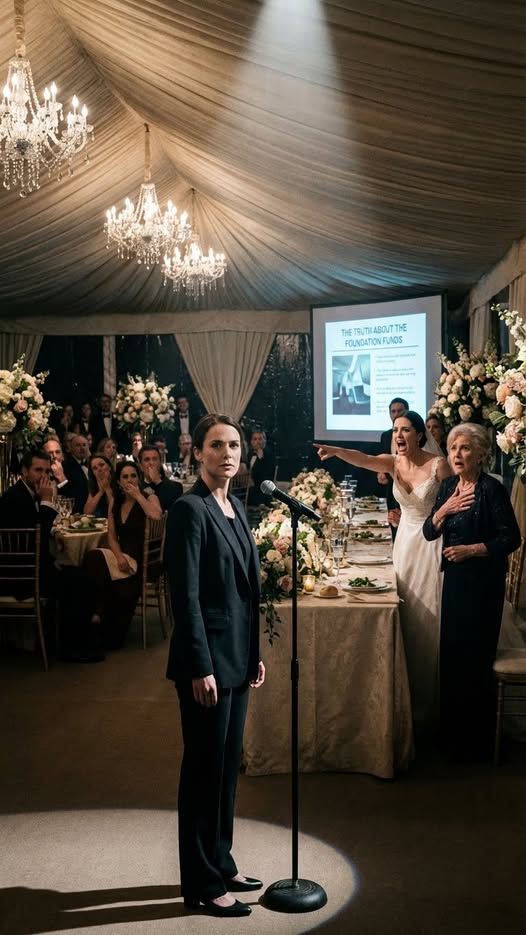
The lights in the tent dimmed, plunging two hundred guests into a hushed twilight. A single spotlight hit the center stage where Brenda stood, clutching a microphone like it was a scepter. She wore a champagne-colored gown that probably cost more than my entire college education.
Tears—practiced, elegant tears—shimmered in her eyes.
“My Diamond,” she began, her voice trembling just enough to be touching without ruining her mascara. “From the moment you were born, I knew you were destined for greatness. You didn’t just walk; you glided. You didn’t just speak; you told stories that captivated the world. Your genius is a gift from God. And watching you build this empire with your own two hands has been the greatest privilege of my life.”
Applause rippled through the tent. Diamond dabbed her eyes with a lace handkerchief, looking every inch the humble artist.
I stood up. I didn’t wait for the applause to die down. I walked out from behind the curtain to the microphone stand at the edge of the stage—the one reserved for the best man.
“Excuse me,” I said.
My voice wasn’t loud, but the high-end sound system carried it to every corner of the tent.
“I have a special presentation for the bride.”
Brenda frowned, confused. She hadn’t approved a speech from me. She took a step forward to intervene, but I nodded to Mike in the booth.
The massive LED screens behind the head table flickered to life. The guests leaned forward, expecting a montage of baby photos or romantic clips of Diamond and Preston in Paris.
Instead, a spreadsheet appeared.
It was an Excel file projected in 4K resolution. The text was crisp, damningly clear.
Column A: Royalties – The Gilded Cage.
Column B: Transfer to Shell Corp – B. Whitmore Holdings.
Column C: Wedding Vendor Payments.
A murmur of confusion swept through the room.
“What is this?” Diamond hissed, her smile freezing into a rictus of panic.
“This,” I said, my voice calm and amplified, “is the accounting for tonight’s event. You see, everyone thinks Diamond wrote a bestseller. But Diamond has never written anything longer than an Instagram caption.”
The screen switched. The spreadsheet vanished, replaced by a grainy video. It was filmed in our basement three years earlier. It showed me, pale and exhausted, typing furiously at a laptop surrounded by energy drink cans. Diamond was lounging nearby on a beanbag chair, scrolling on her phone.
Her voice rang out clearly over the speakers.
“Just finish the chapter, Charity! I have a photo shoot at noon. And don’t forget the part about the orphans. People love orphans. Make it sadder.”
Gasps rippled through the tent like a shockwave.
Brenda dropped her microphone. Feedback shrieked through the speakers, making people wince. “Turn it off!” she screamed, rushing toward the AV booth. But Mike had locked the door.
“And now for the encore,” I said.
The screen changed again. This time, it displayed a chain of emails.
Subject: Paternity Test Results.
Status: COMPLETED.
Probability of Paternity: 0% for Preston Vance.
Probability of Paternity: 99.9% for Richard Vance.
Richard Vance. The man who had just walked Diamond down the aisle. Preston’s stepfather.
Silence collapsed the room. It was absolute, heavy, and suffocating.
Diamond screamed. It wasn’t a pretty sound. “It’s fake! She’s lying!”
“It’s not,” I said. “And neither is the lawsuit I filed this morning.”
Diamond shrieked, hurling a full champagne glass at the screen. It shattered against the LEDs, liquid dripping down the digital evidence of her infidelity. Brenda was pounding helplessly on the locked booth door, her dignity unravelling with every blow.
The guests sat frozen, witnessing the live vivisection of a family.
Then, Preston stood.
He buttoned his tuxedo jacket with deliberate, calm movements. He faced the room, his expression unreadable.
“The show is over,” he said.
He reached into his jacket pocket and pulled out a document. He walked over to where I stood and handed it to me, then turned to face the wreckage of his bride.
“At 9:00 AM this morning, my private equity firm acquired Skylark Publishing,” Preston announced. “I now own the catalog, the Diamond Whitmore trademark, and the ongoing copyright investigation into The Gilded Cage.”
Diamond collapsed into her chair, her face buried in her hands.
“I know Charity wrote every word,” Preston continued. “All royalties are now redirected to the true author. Diamond, you are in breach of contract for fraud.”
“The prenup,” Brenda whispered, her face ashen.
“Void,” Preston said. “So is the marriage.”
He slid annulment papers across the table toward Diamond. Then he turned to Richard, his stepfather, who was staring at the floor, unable to meet anyone’s eyes.
“My mother changed the locks an hour ago, Richard. Your bags are on the curb.”
Finally, Preston walked over to Brenda. Her hands were shaking so violently she could barely stand. He placed a piece of paper in her palm.
It was an invoice.
“$1.2 million,” he said softly. “Since there was no marriage, I cancelled the vendor payments. You’re liable for the event.”
He turned to me and offered his arm.
“Ready to go, Charity?”
I looked at the blue plastic plate still sitting on Table 19. I looked at my mother, broken and bankrupt. I looked at my sister, sobbing into a tablecloth she couldn’t afford.
“I’m ready,” I said.
We walked out together, leaving the chaos behind us.
By morning, Brenda and Diamond were socially erased. The Hamptons is a cruel ecosystem; it tolerates vice, but it destroys failure. Clubs revoked memberships. Publishers cut ties. Diamond tried to play the victim online, posting tearful videos about “sisterly betrayal,” until Preston’s legal team shut down her accounts for defamation.
The lawsuit ended in a rapid settlement. They had no money to fight us.
A week later, Preston met me at a quiet café in the city. He slid a check across the table.
Five million dollars.
“Your back royalties,” he said, “plus interest. And a signing bonus for your new contract.”
I didn’t buy a yacht. I didn’t buy diamonds. I used the money to found the Ghostwriters Shield Fund, a legal defense trust for exploited creatives. I didn’t just defeat them; I replaced the system that created them.
Today, I live by the ocean. The air smells of salt and freedom, not orchids and lies.
I open my laptop. The cursor blinks on a blank white page. I type a title. Beneath it, I type two words that carry more weight than all the gold in the world.
By Charity Rose.
To anyone who has ever been told they were just background noise, listen to me: You are the author. They can steal your credit. They can steal your money. But they cannot steal your voice unless you hand them the pen.
Pick it up. And write yourself back into the center of your own story.