I was terrified the moment he sat down beside me.
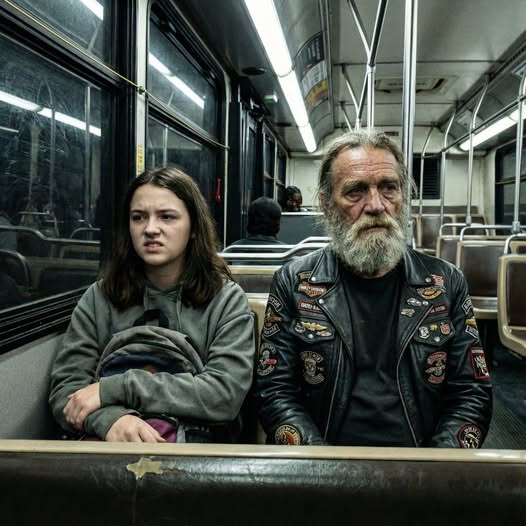
I was seventeen years old, barely five feet tall, hugging my backpack like it could protect me from the world. The bus was half empty, late evening light flickering through dirty windows, and he chose the seat directly next to mine when dozens of others were open. He looked enormous. Leather vest. Heavy boots. A gray beard reaching his chest. Tattoos wrapping around thick arms. He smelled like gasoline and cigarettes, like someone who lived a life far rougher than mine.
My heart slammed against my ribs. I pressed myself into the window, calculating exits, counting stops. Two stops until home. Just survive two stops.
He didn’t look at me. Not once. He sat upright, hands folded in his lap, knuckles scarred and rough. The kind of hands that looked like they had known violence, loss, and work that never makes the news. The bus hummed forward. I tried to breathe quietly.
Then he reached into his vest.
Every muscle in my body locked. I stopped breathing entirely, my mind sprinting through every horror story I’d ever heard about girls who trusted the wrong stranger.
Instead of a weapon, he pulled out a small folded note and held it toward me, still not meeting my eyes.
I didn’t move.
He waited.
“Please,” he said softly. His voice was deep and rough but not threatening. “Just read it. Then I’ll move.”
My hands shook as I took the paper. I unfolded it slowly, bracing myself.
Six words.
“I know what you’re planning tonight.”
The note slipped from my fingers.
I stared at him, my chest hollowing out. How could he possibly know? I hadn’t told anyone. I hadn’t written it anywhere that mattered. I’d been careful. Silent. Invisible.
When I finally looked at his face, the fear shifted into confusion. His eyes were red. Wet. This man I had judged as dangerous had clearly been crying.
“I saw you three nights ago,” he said quietly. “On the bridge. Standing on the wrong side of the railing.”
My blood went cold.
“I pulled over to help,” he continued, voice steady but breaking underneath. “But you climbed back before I reached you. You didn’t see me.”
I couldn’t speak.
“I’ve been riding that route every night since,” he said. “Just making sure you didn’t go back. Tonight I saw you get on this bus. I recognized the look.”
“What look?” I whispered.
“The look of someone who’s already said goodbye.”
The bus rolled on. People around us scrolled phones, chatted about dinner, complained about work. None of them knew a stranger was dismantling my plan one sentence at a time.
“I wasn’t going to say anything,” he said. “I figured you’d think I was crazy. Or dangerous. But when you rode this bus in the wrong direction, I knew I couldn’t stay quiet.”
“My daughter rode this bus,” he added. “Until she didn’t.”
He pulled a worn photograph from his pocket. A girl with bright eyes and an easy smile. She looked alive. Loved.
“Emily,” he said. “She was seventeen too.”
His voice cracked. “She jumped four years ago. I found her.”
The world narrowed. I couldn’t stop crying.
“I missed the signs,” he said. “So now I watch for them. The heavy backpack. The necklace you never wear. The way you don’t look at your phone because you don’t expect messages anymore.”
My fingers closed around the locket at my throat. My grandmother’s. I’d wanted to wear it tonight.
“I know I look scary,” he said. “Kids cross the street when they see me. Parents pull their children closer. But once, when I was eighteen, I almost didn’t survive either.”
He rolled up his sleeve, revealing old scars hidden beneath tattoos.
“What stopped you?” I asked.
“My neighbor,” he said. “Mean-looking Marine named Frank. He didn’t lecture me. He didn’t call the police. He handed me a wrench and asked for help fixing a truck. He just showed up.”
The bus slowed. The stop near the bridge came into view.
I didn’t move.
The doors closed. The bus pulled away.
He exhaled, relief visible in his shoulders.
“There’s a diner two stops down,” he said. “Best pancakes you’ll ever eat. Open all night. Let’s go there instead.”
I nodded.
We sat in that diner until morning. He listened as I told him everything: the bullying, the pressure, the exhaustion, the way depression lies so convincingly it feels like truth. He didn’t interrupt. Didn’t minimize. Didn’t try to fix me.
When the sun rose, he drove me home. My mother was frantic, shaking, on the verge of calling the police. He handed her a card for a counselor who specialized in adolescent mental health and suicide prevention. A professional who helped families navigate the unspoken weight of depression, trauma, and recovery.
He slipped away quietly.
Eight months have passed.
I’m still here.
I’m in therapy. I’m on medication. I’m learning that mental health treatment isn’t weakness—it’s survival. My mother and I talk now. Really talk. About fear, about mistakes, about love that didn’t always know how to speak.
Thomas texts me every week. Sometimes we meet for pancakes. He tells me about his motorcycle club’s charity rides for mental health awareness and crisis intervention. They raise money for counseling services, community outreach, and suicide prevention programs that save lives quietly, far from headlines.
I still have hard days. But now I know they pass.
I was terrified when the biker sat next to me on that bus. I thought he was the danger.
Instead, he became the reason I’m still alive.
Not through force. Not through lectures. Just by noticing. By showing up. By handing me a note that told me I wasn’t invisible.
Sometimes the people who look the scariest are the ones who understand pain the most. And sometimes, one human moment on public transportation changes everything.
This isn’t just a viral inspirational story. It’s a reminder that kindness is a form of intervention, that presence can be lifesaving, and that noticing someone at the edge matters more than you’ll ever know.