Chapter 1: The Alarm of Absence
I woke up to my phone vibrating against the nightstand like a trapped insect trying to escape a jar. The screen glowed with an aggressive blue light in the pitch-black hotel room.
Christmas Eve, 6:12 a.m.
Too early. Far too early for anything except emergencies or flights I definitely wasn’t on. I grabbed the phone, my limbs still half-tangled in the stiff, starched hotel sheets that smelled of industrial bleach and loneliness.
“Mom?”
The whisper was barely audible, but it hit me like a bucket of ice water. Zara. My nine-year-old daughter.
Instant adrenaline spiked through my veins, sharpening the world into painful clarity. I sat straight up, the cheap polyester duvet sliding to the floor.
“Zara, what’s wrong? Are you hurt?”
Silence. A tiny, hitching breath. And then, “I… I think something’s wrong. The house is empty.”
That sentence landed harder than any alarm clock ever could. It wasn’t just the words; it was the hollow, terrified cadence of her voice. I swung my legs off the bed, my feet hitting the thin, patterned carpet that was freezing cold.
I was in yet another anonymous airport hotel, an hour’s flight from home. Why? Because small-city hospitals don’t care that it’s Christmas when they’re drowning in flu cases and short on doctors. Holiday coverage is mandatory, and this week, I was the designated sacrifice.
I had told myself it was fine. I’d be back tomorrow morning. Zara loved my parents. She adored her grandparents. And my younger sister, Samantha, was there with her two kids, Owen and Quinn. A full house. Built-in chaos. Built-in babysitters. It was supposed to be a slumber party, not a horror movie.
Except now, my nine-year-old sounded like she was standing at the edge of a cliff, looking down into a void.
“Okay,” I said, forcing my voice into that calm, clinical register I used when a patient was crashing. “Tell me exactly where you are.”
“In my room,” she whispered. “But it’s too quiet. Not normal quiet. It’s… heavy.”
“All right, put me on speaker. We’re going to walk through the house together. Don’t hang up.”
I heard a faint beep as she switched modes, then the rustle of blankets as she climbed out of bed.
“Okay,” she said.
“Good. Open your door and tell me what you see.”
“The hallway light is on,” she said. “Grandma always turns it off at night. She says it wastes electricity.”
I filed that anomaly away. “Anyone in the hallway?”
“No. Just the light.”
“All right, walk toward the living room. Keep talking to me.”
Her footsteps sounded small and hollow through the phone speaker. I closed my eyes and pictured the hallway of my own house—the house I paid for. I saw the family photos I’d hung with such care, the runner rug I’d bought on sale between night shifts, the mirror my mother always complained made her look tired. All of it mine. All of it paid for with my exhausted bones.
“I’m in the living room,” Zara said. “The TV’s off. Grandpa’s blanket is gone.”
My heart rate picked up a notch. “Is the tree on?”
“No,” she said. “But… Mom?”
“What is it, baby?”
“There’s no coffee cup. Grandpa always has coffee by now. Even before he wakes up fully.”
It was such a small detail, but something about it made my stomach turn over. My father and his coffee were physical constants of the universe.
“Okay,” I said. “Let’s check the driveway. Just peek through the curtain. Don’t open the door.”
She padded over to the window. I heard the soft hiss of fabric moving.
“Mom,” she said, her voice shrinking until it was almost nothing. “Grandma’s car is gone.”
I stopped breathing.
“And Grandpa’s truck,” she continued. “And Aunt Sam’s car, too.”
“So, not a quick coffee run,” I murmured to myself.
“Maybe they just… maybe they left without me?” she asked, the fear bleeding into her voice. “They were talking about leaving early for the beach resort. But they didn’t wake me up. They didn’t say anything.”
That part lodged in my throat like a shard of glass.
“Maybe there’s a note,” I said, clinging to whatever script I could find. “Check the kitchen table. Sometimes people leave notes when they go out early.”
This was the moment where, in a different family—a normal family—the note would say something like, “Ran to the store for milk. Back in 20. Love you. Eat the cookies.”
I listened as she walked into the kitchen.
“I’m here,” she said. “There’s a paper. It looks like a ripped-out notebook page.”
My pulse started to thud in my ears, a rhythmic warning drum.
“Pick it up,” I said. “What does it read?”
She rustled the paper. She took a breath. And then she read, stumbling over the first word.
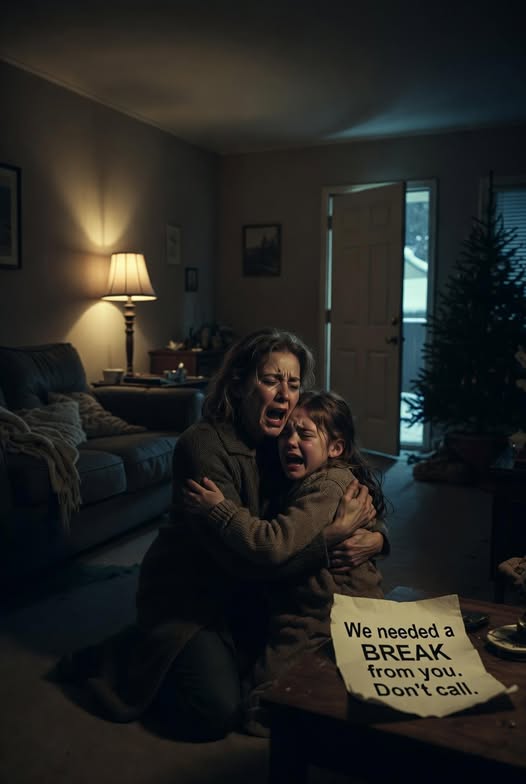
“We needed a break from you. Don’t call.”
The hotel room went very, very quiet. Not because there was no noise—the AC was humming, a door slammed down the hall—but inside my head, the world had just stopped spinning.
“That’s all it says?” I asked, my voice barely a whisper.
“Yes,” her voice cracked. “Mom, did I… did I do something bad?”
“No,” I said immediately, fierce and loud. “Absolutely not. That note is wrong. They were wrong to leave it, and they were wrong to leave you.”
I walked to the tiny window and stared out at a generic parking lot, just to have something to look at that wasn’t my own terrified reflection.
“Okay,” I said. “We’re going to do a quick sweep. Stay on the line. Check Grandma and Grandpa’s room.”
Her footsteps dragged a little now.
“Grandma’s bed is made,” she reported after a second. “Her suitcase is gone. Grandpa’s too. There’s dust where his boots were.”
I forced a breath. “Check Samantha’s room.”
She walked down the hall. A pause.
“Her suitcase is gone too. And the kids’ stuff. Owen’s Switch isn’t here, and Quinn’s unicorn is gone.” A tiny inhale. “They always take those when we go somewhere.”
Of course. They took Quinn’s stuffed unicorn. But not Zara.
I sat back on the edge of the bed because if I didn’t, I was going to fall.
“All right,” I said. “I’m going to try calling Grandma. Stay on the line with me. Just be quiet for a minute.”
I put Zara on mute and dialed my mother.
Straight to voicemail.
My father. Voicemail.
Samantha. Voicemail.
Not even a ring. Not even a half-hearted, “Sorry, can’t talk right now.” Just the cold, digital wall of rejection.
I unmuted Zara. “Okay, I’m still here.”
“I knew it,” she whispered. “They went to the beach without me.”
Her voice did something to me then. It wasn’t the crying. I’d heard her cry before—over scraped knees, lost toys. This was quieter. Flatter. Like she was already trying to shrink herself smaller so the world wouldn’t notice her enough to hurt her again.
I needed another adult. Any adult.
Unfortunately, that left me with Reed.
Reed wasn’t blood. He was just a longtime friend of the family who’d somehow become a permanent extra in our group chats and vacations. He had bad opinions about Seinfeld and a supernatural talent for always being around when there was free food.
I scrolled to his name and hit call.
He answered on the second ring. In the background, I heard loud noise—kids shouting, water splashing, and what sounded suspiciously like a blender crushing ice.
“Naomi? Hey! Merry Christmas Eve!”
“Where are my parents?” I asked. No pleasantries.
He hesitated. “Uh, they’re around. Try again later?”
I heard someone in the background—my mother’s voice—ask, “Is that Naomi?” Then lower, “Don’t answer. Just give me the phone.”
Reed’s voice dropped to a whisper. “They said you knew.”
“Reed,” I said, each word precise as a scalpel. “Where are they? And where is my daughter supposed to be right now?”
He exhaled, a long, guilty sound. “We’re at the resort. The Sands. They left early to beat the traffic. Your mom said Zara would be fine for a few hours. Samantha said she needed a break because Zara’s been… quote… ‘extra’ lately. They were going to pick her up later, I think. Or maybe…”
“If you finish that sentence with anything other than an apology,” I said, “I am going to come to that resort and remove your larynx with a plastic spoon.”
He made a small, terrified noise. “Look, I just tagged along, okay? I didn’t make the plan.”
“You still came?” I said. ” knowing they left a nine-year-old alone?”
I hung up before I said something that would get my medical license revoked.
“Mom?” Zara asked. “Are you still there?”
“Yes,” I said. “I’m here, and I’m coming home.”
Chapter 2: The Long Way Home
“But you’re at work,” she whispered. “You can’t leave.”
“I don’t care,” I said.
I checked the time. If I left now, I could maybe be on a flight before 8:00 a.m. Maybe be home before noon. Maybe.
“Listen,” I said. “I’m going to call Mrs. Martin. She’s coming over to stay with you until I get there.”
“Okay.”
Our neighbor, Mrs. Martin, was the kind of retired schoolteacher who had a key to everyone’s house and a sixth sense for when kids needed cookies or boundaries. Zara loved her. I trusted her with my life.
“Don’t open the door for anyone except her,” I said. “And keep the house locked.”
“Okay,” Zara sniffed.
“I’ll stay on the phone until she gets there,” I promised.
I switched to three-way calling and rang Mrs. Martin. She picked up on the second ring. Bless her.
“Naomi? Is everything all right?”
“No,” I said. “But it will be. I need a favor. Big one.”
I explained in three sentences. Her voice got sharper with each one, the steel of a veteran educator coming through.
“I’ll be there in five minutes,” she said. “Zara, sweetie, I’m coming right now. Don’t be scared. You’re not alone.”
“Okay,” Zara whispered.
When I heard the front door open on Zara’s end and Mrs. Martin’s voice in the background—soothing, capable—some small, clenched part of me finally unclenched.
I pulled up the airline app with shaking hands. The earliest flight home left in one hour and forty minutes. The hospital had booked me into a hotel near the other city’s airport, not ours, so I still had a forty-five-minute drive just to get to the terminal. In other words, no margin for error.
I booked it anyway. Holiday pricing. Last minute. One way. My phone buzzed with the confirmation, and my bank account quietly panicked.
I yanked clothes on, shoved my things into my carry-on, and left half my life strewn across the hotel room. Housekeeping could keep the moisturizer and the dignity.
“Zara,” I said, switching back to her call as I ran down the hallway. “I’m on my way to the airport right now. Mrs. Martin is there with you, right?”
“Yeah,” she said. I could hear the TV murmuring in the background. Cartoons turned up too loud. “She’s making hot chocolate.”
“Good,” I said. “Stay with her. I’ll call from the airport.”
Traffic was already building. It was Christmas Eve, after all. Everyone was going somewhere they actually wanted to be. My leg bounced as the rental car inched forward. By the time I arrived at the airport, my heart had been hammering for so long it felt like background noise.
I sprinted through the terminal, cut through the snaking security line with enough desperation in my eyes that the TSA agents waved me ahead, and made it to the gate just as they were announcing final boarding.
“You’re cutting it close,” the agent said, scanning my boarding pass.
“My daughter is home alone,” I said, breathless. “Because my family forgot what the word family means.”
Something in my voice—raw, jagged—must have landed. She just nodded and gestured me through.
The flight was a blur of turbulence and anxiety. I spent the entire time staring out the window, visualizing my house, visualizing Zara, visualizing the confrontation that was coming.
When I finally arrived home, Mrs. Martin opened the door before I could even unlock it. Zara ran out, hair flying, socks slipping on the hardwood. She slammed into me so hard I stumbled back a step.
“I’m here,” I kept saying into her hair. “I’m here. I’ve got you. I’m here.”
She pulled back just enough to look up at me, eyes red and wide. “Mom,” she whispered. “Did I do something wrong?”
There are moments in medicine where you know instantly that if you screw up even a little, someone dies. This felt like that, except the patient was my kid’s sense of being wanted.
I cupped her face in my hands. “No. You did nothing wrong. They did.”
“The note is on the kitchen table,” Mrs. Martin said quietly. “I haven’t let her look at it again.”
I walked into the kitchen. I picked up the ripped notebook paper. I read it with my own eyes.
“We needed a break from you. Don’t call.”
They hadn’t even bothered to sign it. My parents. My sister. The people who’d wept when Zara was born, fought over who got to hold her first, called her “our little miracle” every time she coughed.
I folded the note and slid it into my bag. Evidence. Souvenir. Motivation. I didn’t know yet.
“Thank you,” I told Mrs. Martin. “I don’t know what I would have done.”
“You would have figured it out,” she said, squeezing my arm. “Because that’s what mothers do. But Naomi… don’t let them back in. Not today.”
“Don’t worry,” I said. “They aren’t coming back today. And when they do come back… they’re going to wish they hadn’t.”
Chapter 3: The Eviction of Expectation
It didn’t start with the note on the table. I wish it had. I wish there had been one big moment I could point to and say, “There. That’s where everything cracked.”
But things like this don’t break at once. They wear down slowly, like a hinge. You stop noticing the rust until the door falls off.
I’m the oldest. Samantha is the youngest. That alone should tell you most of the story. I was the one who remembered bills, appointments, birthdays. She was the one who remembered fun. Our parents encouraged the arrangement. “Naomi’s responsible. Samantha’s spirited.” Those labels became our job descriptions.
By the time I finished medical school, I’d been holding things together for so long, it felt normal. My parents were proud of me, yes, but also very comfortable with the idea that “responsible” meant “available for emotional labor, financial help, and childcare.”
When I finally bought my house after residency, they were the ones who suggested moving in to “help” with Zara. Zara was five then, and Jason, my ex-husband, was halfway out the door already. The offer felt like stability, so I said yes.
It didn’t take long to realize I’d invited two extra adults to live in my home while I worked sixty-hour weeks.
Then Samantha moved in too, after a breakup left her with two kids and nowhere affordable to go. One temporary week turned into months. Months turned into years.
And somehow, I was the only person paying for anything. Mortgage. Utilities. Internet. Streaming services. Groceries. Insurance. If it had a bill, it had my name on it.
If I brought it up gently, my mother clutched her chest and said, “We’re doing our best. Besides, you make more than any of us ever did.”
Maybe that was true. But respect doesn’t cost money. And somehow, that was always the thing in shortest supply.
Worse than the finances was how they treated Zara. She’s sensitive. Thoughtful. The kind of kid who feels things deeply and notices every shift in tone. My family treated that like a flaw. My mother called her “too delicate.” My dad added “dramatic.” Samantha said she needed to “toughen up,” as if nine-year-olds should come with built-in armor.
Still, I believed in family. I believed in the idea that even flawed people can show up when it matters.
So when Samantha suggested the Christmas beach trip months ago—a big family thing, all of us together—I said yes. Even though money was tight. Even though I’d have to join them later. They insisted they’d take good care of Zara.
The night before I left, Zara had said quietly, “Sometimes they’re mean, and I don’t know why.”
I hugged her and told her she was safe. I believed it because I needed to.
I was wrong.
I fed Zara tomato soup and grilled cheese—classic comfort food—and watched her eat. Only then did her eyes stop darting toward the front door like she expected someone to jump out.
When Mrs. Martin left, I put Zara in my bed, drew the curtains, and turned the TV to something gentle. She fell asleep in minutes. Kids crash hard after fear. Adults just pretend they didn’t.
I went back to the kitchen. I photographed the note. The empty hooks. The missing toothbrushes. All the quiet evidence of their departure.
Document. Assess. Plan. The triage instinct took over.
Urgent: Zara.
Serious: Detoxing the environment she’d been drowning in.
Non-emergent: Everything that wasn’t her.
When she woke up later, we curled on the couch.
“Where do you think they are right now?” she asked.
“At the pool,” I said. Honesty mattered now.
“Do you think they’ll come back tonight?”
“I think they’ll come back when the resort kicks them out,” I said. “But you and I won’t be here.”
She blinked up at me. “We’re leaving?”
“Yes,” I said. “We’re taking our own little vacation.”
Her eyes lit up, fragile but hopeful. “Will there be hot chocolate?”
“There will be hot chocolate until you beg me to stop.”
After she fell asleep again, I made calls. First to a colleague who rents a small furnished apartment near the hospital to traveling nurses.
“You can have it for as long as you need,” he said. “I’ll text the door code.”
Next, I called a lawyer friend.
“I need to get people out of my house,” I said.
Instant silence. “They paying rent?”
“No. No lease.”
“Licensees,” he said immediately. “You can revoke permission to stay. Put it in writing. Give them a short deadline. After that, you start the eviction process if they’re still squatting. Can I post the notice while they’re gone?”
“It’s ideal,” I said. “Less drama.”
“A beat. Naomi, you all right?”
“Getting there,” I said.
The next morning—Christmas Day—I told Zara to pack her favorite things. Clothes, books, her stuffed fox, the little lamp she loved. I packed the rest. School supplies, comfort items, the drawings she’d taped to her wall.
“We’re not coming back?” she asked.
“We are,” I said. “But not with them.”
Her lip wobbled. “Like the note?”
“No,” I said firmly. “Not like the note. They left you to get a break. I’m taking you to get safe.”
Then came the last step.
I walked the house one final time. I didn’t touch their sentimental junk or strip their rooms bare. I didn’t throw anything out the window (tempting). I didn’t retaliate.
I just printed three copies of the notice.
EFFECTIVE IMMEDIATELY:
Your permission to reside in this property is revoked. You have 7 days to remove your belongings. Failure to do so will result in formal eviction proceedings. Do not contact Zara. Communications go through me only.
I signed my name.
One copy went on the kitchen table, the exact spot where their note had been. One on the inside of the front door. One on my parents’ bed.
Then I locked up, checked the windows, set the alarm code to something new, and walked out with my daughter’s small hand wrapped around mine.
Chapter 4: The Sound of Panic
The apartment was tiny. Squeaky couch. Thin walls. But it was quiet. It was ours.
That night, Zara and I sat on an air mattress, eating takeout Pad Thai and watching cartoons on my laptop.
“Is this just for Christmas?” she asked.
“We’ll see,” I said. “How do you feel here?”
She looked around thoughtfully. “It’s small.” Then she added, “But it’s nice. No one yelling at the TV, right?”
“Football was a personality in that house,” I joked.
She giggled. Small, but real.
They came back four days later.
I knew the moment it happened because my phone started ringing over and over again. Not just once or twice—the kind of frantic, repetitive calling pattern people have when they’re panicking and want you to fix something for them.
I didn’t answer. Zara and I were coloring at the little table. She kept glancing up at me, checking that I was still there.
My phone buzzed again. This time, I answered. I needed to hear their voices—to know it was real.
It was my mother.
“Naomi,” she said, breathless. “Where are you? Where is Zara? Why is the house empty?”
I kept my tone steady. “She’s with me. She’s safe.”
There was a small, stunned pause. And then my father’s voice rose in the background—not yelling, just startled and angry in a way I knew too well. “She took her. She took the girl and left the house.”
My mother’s voice came back, strained. “Why would you do this? We came home and everything was silent. We didn’t know what happened.”
“I left a notice,” I said. “On the table.”
“We saw it,” she said, her voice tightening. “It says you’re removing us from the house. Surely that can’t be real.”
“It is,” I said quietly.
My father came onto the line fully then. “Naomi, you can’t just throw your family out. We’ve lived there for years.”
“You’ve lived in my home for years,” I corrected gently. “And you left my daughter alone without telling me. You didn’t check on her. You didn’t call her. You left her to wake up and find an empty house.”
“That’s not fair,” my mother said softly. “We were coming back.”
“When?” I asked. “After breakfast at the resort? After a swim? After you remembered she existed?”
She didn’t answer. For a moment, all I heard was quiet arguing between my parents and Samantha. Finally, Samantha’s voice broke through.
“Naomi, this is being blown out of proportion. We didn’t mean for her to be scared. We just needed space, and you work so much. We thought she’d be fine.”
I let out a long breath. “She was not fine. She was terrified. She thought something happened to all of you. She thought she’d done something wrong. And you didn’t leave her a plan. You left her a note telling her not to call you.”
“It wasn’t meant like that,” my mother whispered.
“I know what you meant,” I said. “But I have to look at what it did.”
There was a soft sound on the other end, almost like she was crying but trying not to. Part of me hurt hearing it. But another part—the part that held Zara while she trembled—stayed firm.
“You have six days to move your things out,” I said. “I won’t argue about it. I’m not changing my mind.”
“Naomi,” my father said, voice heavy. “You’re tearing this family apart.”
I closed my eyes. “Dad, I’m holding my family together. Mine. Zara and me. That’s it right now.”
I ended the call.
Chapter 5: The New Architecture
They didn’t stop trying. Of course. The messages came in waves—confusion, hurt, frustration, little attempts to tug on guilt like a loose thread. I didn’t respond. I focused on Zara.
A few days later, on my way into the hospital, they tried showing up in person. A nurse pulled me aside.
“Your family is out front,” she said. “Do you want me to walk you around the back?”
I almost said yes. But avoidance only works for so long.
“I’ll talk to them,” I said.
They stood near the main entrance. My parents and Samantha. They looked different. Smaller somehow. My mother’s coat wasn’t buttoned properly. Samantha’s hair was in a messy bun. My father looked tired.
My mother stepped toward me first. “Naomi, we just want to understand.”
“That’s fair,” I said gently. “I’ll explain, but only if you listen.”
They all nodded.
“You left Zara alone,” I said. “You didn’t tell me. You didn’t check on her. She woke up terrified. She thought she was the problem.”
My mother let out a soft, broken sound. “I never meant for her to think that.”
“I know you didn’t,” I said. “But that’s what happened.”
Samantha crossed her arms. “We were overwhelmed, Naomi. We watched three kids, you know.”
“I know,” I interrupted. “But Zara is not a burden you get to put down because you’re tired. She’s a child. My child. And she deserves to feel safe.”
My father rubbed his forehead. “So that’s it? We’re just out on the street?”
“No,” I said. “You have a week to find a place. You’re adults. I trust you can manage.”
They exchanged looks—uncomfortable, resistant, but also resigned.
“We really didn’t think it through,” my mother said softly. “We thought you’d calm down after a day or two.”
“I’m not angry,” I said. “I’m done.”
There was no yelling. No dramatic exit. Just a quiet understanding that something had broken long before this, and I was finally refusing to hold the pieces together alone.
By the end of the week, they moved out. Not gracefully, but they managed.
Zara and I went back to the house a few days later. It felt different. Quiet in a peaceful way this time. She walked from room to room, touching familiar objects.
“This is really our house now?” she asked.
“Yes,” I said. “Ours.”
We set up her room together. Fairy lights. Drawings. The fox bed sheets she chose.
She asked if we’d ever let them come back.
“Not unless you want to,” I said. “And only in ways that feel safe.”
She thought about that, then nodded.
That night, we made pasta and watched fireworks on TV. She fell asleep on my lap long before midnight. I looked around the room. The same house, but lighter somehow. Quieter hours.
And for the first time in a long time, the future felt like something we got to choose.