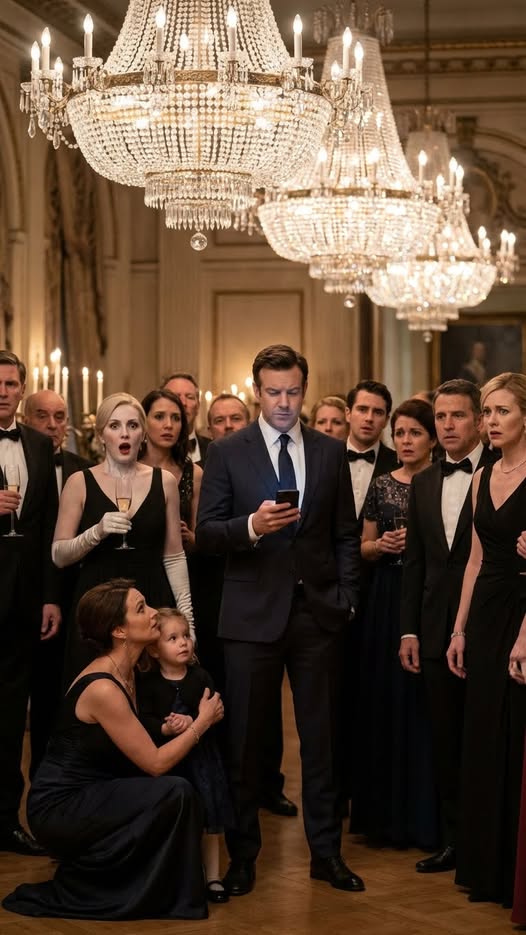
The crystal chandeliers in my sister Victoria’s dining room caught the late afternoon light, splintering it into a thousand sharp, predatory shards. As I helped my daughter Emma adjust her dress, I couldn’t help but notice how the soft, breathable cotton looked against the backdrop of the room’s aggressive opulence. It was a simple piece we’d found at Target—clean, pressed, and vibrant. But in this house, surrounded by the swirling sea of designer labels, it might as well have been burlap.
“Mommy, do I look okay?” Emma whispered. She tugged at her collar, her voice small and uncertain. This wasn’t the daughter I knew at home; the girl who climbed oak trees and sang at the top of her lungs was nowhere to be found. In this mausoleum of wealth, she was shrinking.
“You look beautiful, sweetheart,” I said, smoothing her hair. I meant it. Her natural beauty didn’t need the crutch of expensive fabric to shine, but I could feel the suffocating weight of the room pressing in on her.
My husband, Marcus, stood quietly by the entrance. He had his hands shoved into the pockets of his khaki slacks, looking as unbothered as a man could be. He wore a simple button-down shirt, no tie, and shoes that had seen their fair share of Saturday morning errands. In a room populated by Armani and Versace, we were clearly the budget option—the “charity cases” invited to fill the seats.
Victoria swept past us, the silk of her champagne-colored gown hissing against the marble floor. The dress likely cost more than our monthly mortgage and grocery bill combined. She air-kissed a couple behind us, her heels clicking a rhythmic, arrogant beat.
“Darling!” she trilled to a socialite. “So glad you could make it to our little gathering.”
Little gathering. There were at least sixty people here to celebrate her twenty-fifth anniversary with James. The catering staff alone outnumbered our entire extended family. I felt a familiar prickle of irritation. This wasn’t a party; it was a coronation.
My mother approached us, her expression a masterpiece of carefully curated neutrality. She had mastered that look over the decades—the one that suggested she was trying desperately not to compare her daughters, while doing exactly that in her head.
“Sarah, you made it,” she said. She didn’t say she was happy we were there. She simply acknowledged our presence, like a line item on an invoice.
“Of course, Mom. Twenty-five years is a big milestone for Victoria and James.”
“Yes. Well.” Mom glanced down at Emma. “The child looks… nice.”
Nice. The word hung in the air like a participation trophy. It was a verbal pat on the head, a subtle reminder that we were the “ordinary” ones.
My six-year-old, Tyler, was already at the dessert table, staring wide-eyed at a three-tiered display of delicacies. They were arranged like edible art—gold-leafed, intricate, and utterly alien to a boy who thought a Chips Ahoy was the pinnacle of culinary achievement.
“Can I have a cookie?” Tyler asked, reaching out.
Before I could answer, Victoria materialized beside him. “Those are imported macarons from a pâtisserie in Paris, Tyler. Not cookies.” She looked at me, her smile sharp enough to draw blood. “Perhaps the children would be more comfortable in the kitchen? The staff has some simpler options. You know… things they’re used to.”
I felt the heat rise in my neck. Marcus’s jaw tightened, a small muscle jumping in his cheek, but he remained silent.
“They’re fine here, Victoria,” I said quietly.
Her laugh was a tinkling, hollow sound. “Of course. How silly of me.”
She glided away, and as I watched her go, I felt a cold dread coiling in my gut. I had no idea that by the end of the evening, the foundation of this house—and my family—would be reduced to rubble.
The afternoon crawled forward with the agonizing slowness of a long-term illness. My father held court near the mahogany bar, discussing his latest real estate acquisitions with James and several other men who smelled of expensive cigars and old money. My brother, Daniel, and his wife, Stephanie, were huddled around an iPad, scrolling through photos of their recent Mediterranean cruise.
We stood near the floor-to-ceiling windows, observing the spectacle. We were always the observers, never the participants.
“Aunt Sarah!” My nephew Christopher, Daniel’s eldest, ran up to us. He was ten, the same age as Emma, and dressed in a miniature tailored suit. “Want to see my new watch? Dad got it in Switzerland. He says it costs more than a car.”
Emma looked down at her bare wrist, her face flushing. “That’s very nice, Christopher.”
“What did your dad get you?” he asked with the blunt, unintentional cruelty of a child raised in a bubble.
“A library card,” Emma said softly. “We go every Saturday. I’m on the waiting list for the new fantasy series.”
Christopher blinked, genuinely confused. “Oh. That’s free, right? My dad says free things are for people who can’t afford the good stuff.”
“Christopher! Come here!” Stephanie called out, her voice dripping with artificial sweetness. “Show the Hendersons your watch.”
He bounded away, and I felt Emma’s small hand slip into mine. Her palm was sweaty. I looked over at Marcus. He had retreated to a corner, scrolling through his phone with an unreadable expression. When our eyes met, he gave me a curt nod.
“Everything okay?” I mouthed.
He didn’t answer. He just looked back at his phone, his thumb moving rapidly over the screen.
Dinner was announced, and the seating chart was a final, public insult. We were placed at the far end of the long, linen-draped table, as far from the “main” family cluster as possible. We were the human equivalent of a footnote. The meal was a seven-course marathon of things I couldn’t pronounce, served on china that probably cost more than my first car.
“So, Sarah,” James called out from the head of the table. His voice was booming, designed to draw the attention of the entire room. “Still working at that little clinic downtown? Dealing with the… less fortunate?”
“I’m a Nurse Practitioner now, James,” I replied, keeping my voice steady. “And yes, I help people who actually need it.”
“How admirable,” Victoria interjected, her champagne flute catching the light. “So charitable of you to spend your life in such… gritty environments. Someone has to do the dirty work, I suppose.”
“I enjoy my work,” I said.
“Of course you do, dear,” Mom added, patting my hand condescendingly. “We’re all very proud of your little job.”
Marcus set his fork down. The sound of silver hitting porcelain was like a gunshot in the sudden silence of the room. He didn’t look up; he just stared at his plate, his fingers tapping a rhythmic pattern on the tablecloth.
As the dessert was served, Victoria made a suggestion that would change the course of our lives forever. “Why don’t the children go to the sunroom? They can play with Christopher’s new VR set. It’s much more fun than listening to us old people.”
Emma hesitated, her eyes searching mine for an exit strategy.
“Go on, sweetie,” I encouraged, trying to hide the knot forming in my stomach. “Tyler’s already in there. It’ll be fine.”
She walked away slowly, her Target dress swishing against the marble. I tried to focus on the conversation about hedge funds and offshore accounts, but my ears were tuned to the sound of children’s voices in the distance. Ten minutes later, the door to the sunroom creaked open.
Emma walked back into the living room. Her eyes were rimmed with red, her chest heaving with silent sobs. My heart shattered. I was on my feet before she even reached the rug.
“What happened? Emma, talk to me,” I urged, kneeling beside her.
“The other kids…” she started, her voice breaking. “They said… they said we don’t belong here. They told me my dress is from a ‘poor people’s store.’ They laughed at Tyler because he didn’t know what a VR headset was.”
Victoria appeared at my shoulder, followed by Stephanie and a gaggle of other women, all holding champagne flutes like scepters.
“Oh dear, is something wrong?” Victoria asked. Her tone was dripping with mock concern.
“Emma, what happened?” I asked again, ignoring my sister entirely.
“They called us ‘discount kids,’” Emma sobbed into my shoulder.
One of the women, a socialite named Amanda, whispered to another, “Well, the children aren’t exactly wrong, are họ?” She didn’t whisper quite quietly enough.
Victoria took a long sip of her champagne, her eyes cold. “Children can be so honest, can’t they? No filter. It’s just their way of noticing the world around them.”
I stood up, my hand resting firmly on Emma’s shoulder. I could feel her shaking. “They learned that honesty from somewhere, Victoria,” I said, my voice dangerously level.
“Oh, don’t be so dramatic, Sarah,” Victoria snapped, her façade finally slipping. “Kids notice differences. It’s natural. Your children show up here in clearance-rack clothing while my son is dressed for success. Some families prioritize different things. You’ve chosen a… modest lifestyle. There’s no need to be ashamed of it.”
“There is nothing wrong with how we live,” I said.
“Of course not.” Victoria’s voice was honey-sweet now, which was even worse. “Discount stores serve a very important purpose for people like you. Where would the lower class shop without them? Someone has to keep Target in business, right?”
The women behind her snickered—polite, tinkling laughs that made my skin crawl. Emma’s tears were falling silently now, dignified tears that broke my heart into a million pieces.
“Victoria, that’s enough,” I said.
“I’m simply being honest, Sarah! I love you, you’re my sister, but let’s stop pretending. You show up to family events looking like you’re dressed for a garage sale, and you expect your kids to fit in with… all of this?” She gestured grandly around the room, her hand sweeping over the gold leaf and the marble. “Maybe it’s time to acknowledge that not everyone belongs everywhere.”
The room had gone deathly quiet. Every guest, every family member, was watching.
“There’s no room for your discount-store kids at this party, Sarah,” Victoria said, smiling that sharp, shark-like smile. “Perhaps next time, a more… age-appropriate gathering would be better. Chuck E. Cheese, maybe?”
Emma’s face crumpled, and the room began to blur through my own rising tears. But then, Marcus stood up. He hadn’t said a word all night, but as he stepped into the light of the chandelier, the air in the room seemed to vanish.
Marcus had been sitting by the fireplace, so still I’d almost forgotten he was there. He held his phone in one hand, his thumb hovering over the screen.
“Marcus,” I whispered, not knowing what he was about to do.
He didn’t look at me. He looked at Victoria, then at James, then at the room full of people who had spent the evening treating us like dirt under their polished heels. Then, he raised the phone to his ear.
“David? It’s Marcus Williams. Yes, I know it’s Saturday. I need you to pull the property file for 2847 Riverside Boulevard.”
The name of the address hung in the air. Victoria’s smile faltered.
“Yes, this one,” Marcus continued, his voice calm, professional, and terrifyingly cold. “I need the documentation sent to my email within the hour. The complete ownership records. All of them.”
He paused, listening. “Perfect. Also, I need you to contact the property management company. Effective immediately, I’m implementing a full review of all current lease agreements. Yes, all of them. Starting with the primary residence.”
He ended the call and tucked the phone into his pocket. He turned to face the room. He didn’t look like a man in a department store shirt anymore. He looked like the sun, and everyone else was just a shadow.
“This house,” Marcus said, gesturing to the ornate living room. “2847 Riverside Boulevard. Victorian architecture, six bedrooms, renovated in 2019. Estimated market value of $3.2 million.”
Victoria laughed nervously, though the sound was brittle. “Yes, Marcus. James and I worked very hard to afford this life. We’ve put our souls into this home.”
“You rent it,” Marcus said simply.
The champagne glass in Victoria’s hand stopped halfway to her lips. The silence in the room was so thick you could have carved it.
“I own it,” Marcus continued. “I own this house. I own the property management company that processes your lease payments every month. I’ve owned this entire block since 2018, two years before you even moved in.”
The color drained from Victoria’s face so fast it was like a curtain falling. James stepped forward, his face a mottled purple. “That’s… that’s not possible. We deal with MW Property Holdings.”
Marcus pulled out his phone again, tapped the screen, and turned it around for the room to see. It was a digital copy of a lease agreement. “Lease agreement signed by James Hartford and Victoria Hartford. Monthly rent: $12,000. Landlord: MW Property Holdings. MW. Marcus Williams.”
My father set his drink down on a priceless side table, his hand shaking. “Sarah… you never mentioned… Marcus, you’re just a…”
“A what, Arthur?” Marcus asked, his voice perfectly even. “A guy who works a ‘little job’? I’ve been quiet about my business because Sarah preferred it that way. She wanted her family to love her for who she is, not what we own. She wanted our kids to grow up with a sense of reality, not the hollow vanity I’ve seen in this room tonight.”
He paused, letting the weight of the revelation sink in. The sixty guests were frozen, realizing they were celebrating in a mansion owned by the man they’d spent the last four hours mocking.
“The law firm that handled your lease?” Marcus asked James. “The inspection company that approved your ‘soulful’ renovations? I own those, too. Every upgrade you’ve made to this property passed through companies I control.”
He walked over to Emma andTyler, placing a protective hand on each of their shoulders. “But apparently, being ‘normal’ means watching my daughter cry because she’s wearing a Target dress in a house that I pay the taxes on.”
Victoria’s hand was shaking so violently that the champagne was sloshing over the rim of the glass. “Why would you hide this?” she whispered, her voice cracking. “Why would you let us think…”
“Think what?” Marcus challenged. “That you were better than us? That your designer clothes and macarons made you superior human beings?” He looked down at Emma. “She’s ten years old, Victoria. She didn’t choose ‘discount stores.’ We did. We’d rather invest in her future, her education, and her brother’s college fund than in Italian leather and French cookies.”
Stephanie had gone pale, her iPad forgotten on the sofa. Daniel looked like he’d been slapped across the face. My mother sank into a velvet armchair, looking suddenly very old and very small.
“Sarah,” Mom said, her voice trembling. “You never said. Why didn’t you tell us?”
“Because you never asked, Mom,” I said quietly. “You just assumed. You saw a nurse’s uniform and a Target dress and you decided exactly what we were worth. You’ve spent five years treating us like charity cases, and tonight, you let your grandchildren be bullied in their own father’s house.”
Marcus knelt down to Emma’s level. “Hey, kiddo. That dress? Your mom and I picked it because you love the color. You said it made you feel like a princess. Remember?”
Emma nodded, wiping a stray tear from her cheek.
“You are a princess,” Marcus said, his voice loud enough for everyone to hear. “And don’t you ever let anyone with a rented life tell you otherwise.”
He stood up and looked back at Victoria and James. The temperature in the room seemed to drop twenty degrees.
“Your lease is up for renewal in three months,” Marcus said. “It’s a standard agreement, with one very important clause. Renewal is at the sole discretion of the landlord.”
James had gone gray. “Marcus, please. The business expansion… we’ve tied up all our capital. We can’t afford to move right now. The market is…”
“Perhaps you should have considered your financial stability before mocking my children for theirs,” Marcus interrupted. His voice was pure ice. “Sarah wanted to come today. She wanted her kids to know their family. She wanted them to feel connected to you.”
He looked around the room at the frozen, horrified faces of the guests. “Instead, you taught them that cruelty comes in expensive packaging.”
Victoria began to sob, the champagne glass finally slipping from her fingers and shattering on the marble. The sound echoed like a bell through the silent house. “Marcus, please. This is our home. Our life.”
“It’s a rental property,” Marcus said. “And I’ll be reviewing your file. I’ll let you know my decision regarding your renewal in thirty days. If I decide not to renew, you’ll have sixty days to vacate. I’m sure you can find something more… ‘age-appropriate’ for your budget.”
My father finally found his voice. “Now, Marcus, let’s not be hasty. Victoria made a mistake, but family is family…” Marcus didn’t even let him finish.
“Family is the people who protect you, Arthur,” Marcus said. “Not the people who humiliate you for sport.”
He turned to me. “Are we ready to go?”
I looked at Emma, whose tears had stopped, replaced by a look of sheer, quiet awe as she stared at her father. I looked at Tyler, who was peeking from behind the sunroom door, sensing that the power in the room had shifted irrevocably.
“Yes,” I said. “We’re ready.”
“Sarah!” Mom called out, reaching a hand toward me as we moved toward the door. “Don’t leave like this. We can fix this. We can talk.”
I turned back one last time. “Fix what, Mom? The fact that you only care about us now because you know Marcus has more money than James? The fact that your love has a price tag? That ends today.”
We walked out of the house and into the cool, clean night air. The silence behind us was deafening. It was the sound of a sixty-person party suddenly realizing they were standing on hollow ground.
As we reached the car, the evening air felt like a benediction. I buckled Tyler into his seat, and Marcus helped Emma.
“Dad?” Emma asked as we pulled out of the cobblestone driveway. “Are they really going to have to move?”
Marcus glanced at her in the rearview mirror. “Maybe. Maybe not. That’s a business decision. But they’ll never speak to you that way again. That’s a promise.”
“Will we ever see them again?” Tyler asked.
I took Marcus’s hand across the center console. “I don’t know, babies. But I know this: Wherever we go, whatever we do, we are enough. Just as we are.”
The drive home was quiet, but it was a different kind of quiet than the one we’d endured all afternoon. It was peaceful. It was the silence of a burden finally being lifted.
“Dad?” Emma spoke up again. “If you own all those houses… why do we still shop at Target?”
Marcus smiled, a real, warm smile that reached his eyes. “Because Target has everything we need, kiddo. And we’d rather save our money for experiences than for things. Remember our camping trip last summer? Waking up by the lake?”
“That was the best!” Tyler shouted.
“Better than a Swiss watch?” Marcus teased.
“Way better!” Emma laughed, her tears finally dry.
As we pulled onto our own modest street, my phone began to buzz. It was a text from Daniel. Then Stephanie. Then Mom. I looked at the screen, then turned it off and tucked it into my purse. I didn’t need to hear their apologies. I already had everything I needed.
Inside our house—the one we actually owned, the one filled with books and scratched furniture and love—I tucked the kids into bed. Emma hugged me tighter than usual.
“I like my dress, Mom,” she whispered. “The color is my favorite.”
“I like it too, sweetie. Sleep well.”
I went downstairs to find Marcus in the kitchen, pouring two glasses of water. He looked at me, the intensity of the evening still lingering in his eyes.
“You okay?” he asked.
“I will be,” I said. “I’m just… I’m sorry you had to do that. I know you wanted to keep things quiet.”
“I didn’t do it because of the money, Sarah,” he said, stepping closer and taking my hands. “I did it because they were destroying our daughter’s spirit. I can buy a hundred houses, but I can’t buy back the years she would have spent feeling ‘less than’ because of them.”
I leaned my head against his chest. For the first time in five years, I didn’t feel like the “poor sister.” I didn’t feel like the nurse who struggled while the rest of the family thrived. I felt like a woman who had chosen the right partner—a man who understood that true wealth isn’t measured in marble floors, but in the quiet strength of knowing exactly who you are.
“What are you going to do about the lease?” I asked.
Marcus looked out the kitchen window at the dark trees of our backyard. “James is overleveraged. He’s been using his lifestyle to hide the fact that his firm is failing. If I don’t renew, they’re finished. They’ll have to downsize significantly.”
“And?”
“And I’m going to give them thirty days to show me they can be decent human beings,” he said. “If they can’t… then I’ll find a tenant who actually appreciates the property. Someone who knows that a house is just a building, but a home is something you earn.”
My phone buzzed again on the counter. It was another message from Victoria. Sarah, please. James is having a panic attack. Tell Marcus we didn’t mean it. We were just joking. Please.
I didn’t reply. Some things can’t be fixed with a text message. And some lessons are only learned when the lights go out.
I realized then that my children had seen the most important thing of all: their worth wasn’t determined by a price tag or a champagne party. It was determined by dignity, respect, and the courage to stand up when the world tries to make you small.
We were enough. Just as we were.
As Marcus turned off the kitchen light, I looked back at the shadow of our hallway. The standard lease agreement was more than just a legal document; it was the chronicle of my silent coup. And for the first time in my life, I was the one who held the key.