Every Christmas Eve, the air in our apartment transformed, filled with the rich, comforting scents of honey-glazed ham, buttery mashed potatoes, and fresh cornbread. My mother didn’t just cook for us, though. Every year, she carefully foil-wrapped an extra plate as if it were a sacred relic. When I was small, I’d ask who it was for, and she’d simply say, “Someone who needs it, baby.”
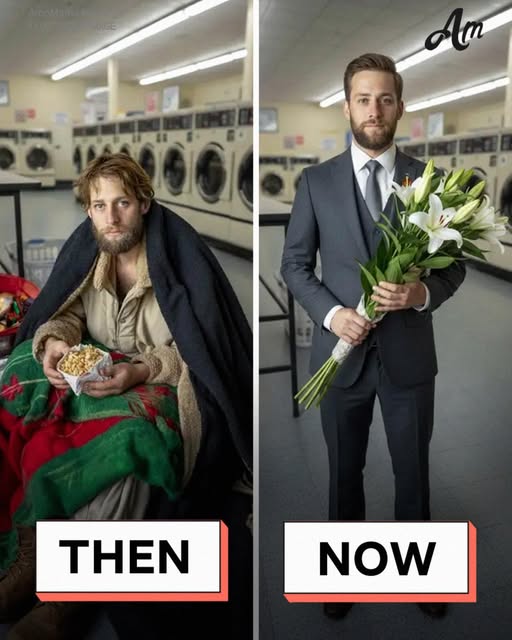
That someone was Eli. He lived in the corner of a 24-hour laundromat at the end of our street, a thin man in a tattered hoodie who carried his life in a plastic bag. He was invisible to most of the town, but not to my mother. Every year, she would kneel beside him, offer the meal, and exchange a few steady words. When I once asked if he was dangerous, she taught me a lesson I’d never forget: “Dangerous is a hungry person the world forgot. Not a man who says thank you.”
Over time, Eli’s story trickled out. He had aged out of foster care with a younger sister, only to lose her in a car crash. He was a man hollowed out by grief and pride, refusing offers of housing because he’d “rather freeze than owe anyone.” My mother didn’t push; she just kept showing up with hot food, thick socks, and kindness that demanded nothing in return.
Then, the world grew darker. Cancer took my mother in less than a year. By December, I was a ghost of myself, navigating a blurry landscape of grief and anger. On Christmas Eve, standing in her kitchen, I heard her voice: “It’s for someone who needs it.” Driven by a sudden, stubborn duty, I prepared a meal—chicken, instant potatoes, and canned beans—and drove to that flickering laundromat.
I expected to find the man in the tattered hoodie. Instead, I found a man in a crisp, dark suit standing tall by the dryers, holding a bouquet of white lilies. It was Eli. The transformation was so total I nearly dropped the bag. “You came,” he whispered, his eyes filling with tears.
As we sat on the hard plastic chairs, the truth my mother had kept finally surfaced. Eli explained that he wasn’t just a stranger she chose to help. Years ago, when I was a toddler, I had wandered away from my mother at a crowded county fair. Panicked and crying, I had run straight to Eli. He didn’t snatch me; he held my hand and walked me directly to a security guard. When my mother found us, she didn’t see a “dangerous” drifter; she saw the man who saved her daughter.
She found him a week later at the laundromat and started a quiet, decade-long mission to save him back. She didn’t just feed him; she listened. She told him about my life—my driver’s test, my college graduation, my first job—treating him like the family he had lost. More importantly, she connected him with job training and counseling. The suit he wore was a promise he’d made to her: that if he ever made it, he’d show her he was okay.
“She asked me one more thing,” Eli said as we stood by her grave later that night. “She asked if I’d look out for you. To be the brother you never had.”
Standing in the cold cemetery grass, I realized my mother’s final gift wasn’t just for Eli. She knew I would be alone, and she had spent years carefully cultivating a guardian for me. She taught me that love doesn’t end at the grave; it finds a way to keep showing up. That night, I didn’t just give a meal to a stranger; I found a brother. We ate together in my quiet apartment, and for the first time since her passing, the world didn’t feel quite so heavy.