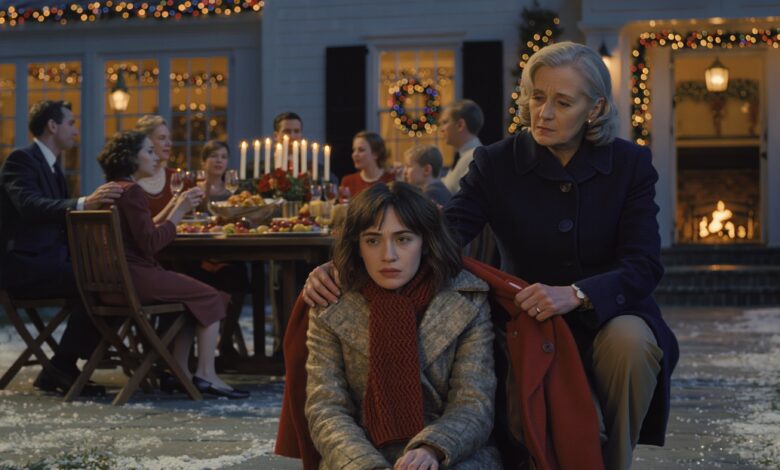
The year my daughter Clare married into the Whitmore family, I told myself to back off. Respect boundaries. Trust her choices. Steven came from money and polish—old Boston names etched into buildings, invitations to fundraisers, a family estate that looked like something out of a magazine. I didn’t like any of it, but Clare was thirty-two, confident, brilliant, and convinced she’d found stability after years as a hard-charging investigative journalist. So I swallowed my discomfort, smiled at the wedding, and said nothing when she moved into their estate instead of starting a life on her own terms.
But by that Christmas, everything felt wrong.
The calls stopped. The visits slowed to nothing. The outspoken daughter who used to challenge senators and CEOs had become restrained, checking with her husband before answering basic questions. The final shove came three days before Christmas—an icy text from Steven, sent from his phone:
“Clare is committed to Whitmore family traditions this year. You may visit after the holidays if our schedule permits.”
Our schedule permits.
I didn’t bother replying. I grabbed my keys, braved a brutal snowstorm, and drove to that estate.
The gates were open, the mansion glowing warm and bright against the dark. I was about to park when I spotted a figure slumped on the walkway, half-buried in snow.
My heart dropped.
It was Clare.
Bare shoulders. Cocktail dress. No coat. Skin blue with cold.
I sprinted across the ice.
“Clare! Honey—what on earth—”
She looked up slowly, as if waking from a trance. “Mom? How…did you get here?”
I wrapped my coat around her shaking body. “How long have you been outside?”
“I don’t know. An hour. Maybe two.”
Two hours. In that weather.
“Why?”
Her eyes flicked toward the glowing windows. The sound of laughter drifted out—glasses clinking, a fire crackling.
“I questioned Douglas about a development project,” she whispered. “He didn’t like my tone. Steven said I needed to ‘reflect on my place in this family’ before coming back in.”
I stared at her, horror turning sharp and focused.
Through the window, I could see them—laughing, drinking, celebrating Christmas—while she froze outside like a disobedient pet.
“You could have died,” I said.
“That’s their way,” she murmured, barely audible. “I shouldn’t have spoken out of turn.”
No. Absolutely not.
“Come on,” I said, pulling her up. “We’re going inside.”
She faltered. “Steven will be furious.”
“I don’t care if the entire Whitmore clan bursts into flames,” I said. “You’re not dying on this walkway.”
Inside, the room fell silent. Seven people stared as I guided my trembling daughter toward the fire.
Steven’s mask of concern slid neatly into place. “Darling, I was just about to check on you.”
I cut him off. “She has hypothermia. She needs blankets and possibly medical attention.”
Douglas rose from his leather chair with the icy authority of a man used to obedience.
“Pauline,” he said. “This intrusion is inappropriate. Clare understands consequences for disrespect in this household.”
“Consequences?” I repeated. “She was left outside in a snowstorm.”
Steven stepped in. “Mom, you don’t understand our family dynamics—”
“No,” I snapped. “I understand perfectly.”
I took a deep breath. Five words. That’s all it took.
“I know about Project Prometheus.”
The room detonated into silence.
Douglas went ash white. Steven froze mid-step. Two of the brothers exchanged panicked looks. Even the usually blank-faced Whitmore wives reacted—eyes wide, hands tightening around champagne flutes.
Project Prometheus. Their buried financial skeleton—the offshore accounts, the bribery laundering, the deals built on the eviction of low-income families. I’d uncovered it years ago while quietly researching the people my daughter was marrying.
I’d hoped I’d never have to use it.
“You’re coming with me,” I told Clare. “Right now.”
No one stopped us.
Back at the hotel, under blankets and warm light, Clare finally cried—soft, exhausted tears that broke my heart.
“How long?” I asked her gently. “How long has this been happening?”
“At first it was subtle,” she said. “Comments about my friends being a bad influence. Encouraging me to scale back work. Saying journalism was too stressful for a wife. Then required dinners. Required opinions. Required silence.”
She looked at her hands.
“By year three, I wasn’t working anymore. By year four, I wasn’t speaking up. By last night…I think I forgot who I was.”
“You didn’t forget,” I said. “You were pushed.”
The next morning, after rest and warmth, clarity started to return to her face. She wasn’t the broken woman I found in the snow—she was waking up.
We called a lawyer. We filed immediately for a protective order and an emergency separation. We gathered evidence. We prepared for war.
The Whitmores retaliated instantly—claiming Clare was unstable, that I manipulated her, that she was experiencing a “psychotic break.” They filed for guardianship of her.
It backfired spectacularly.
Police wellness checks found her rational, coherent, and terrified of returning home. A forensic psychiatrist cleared her completely. Our lawyer documented every controlling behavior the family had inflicted on her.
And then came the final nail.
The journal Clare had secretly kept—the one they hadn’t found—containing years of small entries describing:
Isolation.
Punishment.
Manipulation.
Rules she was required to obey.
Patterns consistent with coercive control.
When she read from it aloud in the attorney’s office, she looked up at me through tears—but this time, they weren’t fear. They were recognition.
“This wasn’t love,” she said. “It was training.”
We both knew then: she’d never return.
Two weeks later, a judge granted Clare full protection under the law. The Whitmores backed down faster than expected—not because they’d grown a conscience, but because they realized we had the leverage to burn their carefully curated empire to the ground.
Our attorney negotiated a clean, immediate divorce.
No alimony requests. No property fights. No claw-backs.
They just wanted us quiet.
Clare didn’t want their money anyway.
She wanted herself back.
This Christmas, my daughter sits beside me, warm, safe, and free. She’s slowly reconnecting with friends, reading again, smiling again. Her voice—the one they tried to silence—is returning.
And the Whitmores?
They don’t speak her name anymore.
Because the moment she stepped out of that house, their power over her evaporated.
And the night I carried her in from the cold, wrapped my coat around her shoulders, and said those five words—
“I know about Project Prometheus.”
—was the night their empire cracked.