The transition from a newlywed glow to the harsh reality of domestic interference can be jarring, but nothing could have prepared me for the calculated audacity of my mother-in-law, Patricia. From the moment Elliot and I began dating, Patricia had treated me with the clinical detachment of a museum curator inspecting a counterfeit artifact. Her smiles were rehearsed, never quite reaching her eyes, and her physical affection was limited to a one-armed hug that felt more like a structural assessment than a greeting. To Patricia, I was not the woman who loved her son; I was an intruder who failed to meet a standard she had never bothered to define.
Her criticisms were a constant, low-frequency hum in our lives. Whether she was critiquing the way I loaded the dishwasher or questioning the nutritional value of the lunches I packed for Elliot, her goal was clear: to establish herself as the ultimate authority on domestic virtue. Elliot, a man who viewed conflict as a personal failure, chose the path of least resistance. “She means well,” he would say, or “That’s just how she is,” effectively leaving me to navigate the minefield of her expectations alone. I told myself that marriage was built on compromise, but I didn’t realize that in our house, the compromise was always mine to make.
The breaking point arrived the day after we returned from our honeymoon. I was still surrounded by the scent of tropical air and the warmth of a new life when the doorbell rang. Patricia stood there, accompanied by a stern, impeccably groomed woman named Marianne. With a triumphant flourish, Patricia announced that she had gifted me a two-week intensive course on how to be an “ideal wife.”
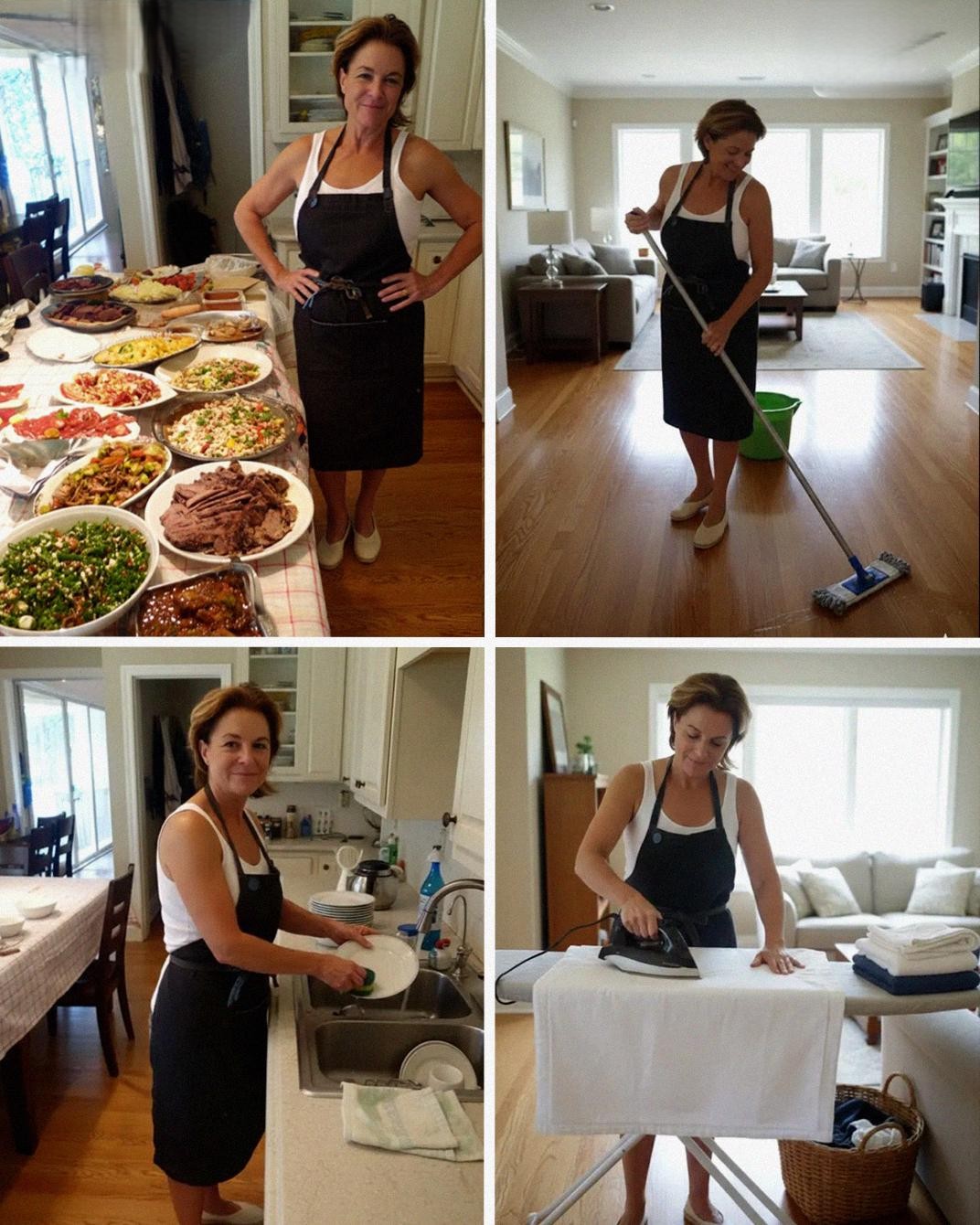
Marianne was a professional domestic trainer, a woman whose entire existence was dedicated to a performative, antiquated version of womanhood. She presented me with a color-coded binder that dictated my life from 5 a.m. until 9 p.m. The schedule was a suffocating list of mandatory exercises “to stay attractive,” polishing the kitchen until it shone, and preparing multi-course meals that felt more like a tribute than a dinner. When I pointed out that I had a career and a life of my own, the response was chillingly uniform. “A good wife makes her home her priority,” Marianne chirped. Elliot, ever the appeaser, suggested I might “learn something useful.”
It was in that moment of profound betrayal by both my mother-in-law and my husband that a cold, sharp clarity settled over me. I realized that if I fought them with words, I would be labeled as hysterical or ungrateful. If I wanted to dismantle this farce, I had to play the part to its inevitable, disastrous conclusion. I smiled, accepted the binder, and began the charade.
Over the next few days, I executed a masterclass in weaponized incompetence. I followed the schedule with meticulous, intentional failure. I slightly undercooked the mandatory omelets; I left “accidental” dust on the windowsills; I prepared dinners that were technically correct but emotionally vacant. Every mistake was a lure, designed to bring Patricia and Marianne closer to the center of the trap. As expected, Patricia’s visits became more frequent and her criticisms more vitriolic. She hovered like a supervisor at a failing factory, demanding to know why the toaster wasn’t polished to a mirror finish.
As I played the role of the struggling student, I noticed a fundamental flaw in Patricia’s armor: she never actually did anything herself. She was a general who had never seen the front lines. One afternoon, when she complained that my soup was bland, I stepped aside and offered her the ladle. “If I’m failing so miserably, please, show me the Sterling standard,” I said softly.
The result was a comedy of errors. Patricia, forced into the role she so aggressively policed, was helpless. She didn’t know how to operate our stove, nearly setting a dishcloth on fire before realizing she had turned on the wrong burner. She spilled salt in a frantic attempt to season the broth and then snapped at me to clean it up. Marianne watched in stunned silence as the woman who had commissioned this “ideal wife” course struggled to perform the most basic tasks of a kitchen. I realized then that Patricia had lived her entire life behind a veil of hired help; her expertise was entirely theoretical.
The finale of my plan took place at the end of the week. I knew Elliot was coming home early, so I staged a session with Marianne and Patricia that I knew would trigger a confrontation. I intentionally fumbled with the vacuum cleaner, prompting Patricia to snatch it from my hands in a fit of pique. She couldn’t find the power switch, her face turning a deep, embarrassed crimson as she complained that the models were “constantly changing.”
When Elliot walked in, he saw his mother struggling with a vacuum and me standing quietly by. He saw the frustration on her face and the exhaustion on mine. Sensing her authority slipping, Patricia pivoted to a full-scale character assassination. She called me lazy, ungrateful, and “unfit” to be a wife. She looked her son in the eye and told him he deserved better—someone who knew her “role.”
I didn’t argue. Instead, I reached into my bag and pulled out my phone. I had recorded every session with Marianne under the guise of “personal review for self-improvement.” I pressed play. Patricia’s voice filled the room, sounding far more malicious in the quiet of our living room than it had in the heat of the moment. Elliot heard her disdain for my career, her lack of respect for my character, and her admission that she was embarrassed for him because of me.
The silence that followed the recording was the most powerful thing I had ever felt. Patricia tried to claim the clips were “taken out of context,” but the evidence was undeniable. I turned to Elliot and asked him a single question: “Is this the foundation of the life you want us to build?”
For the first time in our relationship, Elliot didn’t look at the floor. He looked at his mother and saw her not as a benevolent matriarch, but as a saboteur. He finally found the voice he had been lacking. He admitted he had been a coward for allowing her to treat me like a project rather than a partner. He told his mother she had crossed a line that could not be uncrossed.
Patricia left that night, trailing a silent and defeated Marianne behind her. The fallout was significant, but the recovery was more so. A week later, a fruit basket arrived with a note that was as close to an apology as Patricia was capable of—a confession that she was afraid of losing her son and promised to “do better.”
We didn’t need the basket, and we didn’t necessarily believe the promise, but the dynamic had shifted forever. Elliot finally understood that “staying out of it” was actually a form of taking sides. Our marriage survived not because I learned to cook a better omelet or stay “attractive” at 5 a.m., but because I refused to be diminished by someone else’s insecurity. I taught my mother-in-law that I was never the one who needed fixing, and in the process, I taught my husband how to be a partner. Life isn’t perfect, but it is finally ours.