At first, it didn’t seem like a big deal.
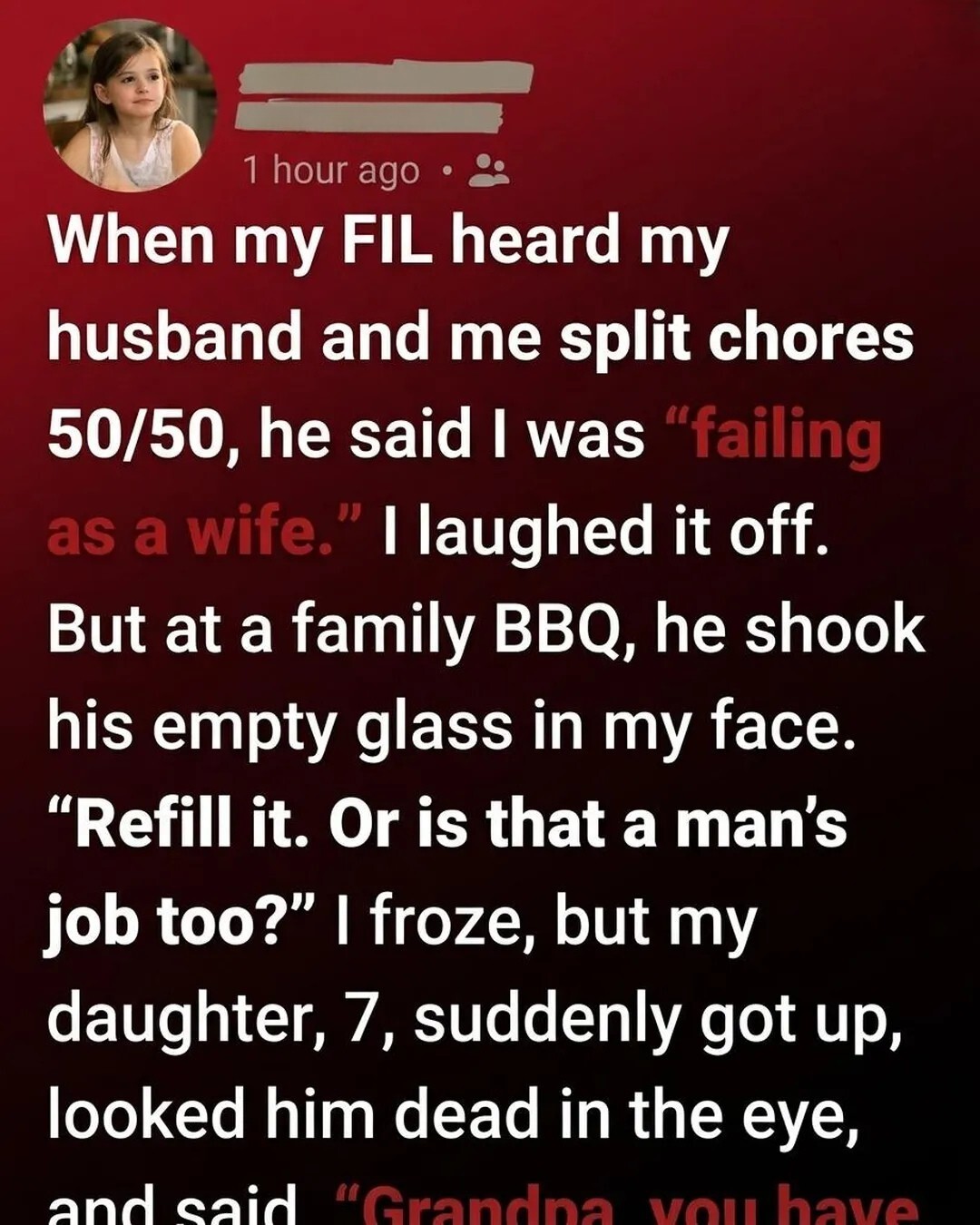
When my father-in-law found out that my husband and I shared responsibilities at home—cooking, cleaning, raising our daughter together—he let out a short laugh and shook his head. Then he said it, casually, like it was nothing:
“Well, sounds like you’re failing as a wife.”
I didn’t react. Not really.
I smiled politely, shrugged it off, and let the conversation move on. I’ve learned over time that not every comment deserves a response. Some things are better ignored, especially when they come from people set in their ways.
Still, the words didn’t disappear.
They lingered.
Not loudly, not aggressively—just quietly sitting in the back of my mind, like something unfinished. I told myself it didn’t matter. That what we had in our home worked for us. That partnership wasn’t weakness—it was strength.
And it was.
My husband and I had built something that felt balanced and real. We didn’t divide life into “his job” and “my job.” We just showed up for each other. Some days he cooked, some days I did. Some days I handled everything, and other days he stepped in without being asked. That was our normal.
And it worked.
A week later, we went to a family barbecue.
It was one of those warm afternoons where everything feels easy on the surface. The smell of grilled food hung in the air, people laughed, kids ran around the yard, and conversations drifted from one topic to another. I told myself to relax. To enjoy the moment. To leave that earlier comment where it belonged—in the past.
For a while, it worked.
I stayed present, smiling, chatting, keeping things light. I didn’t overthink anything. I didn’t look for tension.
But then it happened again.
In the middle of a casual conversation, my father-in-law walked over and stopped right in front of me. He held out his empty glass, not aggressively—but not kindly either. There was a half-smile on his face, the kind that doesn’t quite reach the eyes.
“Refill it,” he said. Then he added, just loud enough for others to hear, “Or is that a man’s job too?”
The air shifted instantly.
It wasn’t loud, but it was enough.
Conversations slowed. A few people went quiet. Others pretended not to notice, but you could feel it—that subtle pause when everyone becomes aware that something uncomfortable just entered the room.
I felt it too.
For a second, I didn’t move.
Not because I didn’t know what to say—but because I was deciding if it was worth saying anything at all. I’ve always believed that peace is more valuable than pride. That not every moment needs to turn into a confrontation.
But this felt different.
Not just because of what he said—but because of where he said it. In front of everyone. Like a quiet challenge.
I opened my mouth to respond.
And then I heard it.
The soft scrape of a chair against the ground.
It wasn’t loud, but it cut through everything.
I turned slightly—and saw my daughter standing up.
She’s seven.
Small. Quiet most of the time. Observant in ways that catch you off guard when you least expect it.
She stepped forward just enough to be seen, her face calm, her posture steady. There was no hesitation in her eyes.
She looked directly at her grandfather.
“Grandpa,” she said, her voice clear and steady, “in our house, everyone helps. That’s what makes it fair.”
That was it.
No anger. No attitude. No raised voice.
Just truth.
Simple, honest, and completely unfiltered.
The kind of honesty only a child can deliver—the kind that doesn’t try to win, doesn’t try to argue, doesn’t try to prove anything.
Just says what is.
And suddenly… everything stopped.
Not the kind of silence that feels tense or uncomfortable.
Something different.
Something heavier—but not in a bad way.
Thoughtful.
My father-in-law’s hand lowered slightly, the glass still in it. His expression shifted—not dramatically, not in a way that would draw attention—but enough.
Enough to notice.
Enough to feel.
No one laughed.
No one jumped in to defend him or challenge her.
For once, there was no need.
The moment spoke for itself.
After a few seconds, conversations slowly started again—but softer. More careful. Like something had changed, even if no one said it out loud.
He didn’t bring it up again.
He didn’t push back.
He just stepped away.
The afternoon carried on, but it felt different after that. Not awkward. Just… quieter. Like everyone had taken a step back to think about something they hadn’t expected to think about.
Later that evening, as we walked home, the sky beginning to fade into soft shades of evening, I reached for my daughter’s hand.
And I held it a little tighter than usual.
She walked beside me like nothing unusual had happened. Like she hadn’t just said something that shifted an entire room.
Kids don’t always realize the weight of their words.
And sometimes, that’s exactly what makes them so powerful.
I looked down at her and smiled.
Not because she “defended” me.
Not because she “stood up” to someone.
But because she reflected something deeper.
She reflected what she had learned.
What she had seen every day in our home.
Partnership.
Respect.
Fairness.
Not as ideas—but as something real. Something lived.
That’s when it hit me.
We weren’t just building a life that worked for us.
We were shaping how she understood the world.
And in that moment, she showed us that she got it.
Not in a loud, dramatic way.
But in the quietest, strongest way possible.
And honestly?
That mattered more than anything anyone else at that table could have said.