My name is Briar. I’m twenty-eight years old, and until recently, I believed that Valentine’s Day was the absolute nadir of my existence. It wasn’t just the suffocating scent of overpriced roses or the cloying sight of heart-shaped butter pats at a candlelit table; it was the realization that my life was being dismantled over a plate of cooling pasta.
I am an EMT student. It isn’t just a career choice for me; it’s a vocation, the first thing I’ve pursued with a singular, burning passion. To ensure I could give the course my full attention, I had quit my job at the urging of my boyfriend, Jace. He had been insistent, almost heroic about it. “Focus on the certification, Briar,” he’d told me. “I’ll handle the rent. Two months, and you’re a professional.” I’d hesitated, worried about the vulnerability of being financially dependent, but he had smoothed over my fears with promises of a shared future.
That future evaporated halfway through our Valentine’s dinner. Jace, after nursing half a bottle of wine with a frantic energy, set his fork down and looked at me with the kind of calm that precedes a storm. He told me he “wasn’t excited” anymore. Four years of partnership, shared dreams, and mutual sacrifices were reduced to a lack of thrill. Worse, he chose to drop this bombshell after convincing me to abandon my financial safety net. When I reminded him that he had begged me to quit my job, he simply shrugged. “I didn’t force you,” he said.
I didn’t stay to argue. I stood up, grabbed my coat, and walked out of that restaurant, leaving him with the bill and the ruins of our relationship. The cold February air hit me with a brutal clarity. I couldn’t go back to our apartment—our home was now a crime scene of broken promises—so I just walked. I walked to keep from drowning in the reality that I had sixty days left of school, zero income, and no place to live.
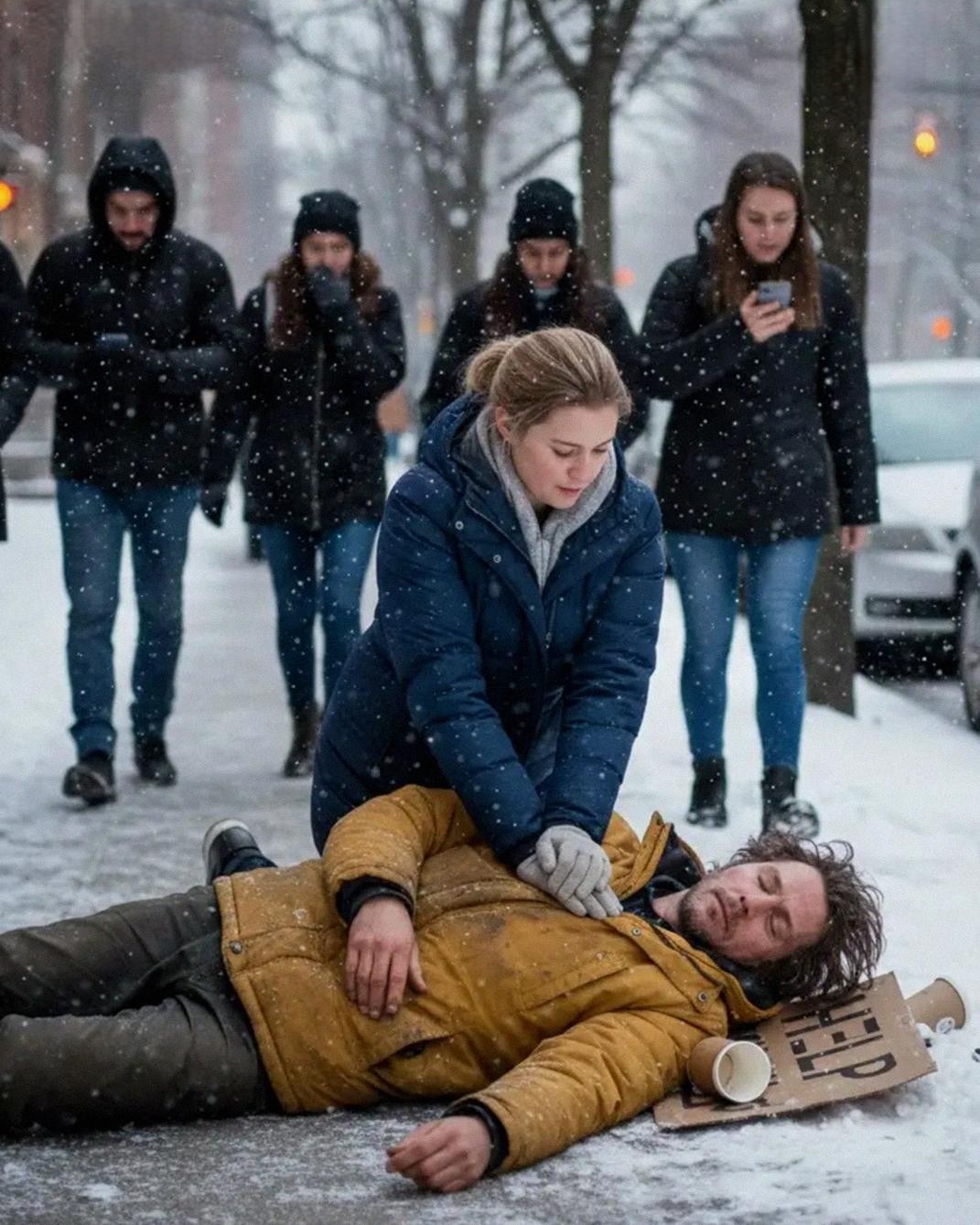
I was halfway down a dimly lit block when a sound cut through the noise of the city—a wet, desperate wheeze coming from an alleyway between a boutique and a dive bar. I saw a man crumpled near a dumpster, his body locked in the throes of a convulsion. People stood at the mouth of the alley, hovering like ghosts. A woman covered her nose, complaining about the smell; a man in a blazer warned others not to touch him, suggesting he was “dangerous” or “on something.”
Compassion, it seemed, was more threatening to them than the prospect of a man dying in the dirt.
“Call 911!” I screamed, dropping to my knees beside him. My training took over, a cold, clinical switch flipping in my brain. I checked for responsiveness and found nothing. His breathing was agonal, his pulse a flickering shadow, and his lips were tinged with a terrifying shade of blue. I laced my fingers and began compressions—hard, fast, and rhythmic. I counted out loud, my voice a rhythmic chant against the indifference of the onlookers. Sweat froze on my brow, and my arms burned with an agonizing fire, but I didn’t stop. I couldn’t let death win in this alley.
When the sirens finally wailed into the street, a paramedic dropped beside me. I panted out a report—no effective breathing, weak pulse, cyanosis—and stumbled back, my hands shaking uncontrollably. They lifted the man onto a stretcher, and as they did, his eyes fluttered open. He looked directly at me, a moment of profound, tethered connection. He rasped a single word: “Marker.”
Someone handed me a felt-tip pen. He grabbed my wrist with surprising strength and whispered, “Your name. Write it. So I don’t forget.” I wrote BRIAR in bold letters on the pale skin of his inner wrist. Then the ambulance doors slammed shut, and he was gone.
I spent the rest of the night in a haze of tears and exhaustion, grieving for Jace and for the state of a world where people would rather watch a man die than ruin a suit. The next morning, a persistent, heavy knock at my door pulled me from a fitful sleep. When I opened it, I found a black limousine idling at the curb. Standing there, looking impeccably groomed and entirely alive, was the man from the alley.
“I’m Murray,” he said, offering a small, humble smile.
I was skeptical. “Murray from the dumpster?”
He winced. “Yes. Can I explain?”
Murray told me a story that sounded like a modern fable. He was an heir to a massive family estate, a man who had more resources than he knew how to manage. His last living parent had passed away the previous week, and in the fog of his grief, he had landed in the city for the funeral and decided to walk a few blocks to his hotel. He was mugged, beaten, and left for dead. “One night,” he said quietly, “was enough for most people to decide I didn’t count. You were the only person who acted like a human being mattered.”
Murray didn’t offer me a reward; he offered me a job. He needed someone he could trust—someone who wasn’t impressed by his wealth and who possessed the moral compass to tell him when he was being misled by his legion of lawyers and advisors. He offered a salary that felt like a fortune, but I refused it on principle. I wouldn’t be “bought.” We settled on a fair wage and a written contract. I would serve as a part-time advisor and observer at his estate, provided it didn’t interfere with my EMT classes.
The following weeks were a whirlwind of transformation. I moved my things out of Jace’s apartment with a level of clinical efficiency that left him stunned. He tried to claim I was “using him,” a projection so transparent it almost made me laugh. I didn’t need him. I never did; I had just been kind enough to let him believe I did.
While I sat in mahogany-paneled boardrooms with Murray, asking uncomfortable questions of his accountants—”Why is this urgent? Who benefits from this speed?”—I spent my nights at the clinic and my afternoons buried in textbooks. Murray never made our arrangement feel like a debt. He provided the stability Jace had snatched away, acting as the bridge that allowed me to reach the other side of my ambition.
Two months later, I walked out of my final assessment with a certificate in my hand and the weight of the world off my shoulders. I had passed. I had done it without Jace’s money, without his “excitement,” and without compromising my dignity.
On my final trip to the old apartment to collect the last of my things, I ran into Jace in the lobby. He looked at me, perhaps expecting to see a woman broken by the struggle of the last sixty days. Instead, he saw someone forged in fire. He tried to jab at me one last time, suggesting I was the one who had been unfair. I simply lifted my hand to silence him. I didn’t need to explain my success to a man who had bet on my failure.
As I walked out into the crisp air, I could feel the season shifting. It was still cold, but there was a hint of spring underneath the frost. I wasn’t waiting for anyone to save me or for a partner to validate my worth. I was Briar. I was an EMT. I had saved a life in an alley, and in doing so, I had saved my own. I stepped into the future, and for the first time in a long time, I was the one holding the marker.