I found my daughter sleeping on the street at 11:47 PM on a Tuesday in October.
She wasn’t in a women’s shelter. She wasn’t crashing on a friend’s sectional in a warm apartment. She wasn’t even curled up in the backseat of her car. She was on the actual pavement, in a grime-streaked alley behind a CVS on Morrison Avenue, wedged between a stack of wet cardboard boxes and a rusting industrial dumpster.
Her winter coat—a charcoal wool trench I had bought her for her twenty-fifth birthday—was pulled over her head like a makeshift tent against the relentless Oregon drizzle. A puddle of oil-slicked water was forming around her hip, soaking through her jeans. Her shoes, the expensive Nikes she used for her morning jogs, were caked in mud and something that looked disturbingly like motor oil.
“Emma?”
My voice came out strangled, a rusty sound I barely recognized as my own.
I had been driving home from a late consultation with a tech startup in the Pearl District. My mind had been occupied with equity splits and burn rates until my headlights swept across the alley entrance. A flash of auburn hair caught the beam—that specific, burnished copper shade that was so much like her mother’s. It was the specific architecture of her misery that stopped me: knees pulled to her chest, arms wrapped tightly around her shins, a posture of self-preservation I remembered from when she was a toddler afraid of thunder.
My brain recognized her before my logic could catch up.
I had slammed on the brakes so hard my seatbelt locked against my chest, bruising a rib. I pulled over illegally in a loading zone, leaving the engine running, the wipers still slapping frantically against the glass. I ran into the rain without a jacket, without an umbrella, without a single thought in my head other than get to her.
Now I stood there, water streaming down my face, my dress shirt plastering to my skin, staring at my twenty-six-year-old daughter sleeping in garbage like she was nobody. Like she didn’t have a father who would burn the world down for her.
“Emma, baby… what?”
She stirred, lifting her head slowly as if emerging from deep, pressurized water. Her face was a ruin. It was streaked with mud and old mascara, the tears caked onto her cheeks like war paint. But it was her eyes that broke me. They were hollow in a way I had never seen, not even when her mother, Catherine, died five years ago.
That had been grief. This was something worse. This was the total absence of hope.
“Dad?” Her voice cracked, a sound like stepping on dry leaves.
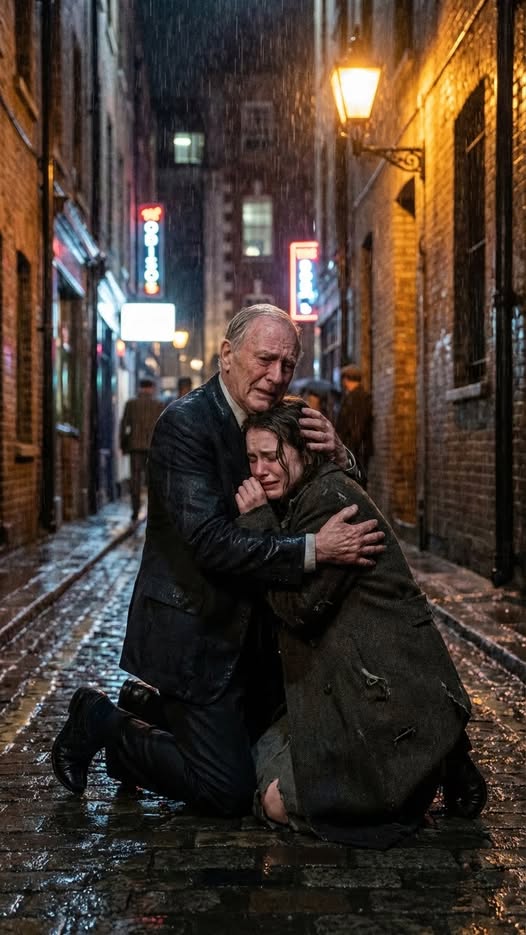
She started crying immediately—visceral, heaving sobs that shook her entire frame. I fell to my knees in the muck, pulling her into my chest, not caring about the oil or the filth.
“He sold the house,” she choked out, burying her face in my wet shirt. “He took everything. I didn’t know where to go. I didn’t know who to call. My phone died two days ago and I couldn’t… I was so ashamed.”
My hands trembled as I helped her stand. She was terrifyingly light. She must have lost fifteen pounds since the last time I saw her at the Labor Day barbecue.
“Who?” I asked, though the question was rhetorical. The rage was already sparking in my gut, hot and white.
“David?”
She nodded, her teeth chattering so hard she could barely articulate the words. “He moved in with his mistress. Some luxury building downtown, the Riverside Towers. He showed me pictures while he was packing my things into trash bags. He told me I deserved nothing. He said… he said I was pathetic for thinking I had any claim to the house.”
She gripped my arm, her fingers digging in. “He changed the locks while I was at work, Dad. I came home and my key wouldn’t turn. There was a note taped to the door: ‘Your belongings are in storage, Unit 247. You have 30 days. Don’t contact me again.’”
Something inside my chest didn’t just break; it calcified.
This was my daughter. The little girl who used to dance on my feet in the kitchen. The woman who had graduated with honors. The bride who had glowed with such blinding happiness three years ago that I had suppressed my own misgivings about David Morrison just to see her smile.
“How long?” I rasped, guiding her toward the warmth of my car. “How long have you been out here?”
“Four days? Maybe five. I lost track.”
Five days. My daughter had been homeless for five days, sleeping in the rain, while I sat in heated conference rooms drinking espresso.
“Let’s get you home,” I said, my voice hardening into steel. “We will figure out the rest later.”
As I buckled her in and cranked the heater, I looked at her reflection in the window. She looked broken. But she didn’t know yet that she had woken up a sleeping giant.
I took Emma back to the house she grew up in. The sanctuary where Catherine and I had raised her. I ran a bath so hot steam filled the hallway, made her tomato soup and grilled cheese—her comfort food since kindergarten—and put flannel sheets on her old bed.
She fell asleep mid-sentence, exhausted in a way that transcended the physical.
I didn’t sleep. I sat at my granite kitchen island, the silence of the house pressing against my ears, staring at the stack of papers Emma had pulled from her waterproof backpack before she collapsed.
She had been suspicious for months. She had saved texts, printed emails, and downloaded property records before he locked her out.
The story laid out in those documents was a masterclass in sociopathy.
David Morrison had transferred the title of their home—the home Emma had inherited from her mother—into his name only. He had done it six months ago using a quitclaim deed. I stared at the signature at the bottom. Emma Bennett-Morrison. It was a decent forgery, but I knew my daughter’s hand. She was left-handed; her loops slanted backward. This signature slanted forward.
The house in Northeast Portland, a lovingly restored Craftsman worth $600,000, had been sold last week. Cash sale. Quick close. Sold for $587,000 to a flipper.
The proceeds hadn’t gone into their joint account. I found the wire transfer receipt crumpled in the stack. The money had been routed to an entity called DM Holdings LLC in the Cayman Islands.
Then, there were the photos. Screen grabs from a tablet she’d found unlocked. David and a woman named Ashley, a twenty-three-year-old pharmaceutical rep. There was an ultrasound photo dated two weeks ago. Ashley was pregnant.
He had planned this. He had systematically dismantled my daughter’s life, stolen her inheritance, impregnated his mistress, and discarded his wife like a used wrapper.
I read until 4:17 AM. Then I made a fresh pot of coffee and read it all again.
When Emma shuffled into the kitchen around noon, wearing her old college sweatshirt and looking fragile as glass, I was ready.
“Dad,” she whispered, wrapping her hands around a mug. “What are you thinking?”
She knew me too well. She could see the calculation in my eyes, the cold arithmetic of retribution.
“I’m thinking,” I said carefully, “that your husband has made a fatal error.”
“It’s over, Dad.” Her voice was flat, defeated. “His lawyer sent an email saying I have no claim because I signed the deed. I have $847 to my name. I can’t fight him.”
“You don’t have to fight him,” I said, pulling out my phone. “I will.”
I dialed Benjamin Caldwell. Ben had handled Catherine’s estate. He was the kind of lawyer who looked like a kindly grandfather but litigated like a shark smelling blood in the water.
“Thomas?” Ben answered on the second ring. “It’s been a while.”
“I need you, Ben. It’s Emma. It’s a felony fraud case, and it’s personal.”
I explained everything. The forgery, the offshore account, the eviction, the alley. By the time I finished, the silence on the other end was heavy.
“Thomas,” Ben said, his voice dropping an octave. “What you’re describing isn’t just a messy divorce. It’s wire fraud, forgery, theft by deception, and money laundering. We can bury him. But I need everything.”
“You’ll have it. We’ll be there at 2:00 PM.”
I hung up and looked at Emma. “One more thing,” I said to her, though I was really speaking to the ghost of the man I used to be. “Before we unleash the lawyers, I’m going to pay him a visit.”
“Dad, no,” Emma’s eyes widened. “He’s… he can be aggressive.”
“I’m not going to fight him, Emma,” I said, standing up and smoothing my tie. “I just want to look him in the eye. I want him to know that the storm is coming.”
Riverside Towers was exactly the kind of place a man like David would choose. Glass, steel, aggressive valet parking, and a lobby that smelled of pretension and money.
It was 7:23 PM. Emma was safe at Ben’s office with a parallegal.
I walked past the doorman with the air of a man who owned the building. I took the elevator to the eighth floor, Apartment 8C. I stood outside the door for a moment. I could hear jazz music playing. Laughter. The clink of expensive glassware. They were celebrating.
I knocked.
The door swung open. David Morrison stood there, framed by the golden light of the hallway. He was wearing Lululemon joggers and a cashmere hoodie, his hair styled in that deliberate messy look that takes thirty minutes to achieve. He held a glass of Pinot Noir.
His face held the smug, relaxed expression of a man who thought he had won a game nobody else knew they were playing.
“Can I help—”
He stopped. Recognition flickered in his eyes, followed instantly by a flash of genuine alarm.
“Thomas.”
“Hello, David.”
He recovered quickly, stepping into the doorway to block my view inside. “Look, if you’re here about Emma, we have nothing to talk about. The divorce is moving forward. Tell her to stop harassing me.”
“Harassing you?” I repeated, my voice terrifyingly calm. “She hasn’t called you once. Hard to make calls when your phone is dead because you’re sleeping behind a dumpster in the rain.”
The smug smile faltered, just for a second. “That’s not my problem. She’s an adult. She made her choices.”
“She didn’t choose to be defrauded, David.”
“I didn’t defraud anyone!” His voice rose, defensive and loud. “That house was in my name. She signed the papers. It’s not my fault she didn’t read the fine print.”
“Except she never signed those papers,” I said, stepping closer. “You forged her signature.”
“That’s a lie,” he spat. “You can’t prove that.”
“Actually,” I said, reaching into my pocket and pulling out my phone, “I can.”
I turned the screen toward him. It displayed an email from Detective Laura Fischer of the Portland Police Bureau’s Financial Crimes Unit.
“Case number 894-Bravo,” I read aloud. “Opened this afternoon at 5:15 PM. Detective Fischer is very interested in your offshore accounts, David. So is the FBI. Apparently, transferring nearly six hundred thousand dollars to the Cayman Islands without declaring it to the IRS is a federal felony.”
The color drained from his face. It started at his hairline and washed down his neck, leaving him pale and sweating.
“You’re… you’re bluffing.”
“Am I? By Monday morning, they will have warrants for your financial records. They already flagged the account.”
Behind him, a young woman appeared from the kitchen. She was blonde, pretty in a generic way, and heavily pregnant. She wore a tight maternity dress and looked confused.
“David? Who is this?”
“Go back inside, Ashley,” David snapped.
I smiled at her. It wasn’t a nice smile.
“I’m Emma’s father,” I said. “You must be the mistress.”
Her hand flew to her throat. “We… David and I are in a relationship. We’re having a baby.”
“How nice. Did he tell you Emma was crazy? That she was unstable? That the marriage was over years ago?”
Ashley hesitated, her eyes darting to David. “He said… he said they were separated.”
“He lied,” I said. “He sold her house while she was at work. He forged her signature, took the cash, and threw her onto the street. You are living in an apartment bought with stolen money, Ashley.”
“That’s not true!” David shouted, his composure shattering. “Don’t listen to him! He’s just a bitter old man!”
I held up my phone again. “Wire transfer. $587,000 to DM Holdings. Withdrawal of $234,000 last week—the exact amount of the down payment on this unit. The police are seizing this apartment as proceeds of a crime, Ashley. When David goes to prison—and he will—you and that baby will be homeless.”
Ashley looked at David. “David? What is he talking about?”
“Get out!” David lunged at me, wine sloshing onto the pristine hardwood floor. “Get the hell out of my house!”
I didn’t flinch. I didn’t move.
“I’m leaving,” I said softly. “But the police will be here. Probably tomorrow. And David? You made one mistake.”
He was breathing hard, fists clenched, shaking.
“You thought because Emma is kind, she is weak. You thought because I am old, I am harmless.” I leaned in, close enough to smell the fear on him. “You were wrong.”
I turned and walked to the elevator. As the doors closed, I saw David stumbling back, Ashley screaming at him, the perfect façade of his new life crumbling into dust.
The collapse was swift and brutal.
Detective Fischer was as good as her reputation. The warrant was executed on Friday morning.
I was sitting in my kitchen with Emma when the call came.
“We got him,” Fischer said. “We froze the offshore account. There’s about $350,000 left. The rest went to the apartment and a very expensive diamond ring.”
“Is it enough to charge him?” I asked.
“Oh, Thomas, it gets better,” Fischer said, her voice grimly satisfied. “We pulled his employment records. David works in commercial real estate acquisitions, right? Senior Analyst?”
“Yes.”
“He’s been embezzling from his employer too. Skimming commission fees into the same offshore account. We’re talking another $180,000 over three years. His firm fired him this morning and they are pressing charges.”
I relayed the news to Emma. She sat at the table, stunned silence filling the room.
“He’s going to prison?” she asked.
“For a long time,” I said. “Wire fraud, forgery, tax evasion, embezzlement. He’s looking at ten to fifteen years.”
“I can’t believe it,” she whispered. “I slept next to a criminal for three years.”
David was arrested at 9:23 AM. It happened in the lobby of the Riverside Towers. He was led out in handcuffs, wearing the same expensive hoodie, but he didn’t look smug anymore. He looked small.
That afternoon, Ashley called Emma.
Emma put the phone on speaker.
“I didn’t know,” Ashley sobbed. “I swear to God, Emma, I didn’t know. He told me the house was his. He told me you guys were amicable.”
“Stop,” Emma said, her voice shaking but firm.
“The police… they put a seal on the apartment door. They gave me twenty-four hours to get my things out. I’m five months pregnant, Emma. I have nowhere to go. Can you… is there any way you can help? Maybe talk to your dad?”
I watched my daughter. This was the moment. She could revert to the people-pleaser she had been, the woman who let David run over her.
Emma looked at the phone. Her eyes hardened.
“You were sleeping with my husband for eighteen months,” Emma said. “You were planning a nursery while I was working double shifts to pay the mortgage on the house you helped him steal. You don’t get to ask me for mercy, Ashley. Call your parents.”
She hung up.
“Was that cruel?” she asked me, tears welling in her eyes.
“No, baby,” I said, squeezing her hand. “That was survival.”
The preliminary hearing took place three weeks later.
David’s lawyer, a slick defense attorney named Stuart Bradshaw, tried to paint Emma as a scorned wife. He argued that she had consented to the sale but simply forgot due to “emotional distress.”
It didn’t work. The forensic handwriting analysis was irrefutable. The signature on the deed was a right-handed forgery; Emma was left-handed. The judge, a no-nonsense woman named Judge Patterson, looked at David with open disdain.
“Mr. Morrison,” she said, peering over her glasses. “Given the flight risk associated with your offshore accounts, bail is denied.”
David was led away in an orange jumpsuit. He looked at me as he passed the gallery. I didn’t look away. I simply nodded.
Outside the courtroom, Ben Caldwell pulled me aside.
“Bradshaw approached me,” Ben said. “They want a plea deal.”
“What are the terms?”
“David pleads guilty to two counts of fraud and one count of theft. He agrees to full restitution—every penny of the house money returned, plus damages. In exchange, the DA recommends six years instead of fifteen.”
“What does Emma get?”
“Everything. $587,000 for the house. $200,000 in punitive damages. Legal fees covered. She walks away with close to $900,000.”
I found Emma sitting on a bench in the hallway, staring at the dust motes dancing in the light.
“He wants a deal,” I told her. “Six years in prison. You get all the money back, plus enough to start over completely.”
“Six years?” she asked.
“If we go to trial, we could get him fifteen. But it will take a year. You’ll have to testify. You’ll have to see him every day in court.”
She closed her eyes. “I don’t want to see him. I don’t want to think about him. I want him to be a ghost.”
“Then we take the deal.”
Six months later, on a Saturday in May, I helped Emma move into her new home.
It was a bungalow in Laurelhurst, with a deep porch and skylights in the kitchen that flooded the room with sun. She had bought it with cash.
David was currently serving his sentence at a federal correctional institution in Sheridan. His assets had been liquidated. He would emerge from prison in his mid-thirties, a convicted felon with massive debt and no career prospects. Ashley had moved back to Arizona; we never heard from her again.
We unpacked the last box of books. Emma stood in the center of her living room, looking around. She looked different now. The hollow look was gone, replaced by a resilience that made her seem older, but stronger.
“Dad,” she said, wiping her hands on her jeans. “Thank you. For finding me. For fighting for me.”
“You don’t have to thank me,” I said. “That’s the job.”
“Mom would be proud of you,” she said softly.
“She’d be proud of you, Emma.”
I drove home that evening as the sun set over the Willamette River, turning the water to liquid gold. I poured myself a bourbon and sat on my back porch.
I thought about Catherine. She would have handled this with more grace, perhaps. She might have been more diplomatic. But she wasn’t here.
I thought about the look on David’s face in that apartment hallway. The sheer, unadulterated shock of realizing that his actions had consequences.
My phone buzzed. A text from Emma.
First night in the new place. Doors locked. Alarm on. I’m safe. Love you, Dad.
I smiled, taking a sip of the bourbon. The burn was pleasant.
David Morrison had learned a hard lesson, one that would keep him company for the next two thousand nights in his cell. He had learned that you can steal a house, you can steal money, and you can steal trust.
But you should never, ever steal a daughter’s future when her father is still breathing.
Because I would have burned the whole city down to get her out of that alley. Luckily for the city, I only had to burn down David Morrison.
And that? That was a pleasure.