I never imagined my quiet, self-imposed exile would end with the sound of splintering wood and a Rolls-Royce in my backyard. For five years, I’d lived in near silence—no friends, no visitors, just me and the creak of my old house. But life, as I’ve learned at seventy-three, doesn’t ask for your permission before shaking you awake.
My home sat tucked along a manicured street where everyone’s lawns looked like magazine covers and each mailbox had its own personality. I moved here after losing my wife and son in a plane crash. The grief hollowed me out. I didn’t want condolences or conversation; I wanted invisibility. Neighbors tried to reach out at first—small talk over fences, polite waves—but I made sure the message was clear: I wasn’t interested. Eventually, they stopped trying. That suited me just fine.
Then, one calm Friday evening, my fragile world cracked open.
The sun was setting, painting the sky in streaks of pink and gold. I’d just finished my tea and settled into my armchair by the window when I heard it—an explosion of noise so sharp and violent it made my chest seize. I stumbled to the back door, heart pounding, and froze.
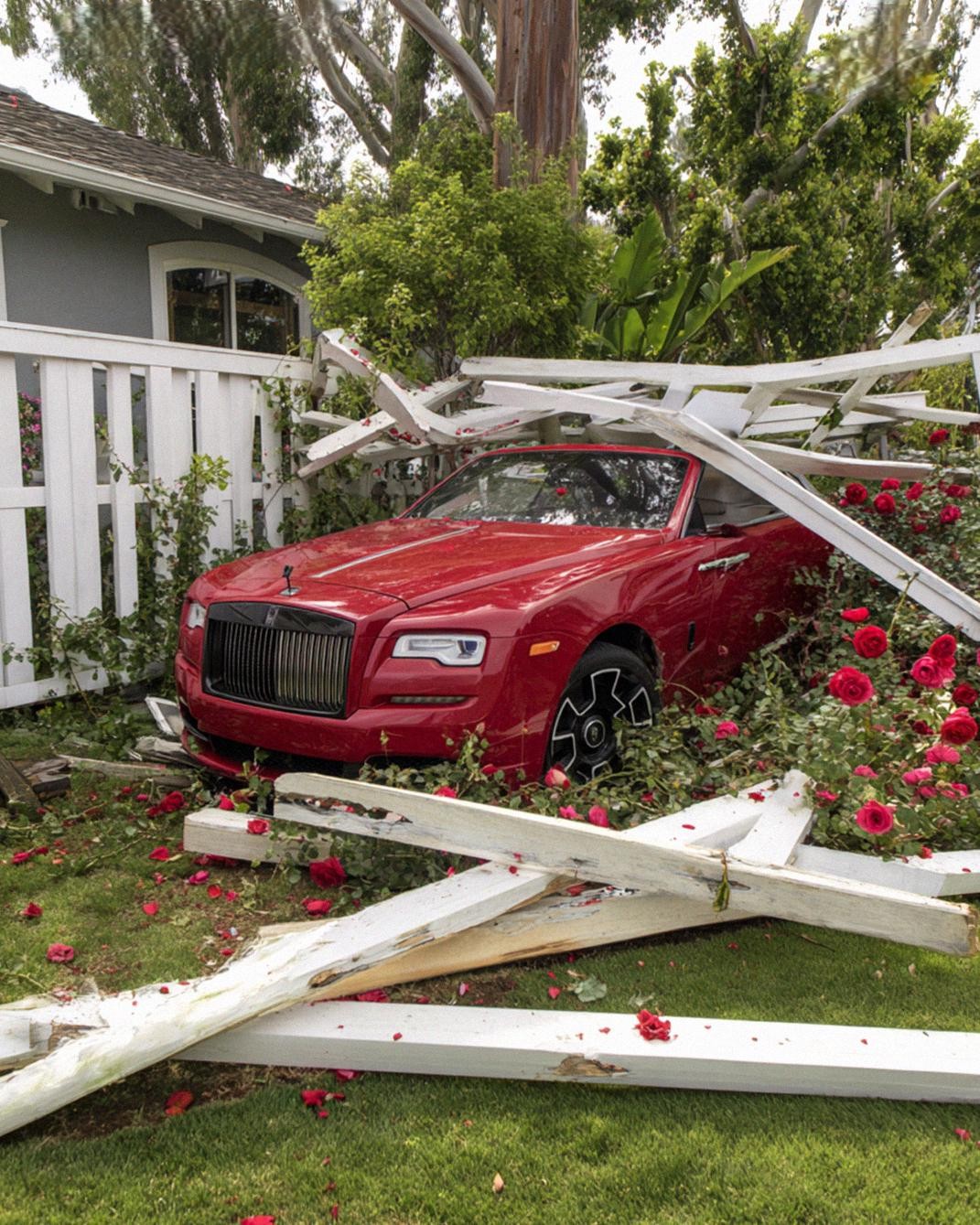
My fence—my old, sturdy fence—was gone. Shattered boards littered the grass like matchsticks. Embedded in the wreckage was a cherry-red Rolls-Royce, its chrome grille gleaming under the dying light. And leaning casually against the hood, like he’d just stepped out of a magazine shoot, stood my neighbor, Mr. Carmichael.
He’d moved into the neighborhood six months earlier. A tall, polished man, all expensive suits and smug smiles, the kind who treated people as background scenery. The moment our eyes met, I knew I was about to be dismissed.
“You wrecked my fence!” I shouted, voice trembling from anger and disbelief.
He smirked. “Small accident, Mr. Hawthorne. Don’t get bent out of shape. You look like the type who might fake an injury to cash in.”
The audacity knocked the breath out of me. “I’m not asking for money,” I said. “You broke it. Just fix it.”
He laughed—short, cruel, and dismissive. “Fence? What fence? Maybe it fell on its own. You should’ve built a better one.” Then, as if to drive the insult home, he added, “And I’m not paying a single cent for that rotten thing.”
Before I could respond, he slid behind the wheel, revved the engine, and sped off, leaving me staring at the wreckage and his tire marks carved into my lawn. The humiliation stung more than the damage itself. I felt small—old, invisible, powerless.
That night, I couldn’t sleep. Every time I closed my eyes, I heard the crunch of wood, his mocking voice, the way he looked right through me. I considered reporting it, but the thought of explaining it—of anyone thinking I was just a bitter old man—kept me frozen. By dawn, I was still pacing the living room, exhaustion heavy in my bones.
Then, just after sunrise, I opened the back door—and stopped cold. My fence was fixed.
Not patched or half-done—rebuilt. Brand new boards, perfectly aligned and sanded smooth. The posts were reinforced, the paint still smelled fresh. Along the bottom ran a row of small solar lights, glowing faintly even in daylight. Near the corner sat a little white table with two chairs, neatly placed like an invitation.
On one chair rested a sealed envelope with my name written in tidy handwriting. Inside was a short note:
“Mr. Hawthorne, you deserve peaceful evenings. Use this however you like. Someone made sure this all happened for you.”
Beneath it was a thick stack of cash.
I sank into one of the chairs, dazed. Who would do this? Certainly not Carmichael—he wasn’t the type to lift a finger unless it earned him applause. I sat there for hours, staring at the fence, half-convinced I’d imagined it.
That afternoon, a knock at the door startled me. Two uniformed police officers stood outside.
“Mr. Hawthorne,” one said politely. “We’re following up about the damage to your property.”
“It’s fixed now,” I replied, confused.
“We know,” he said. “We’ve already reviewed the footage.”
“Footage?”
“Your next-door neighbor, Graham, recorded everything. He had his camera running in his backyard—caught Carmichael’s car slamming through your fence, and his little speech afterward. He turned it over to us last night.”
My knees nearly buckled. “Graham?” I repeated. “From the blue house?”
The officer nodded. “He’s a freelance videographer. He also handled the repairs with the settlement money Carmichael paid. Didn’t want to bother you, said you valued your privacy.”
When they left, I just stood there holding the envelope, realizing that while I’d been locking myself away, someone had been quietly looking out for me.
The next morning, I walked to the blue house for the first time. Graham answered the door in a faded T-shirt, a bowl of cereal in his hand. Beside him stood a small boy with light brown curls, wide eyes, and a cautious smile.
“This is Henry,” he said. “My son.”
I nodded. “Henry, nice to meet you.”
“Hi,” the boy whispered.
I turned to Graham. “You fixed my fence. You didn’t have to.”
He shrugged lightly. “You didn’t deserve what happened. Figured I’d do something about it.”
“Still,” I said. “You went above and beyond.”
He smiled, a little shyly. “After my wife died giving birth to Henry, I shut down for a while too. Then I realized maybe helping someone else heal could help me, too.”
That day, I invited them over for tea. It felt awkward at first—conversation rusty after years of silence—but soon, something shifted. Henry climbed onto one of the chairs and traced the glowing solar lights with his finger, whispering that they kept “night monsters” away. I laughed for the first time in years.
Tea turned into friendship. Graham and I began talking daily—small things at first: weather, repairs, the birds nesting in my oak tree. Then deeper things: loss, fear, second chances.
Henry became my little shadow. Every afternoon, he’d wander into my yard with a book or a toy, asking, “Mr. Hawthorne, story time?” I hadn’t read to a child since my son was alive, but the words came back easily. His laughter filled the space that grief had hollowed out.
Weeks passed. I found myself living again—gardening, baking, waving at neighbors who, for the first time, waved back. Graham helped me install a bird feeder. I helped Henry plant sunflowers. My world, once so small, began to open again.
One evening, as the sun dipped below the horizon, I sat alone in the yard. The fence stood tall and strong, glowing softly from the lights Henry loved so much. The table was still there, now marked with small coffee stains and laughter. I realized something simple but profound: I wasn’t alone anymore.
Carmichael had tried to make me feel invisible. But Graham—and his boy—reminded me that kindness is louder than cruelty, and repair runs deeper than damage.
Before going inside, I planted a new rosebush beside the fence. Its buds were small, delicate, full of promise. It was my quiet thank-you—for the neighbor who fixed more than wood, and the boy who taught me to see light again.
Sometimes life gives you tragedy. Sometimes, it gives you a second chance disguised as a broken fence.