I am typing this with hands that still refuse to stay steady. Every few sentences, I have to stop, close my eyes, and breathe through the phantom pain in my fractured orbital bone, a throbbing reminder that the people who were supposed to be my sanctuary became my executioners. I never wanted to be a public spectacle. I wanted a quiet life. But silence, I have learned the hard way, is the soil in which abuse grows best.
My name is irrelevant now—I am in the process of legally changing it anyway—but the name that matters is Chloe. My daughter turned eight years old three months ago, a milestone that felt less like a birthday and more like a victory against the universe. Chloe is the kind of child who notices the small magic in the world; she saves earthworms from puddles and thanks the bus driver by name. She is my entire gravitational pull.
But Chloe was born fighting. Arriving at thirty-two weeks, she was a translucent, fragile thing of bird bones and desperate gasps. Severe asthma isn’t just a diagnosis for us; it is the third roommate in our small apartment. It dictates where we go, what cleaning products I buy, and the constant, low-level hum of anxiety that lives in the base of my throat. We learned early that her lungs were treacherous. A sudden drop in temperature or a high pollen count could turn a playground visit into a lights-and-sirens ambulance ride.
I became the mother everyone rolls their eyes at. I tore out carpets, installed HEPA filters that hummed like guardian angels in every corner, and carried a backup pharmacy in my purse. My vigilance was the only wall standing between my daughter and suffocation.
My family, however, saw this not as love, but as theater.
My mother, Janet, loved to use the word “dramatic.” To her, my refusal to let Chloe be around cigarette smoke or dusty attics was a personal insult. My father, Dennis, was a man of grunts and dismissive waves, believing that toughness was a cure for biology. But the architect of my misery was my sister, Brooke.
Brooke was two years older and lightyears ahead in our parents’ estimation. She was the Golden Girl—the one who got the piano lessons, the university tuition, and the unadulterated pride. I was the accident, the afterthought, the one who should have known better than to get pregnant at twenty-four. Brooke married Travis, a successful accountant, and secured the suburban McMansion lifestyle our parents covet. But she couldn’t have children.
That biological reality curdled inside her. It turned her jealousy into a weapon she sharpened daily. She looked at Chloe not as a niece, but as a thief who had stolen the attention she believed was her birthright. At Christmas, Brooke would buy Chloe noisy, cheap toys, while my parents showered Brooke with jewelry. I swallowed the insults. I smiled until my jaw ached. I told myself that keeping the peace was better than severing the tie.
I didn’t realize that by keeping the peace, I was handing them the ammunition to destroy us.
Three weeks ago, the levy broke. My supervisor at the dental office quit without notice, leaving me drowning in double shifts. When my regular sitter canceled for a family emergency, desperation clouded my judgment. I asked Janet to watch Chloe for just four hours.
“Fine,” my mother had sighed into the phone, as if I were asking her to donate a kidney. “But bring her here. I’m not driving in this traffic.”
I dropped Chloe off at their sprawling house. I knelt in the foyer, gripping her shoulders. “Your inhaler is in the front pocket, okay? Right here.” I showed my mother. I showed Chloe. “Mom, this stays with her. It’s not a toy. It’s her lifeline.”
Janet waved a hand, already turning toward the television. “Stop being so dramatic, honestly. She’s eight, not an infant. Go to work.”
I kissed Chloe’s forehead. She smelled like strawberry shampoo and trust. “I’ll be back by dinner,” I promised.
I walked out the door, ignoring the cold dread coiling in my gut. It was just four hours. They were her grandparents. They were cruel, yes, and dismissive, surely—but they were family. They wouldn’t actually let harm come to her.
I have never been more wrong in my life.
The shift was grueling, a blur of patient files and ringing phones, but I finished by 6:45 PM. I drove to my parents’ house with a sense of relief, ready to scoop Chloe up and retreat to our safe, filtered sanctuary.
When I unlocked the front door—I still had a key, a relic of a time when I thought I belonged—the atmosphere was thick, almost suffocating. The entire clan was there. Janet and Dennis sat in their recliners. Brooke and Travis were on the loveseat, nursing glasses of wine.
And Chloe? She was curled into a tight ball in the furthest corner of the sofa, her knees pulled to her chest. She looked small. Too small.
“Mommy!” She launched herself at me the moment I stepped into the living room. She buried her face in my stomach, her small body trembling like a leaf in a gale. Her breathing was audible—a high, thin wheeze that made my blood run cold.
“What happened?” I demanded, my hands instantly checking her temperature, her pulse. “Why is everyone sitting here like this?”
Brooke swirled her wine, a slow, predatory smile spreading across her face. “Relax. We were just waiting for you. You have to see this video. It is absolutely hilarious.”
“I don’t want to see a video, Brooke. Chloe is wheezing.”
“Just watch,” she insisted, thrusting her phone into my face.
On the screen, the timestamp showed 4:30 PM. The setting was the guest bedroom. The camera angle was steady, likely propped up on a dresser. Brooke walked into the frame, looking directly at the lens.
“Time for a little lesson in reality,” the on-screen Brooke whispered, winking.
She walked over to Chloe’s backpack, which was resting on the bed. In the background, Chloe was playing with dolls, singing quietly to herself, oblivious to the predator in the room. Brooke unzipped the front pocket. She pulled out Chloe’s red rescue inhaler.
Then, she reached into her own pocket and pulled out an identical red canister.
“Swap time,” Brooke grinned at the camera. “This one is totally empty. Found it in Mom’s old medicine cabinet from, like, 2018. Let’s see how much of a ‘medical emergency’ this really is when the crutch is gone. Teach her to stop sucking up all the attention.”
She placed the dud inhaler into the backpack and pocketed the real one. The video ended with her stifled giggle.
The silence in the living room was deafening. My brain stuttered, refusing to process the malice I had just witnessed.
“You…” My voice was a whisper. “You swapped her life-saving medication? For a prank?”
Janet chuckled, taking a sip of her Chardonnay. “Oh, stop it. Brooke is right. You coddle that girl too much. It’s mind over matter. She needs to learn to breathe without that chemical crutch.”
“It’s albuterol, not heroin!” I screamed, the rage finally detonating in my chest. “Where is the real one? Give it to me. Now!”
Brooke shrugged, leaning back against Travis, who looked bored. “I threw it in the trash compactor. It’s gone. She looks fine, doesn’t she?”
I looked down at Chloe. Her lips were pale. She was working too hard for every breath. I needed to get her to the ER, or at least to a pharmacy, immediately. But first, I needed to ensure the school knew, in case I couldn’t get a replacement by morning.
“I’m calling the police,” I said, fumbling for my phone. “And I’m calling the ambulance.”
The air in the room shifted from mockery to violence in a heartbeat.
“You aren’t calling anyone,” Brooke hissed. She moved with a speed I didn’t know she possessed.
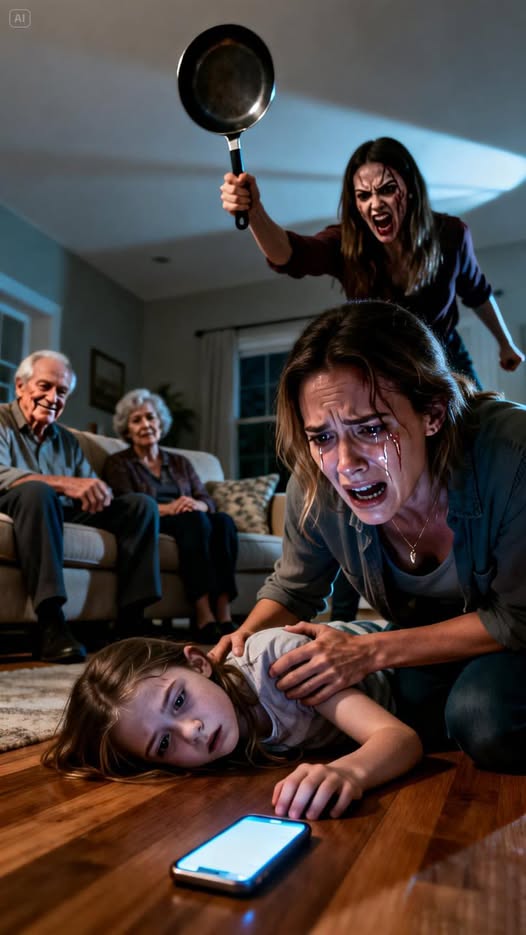
I saw the flash of metal before I felt the impact. She had grabbed a heavy cast-iron skillet from the kitchen island where they had been setting up for dinner. She swung it like a tennis racket.
The sound of iron hitting my facial bone was a wet, sickening crunch. White light exploded behind my eyes. I didn’t even feel the pain at first, just the sudden, jarring shift of gravity as the floor rushed up to meet me.
I landed hard on the linoleum. Blood poured from my eyebrow, blinding my left eye.
“Mommy!” Chloe screamed—a terrified, ragged sound.
I tried to push myself up. “Run, baby,” I gasped. “Run outside.”
But before I could get to my knees, a heavy boot slammed into my ribcage. Dennis. My father. He kicked me with the casual exertion of someone kicking a door shut. I felt a rib snap, a sharp fire in my chest that stole my breath.
“Always making a scene,” Dennis grunted, looming over me. “Ungrateful brat.”
Janet walked over, plucked my phone from my trembling hand, and smashed it against the granite countertop. The screen shattered into a spiderweb of glass. She tossed the wreckage onto my prone body.
“No one is calling the police,” she said, her voice terrifyingly calm. “We are having a family dinner. You can lie there and think about how you’ve upset everyone.”
And then, the impossible happened. They sat down.
I lay on the kitchen floor, bleeding from my head, gasping through a broken rib, drifting in and out of consciousness. And ten feet away, my family—my mother, father, sister, and brother-in-law—passed the salad bowls. They laughed about a neighbor’s new car. They ignored the woman bleeding out on their floor and the eight-year-old child sobbing silently beside her.
The last thing I remember before the darkness took me was the sound of Chloe’s wheezing, syncing with the beat of my own failing heart.
Chapter 3: The Empty Canister
I woke up to silence. The house was dark. The clock on the microwave blinked 11:00 PM. They had left us. They had actually left us there to rot.
I dragged myself to the hallway. Every inch of movement was agony; my ribs felt like jagged glass inside my chest. Chloe was asleep on the floor beside me, exhausted from terror, her breathing shallow and rapid.
I found the old landline in the den—the one Dennis kept because he “didn’t trust satellites.” I dialed 911 with blood-slicked fingers.
The rest is a blur of fragmented images. The paramedics bursting in. The neck brace. The police asking questions I couldn’t answer. A social worker named Mrs. Patterson taking Chloe because I was being admitted for surgery.
“Please,” I grabbed the nurse’s scrub top as they wheeled me into trauma. “Her inhaler. It’s empty. Tell the school. Tell the foster mom. It’s empty.”
“We’ll take care of it, honey. Just rest,” the nurse soothed, injecting something into my IV that pulled me under.
They didn’t understand. They thought I was delirious.
I woke up the next morning in a hospital bed, my face swollen to the size of a melon, my chest bound tight. I demanded a phone. I called the school immediately, but the line was busy. It was 10:45 AM.
Two minutes later, my world ended.
At Chloe’s elementary school, the third-grade class was on a nature walk. The autumn air was crisp and dry—a classic trigger. Chloe started to cough. She felt her chest tighten, that familiar iron band squeezing her lungs. She did exactly what I had trained her to do. She stopped walking. She reached into her backpack. She pulled out the red canister.
She pressed the canister.
Click.
Nothing.
She shook it, panic rising in her throat, and pressed again.
Click.
No mist. No relief. Just the hollow sound of betrayal.
She collapsed on the grass. By the time the teachers realized what was happening and ran for the school nurse’s backup supply, Chloe had been without oxygen for nearly four minutes.
I was still fighting with the hospital phone system when a doctor walked into my room, his face grave.
“Ms. Harper?” (I use that name now). “Your daughter is here. She’s in the PICU. She suffered a catastrophic respiratory arrest.”
I didn’t scream. I couldn’t. The sound that came out of me was a guttural, animal thing that tore my throat raw. I ripped the IVs out of my arm. I didn’t care about my broken ribs or my fractured face. I ran.
I found her hooked up to a ventilator, a machine breathing for her because my sister thought it would be funny if she couldn’t. She looked like a porcelain doll that someone had broken and tried to glue back together.
“She’s in a coma,” the doctor explained gently. “We are cooling her body to try and preserve brain function. The next twenty-four hours are critical.”
I sat by her bed, holding her cold, limp hand. “I’m here, baby,” I whispered through my wired-shut jaw. “Mommy is here. And I am going to burn their world to the ground.”
The police detectives, Morrison and Ramirez, were kind, but I could see the skepticism in their eyes during the initial interview.
“Your family claims you showed up drunk,” Ramirez said gently. “They say you fell and hit your head on the counter. They say Brooke and Travis weren’t even there.”
“They are lying,” I rasped. “There was a video. Brooke showed it to me.”
“We checked Brooke’s phone,” Morrison sighed. “It’s clean. No video. No deleted files in the trash. Your parents back up her story. It’s four witnesses against one, and… well, with your head injury…”
They thought I was hallucinating. The gaslighting was working. My family had circled the wagons, creating a fortress of lies so impenetrable that even the law couldn’t see inside. I felt insanity clawing at the edges of my mind. Maybe I was crazy? Maybe I had imagined the frying pan?
Then, my phone buzzed. It was a new phone, provided by the hospital social worker. A Facebook message notification popped up.
It was from Faith, my cousin. Brooke’s younger cousin. We hadn’t spoken in years.
I heard what happened, the message read. I know they are lying. I have the video.
My heart stopped. I typed back with trembling thumbs: How?
Faith: Brooke is an idiot. She posted it to the family WhatsApp group—the ‘Inner Circle’ chat they excluded you from years ago. She bragged about it. She deleted it an hour later when she realized you were actually hurt, but I have auto-download on. I have it all.
Three dots appeared. Then, a video file.
I pressed play. There was Brooke, smirking, swapping the inhaler. There was the confession. “Teach her to stop getting attention.”
But Faith sent more. She sent screenshots of the chat log from that night.
Janet (7:15 PM): She’s bleeding all over the floor. Ugh. Ruined the rug.
Dennis (7:17 PM): Leave her. She needs to learn respect. Let’s eat.
Brooke (7:20 PM): LOL. Did you hear the noise the pan made?
I showed the phone to Detective Morrison. I watched the color drain from his face. He stood up, his chair scraping violently against the floor.
“We need a warrant,” he said to Ramirez. “Now.”
But the investigation uncovered something even Faith didn’t know about. My father, in his paranoia about burglars, had installed internal security cameras in the kitchen and living room years ago. He had forgotten to turn them off.
The police seized the hard drive. They watched the whole thing.
They watched Brooke swing the skillet with the intent to maim.
They watched Dennis kick his own daughter in the ribs.
They watched them sit down and eat roast chicken while Chloe sobbed over my unconscious body.
The charges were not just assault. The District Attorney was furious.
Brooke was charged with Attempted Murder, First-Degree Assault, and Depraved Indifference to a Child’s Life.
Dennis and Janet were charged with Accessory to Attempted Murder, Assault, and Child Endangerment.
Travis was charged with Conspiracy and Obstruction of Justice.
When the judge saw the footage at the arraignment hearing, he looked at my family—standing there in their expensive suits, looking indignant—and he denied bail for all of them.
“In thirty years on the bench,” the judge said, his voice shaking with suppressed rage, “I have never seen such casual, reptilian cruelty. You are a danger to society.”
The bailiff led them away in handcuffs. I saw Janet look at me in the gallery, her mouth open in shock, waiting for me to save her. I just stared back, my face a mask of bruises, and felt absolutely nothing.
Chloe opened her eyes five days later.
“Mommy?” she croaked. The tube was gone, but her voice was raw.
I wept. I kissed her hands, her face, her hair. “I’m here. We’re safe. They can never hurt us again.”
She has permanent scarring on her lungs. Her asthma is now classified as “brittle,” meaning it’s harder to control. She has nightmares about “Auntie Brooke” coming into her room. But she is alive. She is breathing.
The fallout for my family was biblical.
Because court records are public, the story got out. A local reporter saw the charges—”Depraved Indifference”—and dug deeper. The video Faith provided leaked.
The internet did the rest.
Dennis was fired from his executive VP job three days after the arrest. His company issued a statement distancing themselves from his “abhorrent behavior.”
Janet was kicked out of her country club and her church. Her “friends” gave interviews talking about how they always knew something was off about her.
Brooke lost everything. Her job, her house, her marriage (Travis turned on her immediately in a plea deal attempt, though it didn’t work).
As for me? I burned the bridge and then I salted the earth.
I legally changed my last name to Harper. It sounded strong. It sounded like a fresh start. Chloe loved it. We moved to a new town, an hour away, close to Faith, who has become the sister I never had.
The trial is set for next spring. The District Attorney says Brooke is looking at twenty years, minimum. My parents will likely die in prison.
Sometimes, late at night, I wake up reaching for Chloe, terrified she isn’t breathing. I rush to her room and watch the steady rise and fall of her chest, listening to the rhythm of her life.
I used to think family was blood. I used to think loyalty was enduring pain for the sake of history. I know better now. Blood is just biology. Family are the people who bring you ice chips in the hospital. Family are the cousins who screenshot the evidence. Family are the people who would never, ever let you gasp for air alone.
I look at the empty space where my “parents” used to be, and I don’t feel loss. I feel lighter. I feel like I can finally breathe.
And more importantly, so can Chloe.