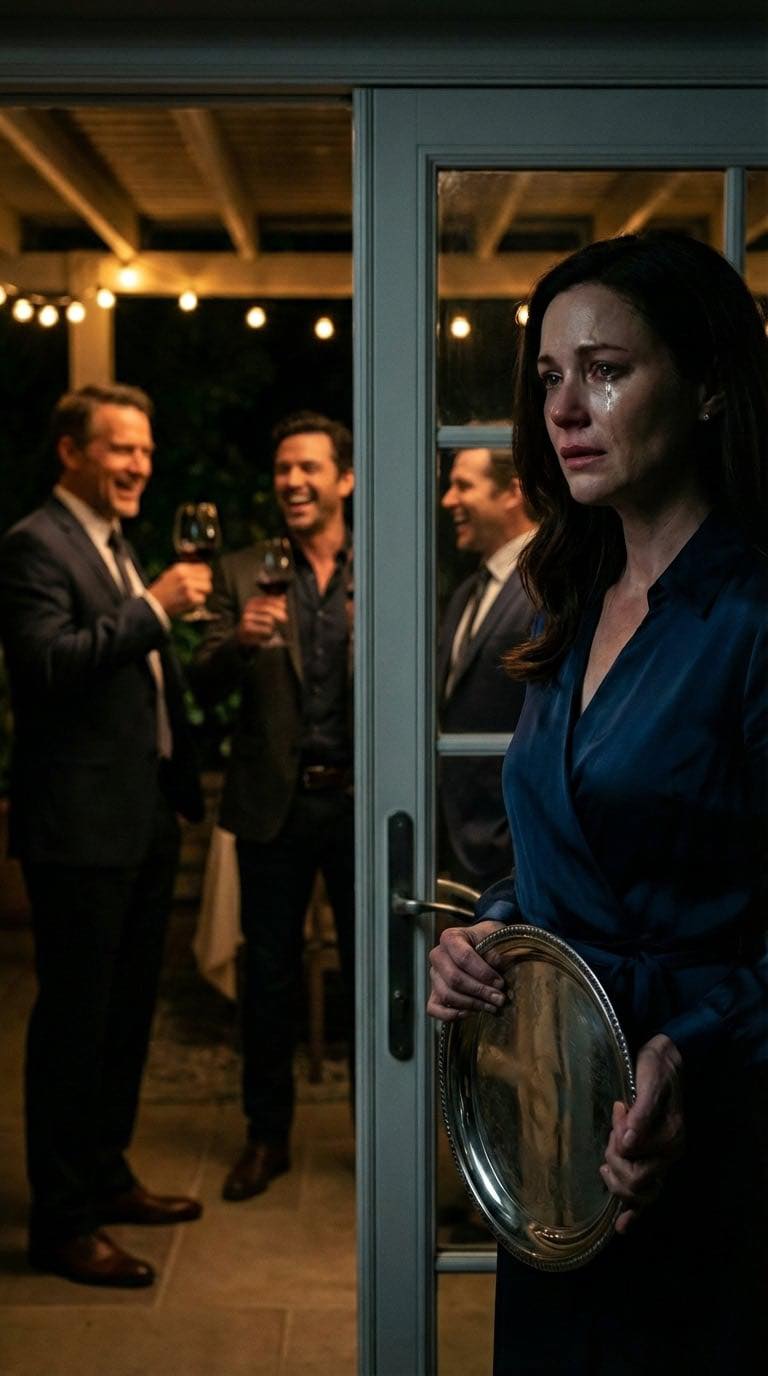
I never intended to become a spy in my own home. I was simply a wife, paused just beyond the sliding glass doors, balancing a heavy tray of food I had spent the entire afternoon preparing. The stainless steel grill behind me was still radiating heat, pressing against my lower back, while the ceramic plates burned a dull ache into my palms.
This was Adam’s ritual. His “Thursday Nights.” His friends, his territory, his sanctuary. That was how he always framed it—a sacred space for male bonding, a necessary release from the pressures of the corporate world. I respected it. I facilitated it.
Then, he laughed.
It wasn’t the easy, familiar chuckle he shared with me over morning coffee. It was a booming, self-assured sound, a baritone performance reserved for other men. It was the kind of laugh that fills a room and demands admiration, a sound that vibrates with the assumption of power.
“I honestly don’t think this joke of a marriage will last another year,” Adam said. His voice carried through the screen door with terrifying clarity. “She’s just… stale. She’s not even close to my level anymore. Honestly, it’s embarrassing.”
The sentence struck me with the force of a physical blow. In the backyard, illuminated by the string lights I had hung myself, his friends lounged deeper into the expensive patio furniture I had paid for. Glasses were lifted. Someone applauded. Someone else laughed louder than the rest, a harsh, braying sound.
I saw nodding heads. I saw shared looks of conspiratorial satisfaction. They ate the steaks I had marinated, drank the vintage Cabernet I had been saving for an anniversary, and they were applauding my obsolescence.
For several seconds, I couldn’t move. My body locked in place, frozen by a paralysis that felt ancient, while my mind sharpened with painful, crystalline clarity. I watched Adam soak in their approval as if it were a prize. I watched him shine, his face flushed with the thrill of cruelty, looking for all the world like a man who had finally said something admirable.
No one noticed me standing in the shadows. That hurt more than the words themselves. Not just the insult, but how naturally it existed in that space. This wasn’t accidental. This wasn’t a slip of the tongue. It was practiced, repeated, affirmed.
That was the precise moment I understood the architecture of my life was a lie. It wasn’t about one bad evening or an off-hand remark fueled by alcohol. This was how he spoke when he believed I couldn’t hear him. This was who he became when he felt safe.
I placed the heavy tray down on the outdoor prep table without making a sound. I didn’t cry. I didn’t step in to scream. I didn’t rush forward demanding explanations. I simply stood there long enough to grasp one singular, devastating truth.
The marriage was already finished. The corpse was cold. The only thing left undecided was how long I would keep pretending it was still breathing.
Before that night, people often called me fortunate. “Lucky Elina,” they would say. Fortunate to own a successful logistics company. Fortunate to have a husband who could charm a room full of strangers in five minutes. Fortunate to live a life others assumed was effortless.
What they never saw—what I hid diligently—was how deliberately I diminished myself to fit inside Adam’s ego.
I had built my business, Vector Logistics, doing freelance dispatch work at a kitchen table years before Adam ever referred to himself as an “entrepreneur.” As the company expanded, I handled contracts, navigated international trade laws, and pulled all-nighters that turned into all-weekers. Adam, conversely, handled “vision.” He dealt in stories, potential, and ambitions that never moved beyond the conversation phase.
Whenever one of his ventures collapsed—and they always did, usually due to “bad partners” or “market shifts”—I quietly absorbed the financial impact. I refilled the bank accounts. I told myself patience was the currency of marriage. I told myself support equaled love. I told myself success belonged to us both, even when I was the only one earning it.
When my income exceeded his by triple, I stopped discussing numbers. When clients praised my strategic mind, I deflected the credit to “our team.” When he joked at parties about being the visionary while I was the “details girl,” I smiled and let him keep the title.
Protecting his fragile sense of self-worth felt simpler than confronting reality. I became the steady one, the reasonable one, the shock absorber for his insecurities. Friends would say, “You’re such a strong couple.” What they really meant was that I was strong enough to carry both of us.
I accepted that role unquestioningly until I heard my life’s work and my devotion reduced to a punchline for an audience of drunk men.
Standing outside those doors, the fog lifted. I hadn’t been unlucky in love. I had been loyal to someone who quietly resented the life I built. And once I saw that—once the mechanism of his resentment was exposed—there was no returning to ignorance.
I didn’t plan what I would say. There was no dramatic rise of music, no rehearsed speech. Just a cold, calm certainty settling in my chest, heavy as a stone. I pushed the glass door open.
The laughter died instantly. It was as if I had sucked the oxygen out of the backyard.
Adam turned first, his smile frozen halfway between confidence and panic. His friends followed, eyes shifting, glasses lowering, bodies stiffening like schoolboys caught destroying property.
I stepped onto the patio and set the tray of food on the center table. The clatter of the platter against the glass top sounded like a gunshot in the silence.
“Why wait a year?” I asked. My voice was even, almost polite, stripping the moment of any hysteria they might have expected. “Let’s end it tonight.”
Silence followed—absolute and suffocating. Adam opened his mouth, then closed it again. The version of him who always knew how to spin a story, who could talk his way out of missed payments and failed promises, suddenly had nothing ready.
I didn’t accuse. I didn’t question. I didn’t ask for explanations I already possessed.
“I wouldn’t want you stuck in a marriage you clearly don’t respect,” I added, locking eyes with him. “Especially with someone so far beneath your level.”
I shifted my gaze to his friends. One stared at his expensive loafers. Another, Mark Reynolds, Adam’s “best man,” pretended to check his phone, his face flushing crimson. The approval they’d offered moments earlier had evaporated into the humid night air.
Adam finally found his voice. “Elina, baby, we were just talking shit. You took it out of context. It’s just guy talk.”
I shook my head once. A small, final movement. “This is the context, Adam,” I said. “This is who you are when you think I’m not listening.”
Then I turned and walked back into the house.
I didn’t wait for him to follow. I didn’t stay to watch his friends scatter like cockroaches under a kitchen light. I didn’t look back to see whether regret had reached him. For the first time in twelve years, I didn’t manage his feelings. I had said the only sentence that mattered. Everything else was just logistics.
I went straight to the bedroom. Not the couch, not the guest room, but the master suite that still held the illusion of “us.” I pulled my travel suitcase from the walk-in closet and opened it on the bed. My movements felt automatic, efficient—muscle memory from a life of business travel I didn’t remember training for.
I packed what mattered. Work clothes first. The structured blazers I wore to meetings he never attended. The leather laptop bag that carried my entire professional life. The diamond studs I bought myself after closing the Hansen Deal. Each piece was a quiet celebration I had never announced, a totem of the self I had suppressed.
I left behind items tied to memories. The anniversary gifts, the shared trinkets. Those could stay. I wasn’t fleeing a home; I was separating a life.
Adam appeared in the doorway, breathing unevenly. His hair was no longer perfectly arranged; sweat beaded on his forehead.
“Elina, please,” he said, breathless. “Let’s talk. You’re being irrational.”
“There’s nothing to discuss,” I replied, folding a silk blouse without turning. “You already said everything that needed to be said.”
He stepped closer, his presence looming. “You’re overreacting. It was just words. I was blowing off steam. You know how the guys get.”
I zipped the suitcase. The sound was a sharp tear in the room’s quiet. I finally faced him.
“You didn’t joke about leaving,” I said, my voice dead calm. “You joked about replacing me.”
The room fell silent again. He looked at me, truly looked at me, and realized his charm was hitting a wall of reinforced concrete.
“I know about the lawyer, Adam,” I lied. I didn’t know, not for sure. It was a gamble, a bluff born of intuition. “I know about the account you opened without telling me. And I know you’ve been telling people I’m ‘difficult’ to work with.”
His face drained of color. The mask slipped completely. “How do you… who told you?”
“Because I’ve been paying attention longer than you realized,” I said, lifting the suitcase. “I’m not leaving because you embarrassed me, Adam. I’m leaving because you plan to erase me.”
For the first time that night—perhaps for the first time in our marriage—he had absolutely nothing to say.
In that silence, I realized something profound. I wasn’t packing in grief. I was packing in clarity.
I had just closed the suitcase and reached for the door handle when my phone buzzed in my pocket. I almost ignored it, but something—an instinct—made me check.
One message from an unknown number.
Check your husband’s Thursday nights. You deserve to know what he’s been planning.
I stared at the screen, my pulse surprisingly steady. I wasn’t confused or frightened. Something in me, some deep subconscious alarm system, already knew this wasn’t a coincidence.
Another message arrived seconds later.
I’m sorry it took me this long. I didn’t know how to stop it.
A name followed: Mark Reynolds.
Adam’s closest friend. The one who had cheered the loudest. The one who had looked away when I spoke.
I stepped into the hallway, past Adam who was now sitting on the edge of the bed with his head in his hands, and dialed the number.
Mark answered on the first ring. His voice was low and tense, like someone holding his breath in a closet.
“Elina, I know the timing is terrible, but you need to hear this now.”
“Say it,” I replied, walking out the front door into the cool night air.
“What you heard tonight wasn’t a joke,” Mark whispered. “It was part of a plan.”
The word plan landed heavily.
“Those Thursday nights weren’t dinners,” he continued, the words rushing out. “They were strategy meetings. Adam has been documenting everything. Emails, late nights, decisions you made without him. He’s building a case.”
“A case for what?” I asked, though the answer was already forming in the dark corners of my mind.
“To make you look unstable,” Mark said. “So he can challenge your competency, take over Vector, and leave you with nothing. He calls it ‘Project Smokescreen’.”
The driveway felt unnaturally quiet. The crickets seemed to have stopped.
“I have proof,” Mark added. “Messages. Notes. Audio recordings. He’s been recording you, Elina.”
I closed my eyes briefly. This wasn’t betrayal anymore. It was a coup.
“Meet me tomorrow,” I said. “Bring everything.”
Ending the marriage was only the beginning. I wasn’t just losing a husband; I was entering a war.
We met the next morning at The Greyline, a quiet café across town where Adam would never be caught dead. Mark arrived early, sitting with an untouched black coffee. He looked smaller than the night before, as if the bravado he wore around Adam had cracked, revealing a fearful man underneath.
“He believes if he controls the narrative, he controls the outcome,” Mark said before I even sat down. “If people think you’re unstable, emotional, or ‘hormonal’—his words—no one questions why he takes over the CEO role during the divorce proceedings.”
He slid his phone across the table.
Messages filled the screen. Group chats titled “The Endgame.” Long threads of Adam’s unmistakable syntax.
Document everything. Frame it as concern. Let her think she’s overreacting. If she gets angry in public, that helps us. We need a breakdown.
My stomach tightened, a knot of cold iron forming behind my navel, but my hand stayed steady as I scrolled.
“They planned it like a product launch,” Mark said quietly, refusing to meet my eyes. “Roles, timelines, talking points. Every Thursday night, he updated us. What you said, how you looked in meetings, who noticed you working late.”
I scrolled further. Notes about my email tone. Photos taken through my office window from the parking lot. Conversations rewritten to sound erratic or threatening.
“He said you were changing,” Mark added. “That success went to your head. That you needed ‘managing’ before you ruined everything he helped build.”
I looked up at him. “And you believed him.”
“At first, I thought he was just venting,” he admitted, shame coloring his voice. “Then it became clear this wasn’t anger. It was methodical. He wanted to leave you, Elina, but not empty-handed. He wanted the company, the reputation, and the sympathy. He wanted to look like the long-suffering husband forcing a difficult intervention.”
I leaned back, breathing slowly. This wasn’t emotional cruelty. It was corporate raiding disguised as a marital crisis.
“And the others?” I asked.
“They followed,” Mark said. “Because it was easier than confronting him. Adam makes you feel… important. Included. No one wants to believe their friend is a monster.”
I stood up and picked up my bag. “Send me everything. Every message, every note, every audio file.”
“What are you going to do?” Mark asked, fear flickering in his eyes.
“Adam mistook my silence for weakness,” I said. “That is going to cost him everything.”
That afternoon, Mark sent dozens of files. I opened the first folder on my laptop and immediately saw how deep the rot went.
Legal documents. Drafts of a competency challenge. Registrations for a newly formed company: Apex Logistics. The name was close enough to mine to cause confusion, but distinct enough to bypass initial trademark flags. Same industry, same language, same promises. Adam had been building a shadow version of my business using my resources.
I reviewed timelines showing when the company was registered, when outreach emails were drafted to my top clients, and when talking points were prepared. It wasn’t impulsive. It was paced, deliberate, designed to activate the moment he painted me as “unstable.”
There was more. A list of my employees—names I knew, people I trusted—with notes and vulnerabilities next to them.
Sarah: Single parent, needs stability. Offer a raise.
David: Ambitious, wants promotion, loyal to Elina but greedy. Persuade carefully.
I leaned back, the air in the hotel room growing still. They had studied my team like inventory. Adam wasn’t just leaving me. He was dismantling the life I built piece by piece, intending to rebuild it in his own image.
Anger flared briefly, hot and sharp, threatening to overwhelm me. But anger clouds judgment, and I needed clarity. I called the only person who could hear this without flinching: Diane Holloway, the city’s most feared corporate litigator.
I didn’t cry on the phone. I didn’t dramatize. I presented facts like I would in a boardroom.
There was a pause on the line. Then Diane spoke, her voice like grinding stones. “Do not respond to him. Do not warn him. We move quietly from here.”
I met her an hour later. Diane listened without interrupting, her eyes scanning the evidence with the clinical focus of a surgeon. When I finished, she leaned back in her chair.
“This isn’t a marital disagreement,” she said. “This is a conspiracy to commit fraud and theft of intellectual property. He is trying to stage a coup.”
She began outlining the steps with precision. Emergency injunctions. Temporary restriction of access. Preservation of records.
“Your husband believes emotional pressure will make you slip,” Diane continued. “Men like this depend on reactions. You’re not going to give him one. We will answer with facts.”
Before I left her office, she stopped me. “One more thing. People like your husband rarely act alone. Once pressure is applied, the rats will start jumping ship. Be ready.”
She was right. That night, my phone lit up with messages from numbers I hadn’t heard from in years. Wives of Adam’s friends. Business acquaintances. The silence around Adam was breaking.
While he was busy crafting narratives about my “breakdown,” I was doing what I had always done best: preparing.
The next move would not happen in a bedroom. It would happen in the boardroom.
I arrived at the Vector offices before sunrise. The building was quiet, the kind of heavy silence that exists before a storm. Security nodded as I passed; the cleaners waved. These were the people who saw me here at all hours, the people who knew who actually kept the lights on.
The conference room lights flickered to life one by one. I set up methodically. Financial records on one end of the mahogany table, client contracts on the other. A single screen at the front, waiting for slides that would not flatter anyone.
At 10:00 AM sharp, the Board of Directors filed in. And then, Adam.
He wore the confident expression I had seen a thousand times—the smile that suggested control, the posture of a man who believed the room would bend to his will. He assumed this meeting was his coronation. He began speaking before anyone else could settle.
“I know there have been concerns about recent instability in leadership,” he said, his voice smooth, glancing briefly in my direction with a look of practiced pity. “I want to reassure the Board that I am taking steps to protect the company during this… difficult personal time.”
That was when Diane stood up from the corner shadow.
“We will not be discussing opinions today,” she said calmly. “We will be discussing evidence.”
The air in the room shifted instantly. Adam’s smile faltered.
I stood next and pressed the remote. The screen blazed to life.
Slide 1: THE THURSDAY LOGS.
Messages, dates, timestamps. Adam’s words, blown up in high definition.
“Document everything. Frame it as concern. If she reacts emotionally, it helps us.”
Adam’s face tightened into a mask of shock. “These… these are taken out of context,” he stammered, his charm evaporating. “This is a personal dispute being dragged into business.”
I clicked to the next slide.
Slide 2: REVENUE ATTRIBUTION.
Two columns. My name. His name.
Over the last two years, every major contract—The Kaito Shipment, Rossi Distribution, TechGlobal—was listed. My column was full, a wall of generated revenue. His was blank, save for travel expenses and “client entertainment.”
A board member, Mr. Henderson, leaned forward, adjusting his glasses. “Adam,” he asked, his voice gravelly. “Can you identify a single account you personally secured during this period?”
Adam opened his mouth. He closed it. He looked around the room, but the friendly faces he was used to were now cold stone.
I moved to the next slide.
Slide 3: PROJECT SMOKESCREEN / APEX LOGISTICS.
The registration documents for his shadow company. The logo. The planned outreach timelines.
“This,” I said, my voice steady and projecting to the back of the room, “was designed to activate once I was discredited. This is not a concern for my health. This is a premeditated attempt to steal this company’s assets and clients.”
Adam stood abruptly, his chair screeching against the floor. “This is a misunderstanding! Mark… Mark had his own agenda! You all know how emotional Elina can be!”
That was his mistake. The final nail.
One of our oldest clients, Mrs. Vance, who sat on the board, spoke then. Her voice was measured, lethal.
“We have never considered Adam a decision-maker,” she said, looking at him with disdain. “Elina is this company.”
Silence—the kind that swallows arguments whole—descended. Adam sat back down slowly, his confidence gone, replaced by the terrified calculation of a man realizing there is no exit.
Diane closed her folder with a snap. “The Board has everything it needs.”
In that moment, the story Adam had spent months writing collapsed under the weight of the truth. Not with shouting. Not with drama. But with facts he could not outrun.
The divorce was finalized months later on a gray morning that felt quieter than I expected. No raised voices, no accusations, no last attempts to rewrite the past.
Adam sat across from me at the long wooden table. He looked smaller, somehow. The tailor-made suits didn’t fit as well; the posture was slumped. The confidence that once filled every room was gone, replaced by a tension he could not hide.
He did not look at me when the papers were placed in front of him.
Diane reviewed the terms one final time. I retained full ownership of Vector. The house, the intellectual property, the assets. There would be no alimony. A strict non-compete clause would keep him far away from the logistics industry for five years.
Adam’s lawyer said nothing. There was nothing left to negotiate. The evidence had been overwhelming.
When it came time to sign, Adam hesitated. His pen hovered over the paper.
“I never meant for it to go this far,” he said quietly, addressing the table.
I met his eyes for the first time that day. “You planned for it to go exactly this far,” I replied. “You just didn’t expect to lose.”
He nodded once, a jerky, defeated motion, and signed.
As he stood to leave, he whispered an apology. It sounded rehearsed, late, weightless. I did not respond.
Real closure doesn’t come from words or apologies. It comes from walking out of that room with my name intact, my work protected, and my future finally my own.
Life did not magically become easy after the divorce. It became clear.
The company stabilized faster than anyone expected. Decisions that once took days of managing Adam’s ego now took minutes. Meetings ended on time. The tension that had lived quietly in the background of my office was gone, and in its place was momentum.
But the most unexpected change came through my inbox.
After the story of the attempted boardroom coup circulated in the industry, messages began trickling in. Women I had never met. They wrote about overhearing similar conversations, about being slowly painted as difficult or emotional, about shrinking themselves to keep peace with men who quietly resented their competence.
They didn’t thank me for revenge. They thanked me for the roadmap.
One message stayed with me: I thought I was crazy until I heard your story. Now I know I was being managed, not loved.
I saw Adam one last time, months later.
It was in a grocery store on a quiet Tuesday afternoon. He was standing in the pasta aisle, comparing prices on jarred sauce. His shoulders were hunched, his clothes ordinary and unremarkable. He looked like someone trying very hard not to be noticed.
For a moment, our eyes met.
I recognized the hesitation immediately—the instinct to approach, to charm, to explain, to try and reclaim a version of himself that no longer existed. He took one step toward me, mouth opening to form a greeting.
Then he stopped.
Not because I looked angry. But because I didn’t look at him with any emotion at all.
I returned my attention to the shelf in front of me, selected a brand, and continued down the aisle. The same calm focus I used in meetings, the same indifference reserved for problems already solved.
Out of the corner of my eye, I saw him abandon his cart and turn away fast, retreating toward the exit. It was as if staying any longer would force him to face something he could not undo: his own irrelevance.
I did not feel satisfaction. I felt free.
Because the opposite of love is not hate. It is indifference.
And in that aisle, under the hum of fluorescent lights, I understood the final truth. The real power was never in proving my worth to him. It was in no longer needing him to see it.
For a long time, I thought revenge meant watching someone fall. I was wrong. Revenge is not destruction. It is separation. It is the moment you stop arguing with someone who has already decided not to see you clearly.
Adam did not lose because I exposed him. He lost because I stopped carrying him.
I didn’t win by shouting or humiliating him. I won by telling the truth once, protecting my work, and walking forward without dragging his ego behind me.
If there is one thing I want you to take from this story, it is this: Pay attention to patterns, not promises. Listen to how someone talks about you when they think you are not listening. And never confuse silence with peace.