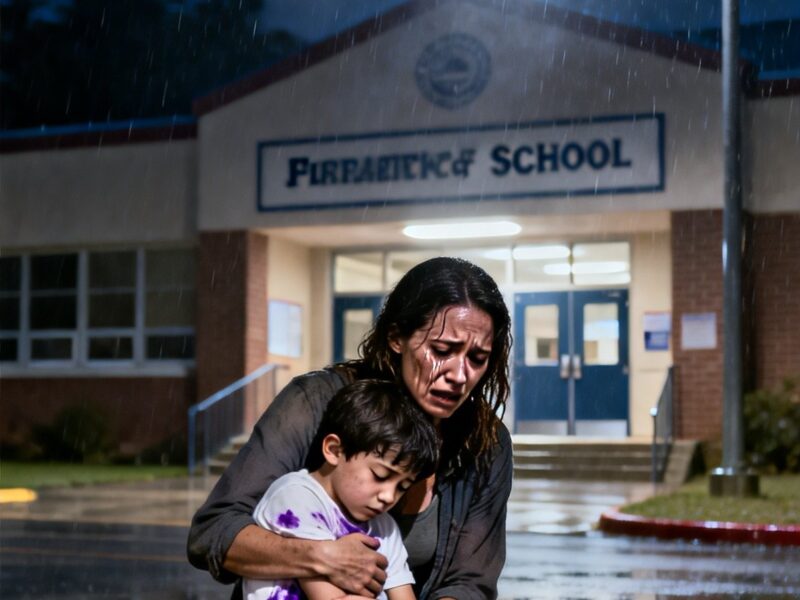
The smell of a children’s birthday party is a nauseating cocktail of sugary frosting, latex balloons, and the stale, humid air generated by twenty over-caffeinated seven-year-olds. It is supposed to be a scent of innocence, of celebration. But on that Saturday at the Sunnybrook Community Center, it smelled like the ozone before a lightning strike.
I was standing near the juice boxes, adjusting a stray streamer, when she walked in. She didn’t look like a villain. She looked like a “friend.” She carried a pastel-colored gift bag with Purple Tissue Paper erupting from the top like a silent, mocking flare. She was young—younger than me, certainly—with a polished, corporate sheen that seemed entirely too deliberate for a Saturday morning.
“Hi! I’m Chelsea,” she chirped, her voice a saccharine melody that cut through the cacophony of the bounce house. She directed the smile toward my daughter, Maya, who was currently preoccupied with trying to fit an entire marshmallow into her mouth. “A friend from your dad’s work.”
Maya barely glanced at her before spinning away toward her friends, but Chelsea’s eyes didn’t follow the child. They locked onto mine. They were calculating, predatory eyes. I recognized them instantly. I had seen them three nights ago, illuminated by the cold blue light of my husband’s phone at 11:47 p.m. In that photo, she wasn’t wearing a blazer. She was wearing my husband’s favorite dress shirt, unbuttoned, and a look of triumphant possession.
Across the room, my husband, Julian, turned into a pillar of salt. He was standing by the snack table, his hand frozen mid-reach for a napkin, his face draining of color until he matched the white paper plates. He looked like a man watching his own execution.
“Chelsea,” I said, my voice projecting with a terrifying, crystalline clarity that silenced the surrounding mothers. “So glad you could make it. I was just telling Andrea and the other moms about you.”
The smugness on her face flickered. She thought she had won. She thought by showing up at my daughter’s sanctuary, she was staking a claim on the territory of my life. She didn’t realize I had been a volcano for three weeks, and she had just walked right into the crater.
“I was just explaining,” I continued, stepping closer until I could smell her expensive, floral perfume, “exactly how you and my husband have been sleeping together for the last four months. It’s a fascinating story, really. Full of hotel receipts and late-night conferences.”
The industrial hum of the bounce house motor was the only sound left in the room.
The silence of a room full of parents is different from any other kind of quiet. it’s a heavy, judgmental vacuum. Chelsea’s smile didn’t just fade; it disintegrated. Andrea, whose son was in Maya’s class, stood with a plastic fork suspended halfway to her mouth, her eyes wide with a mixture of horror and sudden, fierce solidarity.
“Excuse me?” Chelsea stammered, her voice thinning into a pathetic reed.
Julian finally broke his paralysis, rushing toward us with his hands held out as if he were approaching a bomb. “Eleanor, babe… can we just… let’s talk outside. Please.”
“We’re done talking, Julian,” I said, pulling my phone from my pocket. I had been building this folder like a prosecutor building a capital case. I opened the gallery of Screenshots. “But perhaps Chelsea wants to hear some of her greatest hits. Volume cranked up, of course.”
I began to read. I didn’t yell. I used my “professional” voice—the one I used when I was closing deals at the firm. “‘Can’t wait to feel you again,’ October 12th. ‘Told her I have a work trip next week so we can have the whole weekend,’ November 4th.”
“Stop!” Julian lunged for the phone, but I stepped back, my spine a steel rod.
“She has no idea,” I said, looking up at the room full of witnesses. “That last one is my favorite. It really captures the profound respect you both have for the life we built.”
The room shifted. It was visceral. The other mothers began to draw their children closer, a silent herd instinct taking over. One woman literally covered her son’s ears. Chelsea began to back toward the exit, clutching that ridiculous gift bag to her chest like a riot shield.
“This is insane,” she hissed, her eyes darting for an escape. “You’re insane.”
“I have the Hotel Receipts, the credit card statements, and forty-seven distinct text messages,” I replied, my voice dropping to a deadly whisper. “And now, I have a room full of people who watched you walk into a seven-year-old’s birthday party like you belonged here. You didn’t just cross a line, Chelsea. You erased it. And in ten seconds, I make sure your HR department sees every single one of these messages. I know you met at the conference. I know you violated the company’s fraternization policy. My investigator was very, very thorough.”
She turned and ran. She didn’t walk; she fled, her heels clicking frantically against the linoleum. Julian threw one desperate, hollow look back at me before following her into the parking lot. He looked like old newspaper—gray, fragile, and ready to be discarded.
The room stayed frozen for a heartbeat longer. Then Andrea walked over and squeezed my shoulder. “I saw everything,” she whispered. “If you need a witness for the filing, I’m in.”
I held it together long enough to cut the cake. I held it together until the last guest left. But as I watched Julian’s car pull away, I realized the house was about to feel very, very empty.
The community center felt cavernous once the noise of the children had faded. Julian came back inside alone twenty minutes later. The grayness of his skin had deepened. He walked past the discarded streamers and the half-eaten cupcakes, stopping six feet away from me.
“We need to talk,” he said.
“We really don’t,” I replied, Methodically stacking empty juice boxes.
“Please. Not here. Not like this.” His voice cracked, a pathetic sound from a man who had spent four months playing a different character.
Andrea moved closer to my side, her presence a silent warning. Two other moms were still there, ostensibly helping with the trash, but their phones were out. They weren’t even pretending they weren’t recording.
“You brought her here, Julian,” I said, turning to face him. “You gave her the address. You gave her the date. You gave her our daughter’s sanctuary. So yes, actually, here is the only place left to do this.”
He reached for my arm, and I recoiled as if his skin were caustic. “Don’t touch me. Ever again.”
“I didn’t know she was coming!” he burst out, the lie leaping from his throat with practiced ease. “I swear, Eleanor, I didn’t know.”
“You expect me to believe that? After everything?” I pulled up the messages from forty-eight hours ago. I turned the screen toward him so the other parents could see the glowing text. “‘Missing you already. Can’t stop thinking about Thursday night.’ Thursday, Julian. As in, two nights ago while I was tucking our daughter into bed.”
His jaw worked, but no sound came out. He looked at the circle of judging eyes around him and withered.
“So, either you’re lying now, or you were lying to her, or both,” I said. “Which is it?”
“I was trying to let her down easy,” he whispered, his voice trembling. “I didn’t want her to—”
“To what? Show up at Maya’s party?” I felt my voice rising, the composure I had fought so hard for beginning to fray at the edges. “Too late. You invited a shark into our home and you’re surprised there’s blood in the water?”
One of the dads, a man named Brian who I had known for years, stepped forward. “Look, man. I think it’s time for you to go.”
Julian ignored him, his focus entirely on me. “Where am I supposed to go?”
“Chelsea’s place,” I said, the laugh that escaped me sounding like breaking glass. “You seemed plenty comfortable there in the photos. Oh wait—she lives with her sister, doesn’t she? Not my problem. There’s a suitcase in your trunk. I packed it this morning. I figured you’d need it eventually.”
The air seemed to leave his lungs. He sagged against the wall, and for a fleeting, treacherous second, I almost remembered the man I had married eight years ago. I remembered the man who had promised forever in front of a hundred people. Then I remembered the selfie. I remembered the calculation in Chelsea’s eyes.
“I’ll be at my mom’s,” he said finally. “We can talk tomorrow.”
“Nothing to talk about. My attorney will be in touch on Monday.”
He left without another word. The door closed, and the room finally exhaled. Andrea squeezed my hand. “Thirty minutes. We’ll handle the cleanup. You just sit down.”
I sat on a tiny plastic chair, watching my mother lead Maya back into the room. My daughter was clutching a stuffed unicorn, her birthday crown crooked. She looked at the door, then at me, and asked the question that ended my marriage for good.
“Is Daddy in trouble?” Maya asked, her small voice echoing in the quiet hall.
I knelt down, bringing myself to her eye level. The world was blurred at the edges, my vision tunneling. “Yes, sweetheart. Daddy is in trouble. But it’s not your fault. Do you understand me? None of this is because of you.”
She nodded, a solemn, heavy gesture for a seven-year-old, and ran back to her friends who were lingering near the exit. My mother, Lydia, stood in the doorway. She had been watching the entire exchange with pursed lips and eyes like flint. She had seen this movie before; my father had played the same lead role when I was nine.
“Drink something,” my mother commanded, handing me a paper cup of tepid punch. “You look like you’re about to vanish.”
“I’m fine,” I lied.
“You’re not. And you shouldn’t be.” She leaned in, her voice low. “I keyed your father’s car when I found out. Not my proudest moment. You? You gathered evidence. You stayed three steps ahead of him. You protected your daughter from the blast zone until his little friend decided to walk into the middle of the minefield. You handled this with a surgical precision he doesn’t deserve.”
Andrea joined us, her phone still gripped tightly. “Eleanor, I don’t want to add to the stress, but that text you got from the unknown number? Chelsea’s ‘you’ll regret this’? It’s already circulating on the neighborhood Facebook group. Someone posted a vague status about ‘drama at the center.’”
My stomach dropped. I had lived in this neighborhood for six years. I was the woman who organized the block parties. I was the one people called for school fundraiser ideas. Now, I was the “Vindictive Wife” in a suburban tragedy.
“Let them talk,” my mother said. “Public record is a powerful thing in a divorce court. Especially when it involves a pattern of harassment.”
I felt my phone vibrate. A message from Julian: “I need to get some things from the house. Can you give me an hour?”
I typed back with cold, steady fingers: “No. You can get them supervised next week. Change the locks. Don’t come near the property.”
I watched the three dots appear, disappear, and then reappear. My phone rang. I declined it. It rang again. I silenced it and shoved it into the dark depths of my purse.
“Time to go home,” I said to Maya.
We loaded the car with presents—shoving them into trash bags like we were fleeing a natural disaster. As I pulled out of the parking lot, I saw Julian’s car parked at the far end, his head resting against the steering wheel. I didn’t slow down. I didn’t look back.
At home, the silence was deafening. Maya went straight to her room, the door closing with a soft, deliberate thud.
“Let her process,” my mother said, sitting on my sofa and opening my laptop. “Now, give me your attorney’s email. We’re sending the incident report from the community center immediately.”
I collapsed onto the floor, the adrenaline finally crashing. I was free, but the cost of that freedom was a crater where my life used to be. And then, my phone lit up with a photo from an unknown number that made my blood run cold.
It was a selfie of Chelsea.
She was sitting in her car, mascara streaked down her cheeks, looking fragile and broken. The caption below it read: “Hope you’re proud of yourself. You destroyed two lives today over a mistake.”
I showed the screen to Andrea, who had stopped by with a bottle of wine and a stack of pizzas. She made a sound of pure disgust. “She’s really doubling down on the victim thing? She crashed a child’s birthday party!”
“It’s strategic,” I said, my brain beginning to click back into its professional gear. “She wants to bait me. She wants me to say something cruel back so she can use it to claim I’m the aggressor.”
My phone buzzed again. This time, it was a text from my Mother-in-law, Brenda.
“Eleanor, I heard what happened. I need you to understand that Julian made a terrible mistake, but destroying him publicly won’t fix your marriage. Think about Maya. She needs her father.”
I felt a surge of cold fury. I typed back: “Brenda, Maya needs a father who respects her mother. Julian made his choice over four months of hotel rooms. I am simply acknowledging that choice. Please don’t contact me again.”
I blocked her number. Then I blocked Julian’s brother. Then his aunt. I felt like I was cutting anchor lines, one by one, letting the ship drift away from a shore that was already on fire.
“She’s private on Instagram now,” Andrea noted, scrolling through her feed. “But Hannah says people are already finding her LinkedIn. Someone apparently sent the screenshots to her boss at the tech firm.”
“I didn’t do that,” I said, though I didn’t feel a shred of guilt. “But her choices have consequences. Fraternization policies exist for a reason.”
My daughter’s bedroom door opened. Maya appeared in the hallway, her birthday crown back on her head, though it was now slightly crushed. She was holding her stuffed rabbit.
“Can we watch a movie?” she asked.
“Absolutely, baby.”
We huddled on the couch, watching an animated film about friendship and magic—a world where the villains are easy to spot and the problems are solved with a catchy song. For ninety minutes, I pretended the world wasn’t falling apart. I stroked her hair and ignored the constant vibration of my phone on the coffee table.
When Maya finally fell asleep, I carried her to bed and tucked the covers around her. I stayed there for a long time, watching the rhythmic rise and fall of her chest, mourning the family she thought she had.
When I returned to the living room, my mother had made tea. “Drink. You need to sleep. Tomorrow is going to be worse.”
She wasn’t wrong. Monday morning arrived with fourteen missed calls and a voicemail from Julian that started with begging and ended with a threat of a custody battle.
But it was the email that arrived at 2:00 p.m. that changed the trajectory of the war. It wasn’t from Julian, and it wasn’t from Chelsea. It was from a woman named Sarah—Chelsea’s roommate.
The email was titled: Regarding your husband.
“Hi Eleanor,” it read. “You don’t know me, but I’m Chelsea’s roommate. She came home yesterday completely falling apart, saying she lost her job because of you. I thought you should know she’s not doing well. She’s not thinking clearly and I’m worried. I know what happened was wrong, but she’s a human being and she’s really suffering.”
I stared at the words until they blurred. The audacity was breathtaking. They were trying to make me responsible for the emotional well-being of the woman who had spent four months dismantling my life.
I forwarded it to my attorney, Victoria Vance, immediately.
“Do not engage,” Victoria replied within minutes. “This is a classic manipulation tactic. They want you to feel guilty so you’ll back off the evidence or drop the adultery claim. If she’s in a crisis, her roommate should call a professional, not the wife of her affair partner. Forward all future contact to me.”
I deleted the email, but the poison stayed in my system. I felt a weird, twisted sense of responsibility—the “good girl” conditioning I hadn’t yet purged.
I was at the school pickup line later that afternoon when I saw him. Julian was leaning against his car at the far end of the parking lot. My blood went cold. He had no right to be here. He was supposed to be at his mother’s.
I grabbed Maya’s hand the second she walked out of the school doors and moved toward my SUV. Julian intercepted us, his hands held up in that same “don’t shoot” gesture.
“I just want to talk to her for five minutes, Eleanor.”
“No,” I said, my voice low so Maya wouldn’t hear the tremor in it. “You made a scene at her party. You don’t get to ambush her at school.”
“She’s my daughter too!” he hissed, his face flushing red.
“Then you should have thought about that before you brought Chelsea to her birthday!” I retorted. Other parents were staring now. The “neighborhood drama” was getting a sequel.
A teacher began walking toward us, sensing the friction. Julian saw her and backed off, but his eyes were dark with a resentment I hadn’t seen before.
“This isn’t over,” he said.
“It is for today.”
I locked the doors and drove away, my hands shaking so hard I had to grip the steering wheel until my knuckles turned white. I got home and immediately filed for an Emergency Custody Modification.
The war had shifted. It was no longer about the affair. It was about the child. And Julian was about to realize that you don’t play games with a mother’s protection and expect to win.
Six weeks later, I stood in a courtroom that smelled of old wood and floor wax. I wore a navy suit, my hair pulled back in a severe, professional knot. Across the aisle, Julian looked haggard. His expensive suit hung loosely on his frame, and he wouldn’t meet my eyes.
His attorney, a man with a booming voice and a penchant for melodrama, stood up.
“Your Honor, we are looking at a case of systematic alienation and public humiliation. My client made a mistake, yes. But the Petitioner here weaponized that mistake. She turned a private family matter into a public execution at a child’s birthday party. She humiliated him in front of his peers, his daughter’s teachers, and his neighbors. She deliberately sought to destroy his career and his reputation.”
I sat perfectly still, as Victoria had coached me. I didn’t scowl. I didn’t cry. I looked at the judge—a woman with graying hair and eyes that had seen everything.
Victoria stood up. “Your Honor, the ‘public spectacle’ was created by the Respondent’s affair partner when she walked into a seven-year-old’s birthday party uninvited. My client didn’t seek out a confrontation; she reacted to one that was brought into her home. We have thirty-two witnesses who will testify that the disruption was initiated by the appearance of the woman my client’s husband had been seeing for four months.”
She then presented the Fraternization Policy from their firm. She presented the text messages. She presented the hotel receipts that showed Julian had spent nearly $4,000 of marital assets on his mistress over the summer.
But the final blow was the testimony of Andrea.
“Eleanor was incredibly calm, considering the circumstances,” Andrea told the court. “She knelt down to comfort her daughter first. She didn’t scream. She stated facts. The husband’s friend was the one who was aggressive. She smiled at us like we were all in on some joke.”
The judge looked at the receipts. She looked at the timestamped messages from Thursday night—the ones Julian sent while I was “too busy” with our daughter.
“Respondent,” the judge said, her voice like iron. “You brought a third party into a child’s birthday celebration. You allowed that third party to believe she had a place in that sanctuary. That shows a profound lack of judgment regarding the emotional safety of your daughter.”
The ruling was swift. I was granted Primary Physical Custody. Julian was granted visitation, but for the first three months, it was to be supervised. The house stayed mine. The assets were split, but with a significant adjustment for the funds he had diverted to the affair.
When we walked out of the courtroom, Julian’s lawyer was trying to spin it as a “partial victory.” Julian just looked at me.
“Are you happy now?” he asked. “You got everything. You ruined me.”
“I didn’t ruin you, Julian,” I said, stopping at the top of the marble steps. “I just stopped helping you hide who you really are. There’s a difference.”
I walked down the steps, the sun hitting my face for the first time in months.
I went to pick up Maya from school. We went for ice cream. We sat in a booth—just the two of us—and she told me about her science project. She was happy. She was safe. And for the first time, I wasn’t waiting for the other shoe to drop.
Four months later, it was Maya’s eighth birthday.
I was terrified of this day. I was worried the memory of the “Community Center Incident” would haunt her. But we kept it small. We stayed at home. Andrea was there with her kids. My sister flew in.
There were no uninvited guests. No pastel gift bags with purple tissue paper. No blue-light selfies.
We had a chocolate cake with rainbow sprinkles. Maya blew out all eight candles in one breath. As everyone clapped, she leaned over and whispered in my ear.
“This one’s way better, Mommy.”
“Why’s that, baby?”
“Because it’s just us. No weird stuff.”
I kissed the top of her head, the scent of her shampoo better than any expensive perfume. Later that night, after the guests had left and Maya was tucked into bed with her stuffed rabbit, my phone buzzed.
A text from Julian: “I hope she had a good day. Tell her I’ll see her on Saturday.”
I typed back: “She had a wonderful day. I’ll have her ready by 10:00.”
Then, another message appeared. “Chelsea still hasn’t found a job. You know that’s on you, Eleanor. You went too far with the public reveal.”
I looked at the message for a long time. In the past, I would have felt a twinge of guilt. I would have wondered if I was the “monster” he claimed I was. But I looked around my quiet, peaceful home—the home I had fought for. I thought about the four months of lies. I thought about the girl who sat in a shed in Indiana thirty years ago, learning that truth is the only thing that lasts.
I didn’t reply. I deleted the thread.
I walked onto my back porch and looked at the stars. The neighborhood was quiet. The gossip had moved on to a new tragedy. I was no longer the “Vindictive Wife.” I was just Eleanor. A woman who had drawn a line in the sand and refused to let anyone cross it.
Some truths need daylight. Some people need consequences. I had only turned on the switch.
I finished my wine, went inside, and locked the door. The deadbolt clicked into place with a satisfying, final thud. I went upstairs, dreamless and undisturbed, finally at peace in a life that was entirely, beautifully, my own.
People often ask me if I regret doing it the way I did. If I regret the “Birthday Party Reveal.”
I tell them the same thing: Silence is a luxury that only the guilty can afford.
If I had handled it privately, Julian would have gaslit me. He would have told me I was imagining things. He would have kept Chelsea in the shadows, a slow-growing rot in the foundation of my daughter’s life. By bringing the truth into the light—harsh, ugly, blinding light—I made sure there was no way for him to rewrite history.
I see Andrea at school every day. We don’t talk about the affair anymore. We talk about the PTA. We talk about the soccer schedule. But there’s a look we share—a look of mutual respect.
My marriage is over, but my family is intact. My daughter knows her mother is a fortress. She knows that in this house, the truth is sacred.
And as for Chelsea? I heard she moved two states away. I heard she’s still looking for a firm that doesn’t mind a history of ethics violations. I hope she finds what she’s looking for. But I hope she never walks into another child’s birthday party thinking she belongs there.
I am the architect of my own peace now. And the blueprints are perfect.