The August heat in Greenwich, Connecticut, didn’t just simmer; it suffocated. It was a thick, wet blanket that smelled of expensive fertilizer and the salt-tinged air of the Long Island Sound. I stood on the porch of the Vanguard Estate, watching my six-year-old son, Leo, line up his plastic dinosaurs on a Persian rug that probably cost more than my first three years of salary.
He was methodical, quiet—a tactical silence that felt far too heavy for a child his age.
“Dad, can we just… not go?” he asked, his voice a brittle thread. He didn’t look up from a triceratops.
I knelt beside him, the humidity making my dress shirt cling to my spine like a second, unwanted skin. “Why, buddy? You love the outdoor pool here.”
His hand trembled over a T-Rex. “Grandma Eleanor says I talk funny. She says I’m a ‘glitch in the software.’”
My jaw didn’t just clench; it locked. Eleanor Vanguard, my mother-in-law, had been treating Leo like a defective product since the moment he exited the womb. To her, his slight speech impediment and his preference for solitude weren’t traits; they were stains on the pristine Vanguard bloodline. To the Vanguards, people were either assets or liabilities. My son was being written off as the latter.
“You talk perfectly,” I lied, smoothing his hair. “We’re only staying for two hours. I promise.”
That was a lie, and I knew it. My wife, Paige, chased her mother’s approval with the desperate fervor of a cult member. Five years of marriage had taught me the fundamental law of the Vanguards: You don’t just marry the girl; you marry the trauma, the narcissism, and the monolithic ego of a real estate empire built on the bones of the middle class.
I walked into the kitchen, where Paige was obsessively arranging organic potato salad. She looked like a high-strung thoroughbred, her eyes darting to the clock every few seconds.
“Paige,” I said, my voice low. “We need to set a boundary with your mother. Her comments to Leo are crossing a line into psychological abuse.”
She didn’t stop her frantic garnishing. “Mason, please. It’s the annual reunion. Can we have one day without your ‘investigative journalist’ theatrics? She’s just old-fashioned.”
“She called him a ‘glitch,’ Paige. Our son isn’t a line of code in her commercial real estate portfolio.”
She spun around, her designer apron stained with mustard. “She’s the reason we have this life! The reason Leo is in the best private school! You’re too sensitive. You don’t understand how families like ours maintain excellence.”
I understood perfectly. It wasn’t excellence; it was a gilded cage maintained by fear and wire fraud. I was a freelance journalist who had spent a decade uncovering corporate rot. Her father, Richard Vanguard, looked at me like a cockroach that had somehow learned to use a fork.
“We’re leaving in two hours,” I stated.
“We’re staying for the fireworks,” she countered. “Move. We’re late.”
The party was a sprawling monument to excess. Fifty relatives swarmed the back lawn, clutching crystal flutes of vintage Krug. When we arrived, Eleanor glided over, looking like a predatory shark in a cream-colored pantsuit.
“There’s my little disappointment,” she said, her smile as cold as a morgue slab. “Still struggling with those ‘R’ sounds, Leo?”
Leo vanished behind my leg. I felt a cold, calculated rage begin to simmer in my marrow. My friend Tony, a high-stakes divorce attorney, had warned me months ago: “Mason, document everything. If that family decides you’re a liability, they won’t just divorce you. They’ll erase you.”
I watched Paige whispering with her mother near the dessert table. They weren’t looking at Leo with love; they were looking at him like a property with a foundational crack.
Then, the world stopped spinning.
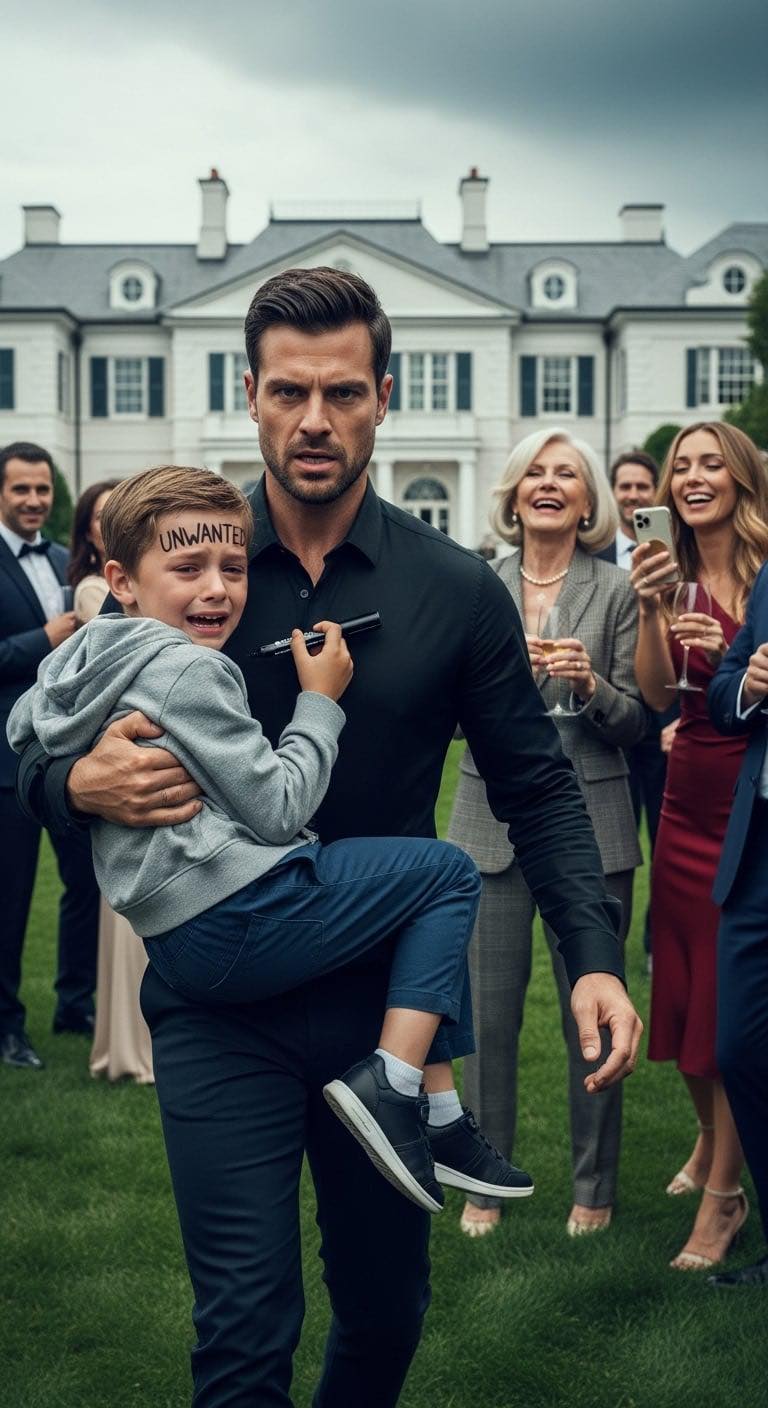
Leo was standing near the towering, five-tier cake. Eleanor approached him from behind. I was twenty feet away, trapped in a conversation with a cousin about offshore tax havens. I saw Eleanor reach into the pocket of her pantsuit. She pulled out a thick, black Permanent Marker.
I saw her hand snake out and grip Leo’s shoulder with bruising force. The chatter of fifty wealthy socialites died in an instant. A collective gasp rippled through the garden.
Time warped. I saw Eleanor cap the marker with a decisive, metallic click. She stepped back, a triumphant glint in her eyes.
Written across my six-year-old son’s forehead, in jagged, hateful block letters, was a single word: UNWANTED.
Leo stood frozen. He didn’t know what the word meant yet. He only knew the weight of fifty pairs of eyes and the cruel grip of his grandmother. He looked at his mother, searching for a savior.
I looked at Paige. I waited for the maternal roar. I waited for her to strike her mother down.
Instead, Paige let out a high, brittle giggle. She reached into her Birkin bag and pulled out her iPhone.
“Oh my god, Mom, that is savage!” Paige laughed, framing the shot. “Hold still, Leo! Mommy needs this for the group chat.”
Click.
The sound of the camera shutter was the loudest noise I had ever heard. It was the sound of my marriage dying. It was the sound of a war beginning.
I didn’t scream. I didn’t throw a punch. Rage, when it is absolute, is silent. It is a cold, mechanical thing.
I walked across the lawn. The crowd parted like the Red Sea before an avenging angel. I reached Leo, who was beginning to tremble. I knelt in the grass, ignoring the stains on my slacks, and looked him in the eyes.
“Leo,” I whispered. “Look at me.”
His eyes were brimming with tears. “Dad? Did I do something bad? Why are they laughing?”
“You are the best thing that ever happened to this world,” I said, my voice a low, vibrating chord of steel. “And today is the last day anyone ever makes you feel otherwise.”
I scooped him up. He buried his face in my neck, his small body heaving with silent sobs.
“Mason, honestly,” Eleanor sighed, waving her marker like a conductor’s baton. “It’s a joke. It’s a metaphor. The boy needs to toughen up if he’s going to inherit a cent of my money. He’s soft, just like his father.”
I turned to Paige. She was already filtering the photo on her phone.
“We’re leaving,” I said.
“Don’t be dramatic, Mason. The lobster hasn’t even been served,” Paige snapped. “Put him down. He’s ruining the vibe.”
“I am leaving,” I repeated. “You can come with us right now, or you can stay here and consider this the moment you lost your son.”
Paige glanced at her father, Richard, who was watching with an amused smirk. She chose the money. She always chose the money. “Go then. Take the car. I’ll hitch a ride with Shawn later. You’re embarrassing me in front of the Hamptons crowd.”
“You have no idea what embarrassment looks like, Paige,” I said. “But you’re about to find out.”
I walked to my car, buckled Leo into his seat, and drove. I didn’t go to our house. I went to a Residence Inn three towns over and checked in under my middle name.
Once Leo was asleep, exhausted from crying, I sat at the small desk in the hotel room. I pulled out my laptop—the one with the encrypted partition.
For eighteen months, I had been the “peacekeeper.” But I was also an investigative journalist. Every time Richard bragged about “greasing the wheels” for the Harbor Point development, I took a note. Every time Shawn mentioned the “off-book” accounts in the Caymans, I took a screenshot of his open laptop during family dinners. Every time Eleanor used the Vanguard Hope Foundation as a personal slush fund for private jets, I saved the tail numbers.
I called Jeremy Paul, the Editor-in-Chief of The Chronicle.
“Mason? It’s 11 PM on a Saturday,” Jeremy grumbled.
“I have the Vanguard Dossier, Jeremy. It’s not just a story. It’s a decapitation. I have the bank records, the bribery logs for the city inspectors, and the structural reports they buried for the apartment complex on 4th Street—the one with the shifting foundation.”
The line went silent for five seconds. “That’s your wife’s family, Mason. That’s a suicide mission.”
“No,” I said, looking at the sleeping boy on the bed, the word UNWANTED still faint on his skin despite the rubbing alcohol I’d used to scrub it. “It’s a rescue mission. I want the front page. Tomorrow.”
“Bring it in,” Jeremy said. “God help them.”
Next, I called Tony.
“I’m filing, Tony. Divorce. Full custody. And I want an emergency restraining order against the entire Vanguard tree. I have audio of the incident today. I was wearing my digital recorder for the reunion. I caught the whole thing—the marker, the laughter, Paige’s reaction.”
“Jesus, Mason,” Tony whistled. “You’ve been a busy bee. If you have that audio, and the photo Paige took? I’ll have a judge sign the order before the sun comes up. Connecticut judges hate wealthy child abusers.”
“Do it,” I said.
I spent the night writing. I didn’t write a dry report; I wrote a manifesto of corruption. I linked the Vanguards’ public philanthropy to their private greed. I showed how a family that claimed to build the city was actually hollowing it out from the inside.
By 6:00 AM, the upload was complete. The “Nuclear Option” had been launched.
At 7:00 AM, the front door of the hotel room rattled. It was Paige. She had tracked the car’s GPS. She let herself in with a spare key she’d demanded from the front desk, claiming a family emergency.
She looked wrecked—her makeup smeared, her dress wrinkled. She looked like the ghost of the woman I had married.
“You’ve lost your mind,” she hissed, stepping into the room. “My father is calling his lawyers. He’s going to have you arrested for kidnapping.”
I took a slow sip of hotel coffee. “Check the news, Paige. Use your phone for something other than social climbing for once.”
She frowned, pulling out her iPhone. Her face went from pale to translucent. The headline on The Chronicle‘s website was monolithic: VANGUARD PROPERTIES: A LEGACY OF BRIBERY, FRAUD, AND ENDANGERED LIVES.
Below the headline was a photo of the Harbor Point blueprints and a copy of a $50,000 check made out to a city inspector’s “consulting firm.”
“What did you do?” she whispered. “Mason, what did you do?”
“I told the truth,” I said. “The FBI is likely at your father’s office right now. The IRS is moving on the foundation’s accounts. And as for you… you’re being served with divorce papers in approximately ten minutes.”
“You’re destroying us!” she shrieked.
“No, Paige. You destroyed yourself when you laughed at your son while your mother branded him like cattle. You chose a side. This is the consequence.”
A knock at the door signaled the arrival of two people: a process server and a uniformed police officer.
“Paige Vanguard-Miller?” the server asked. “You’ve been served.”
The officer stepped forward. “Ma’am, there is an emergency protective order in place. You are to have no contact with Mason Miller or Leo Miller. You need to leave these premises immediately.”
Paige looked at me, her eyes filled with a terrifying mix of realization and hatred. “My father will bury you in a mountain of legal fees. You’ll be broke before the first hearing.”
“Your father’s assets are being frozen as we speak,” I said. “He can’t even pay for his own bail, let alone your vendetta.”
The next six months were a blur of depositions and headlines. The Vanguard empire didn’t just crumble; it imploded. Richard Vanguard was indicted on 24 counts of racketeering and wire fraud. Shawn was caught trying to flee to the Grenadines with a suitcase full of bearer bonds.
But the real battle was in Courtroom 4B.
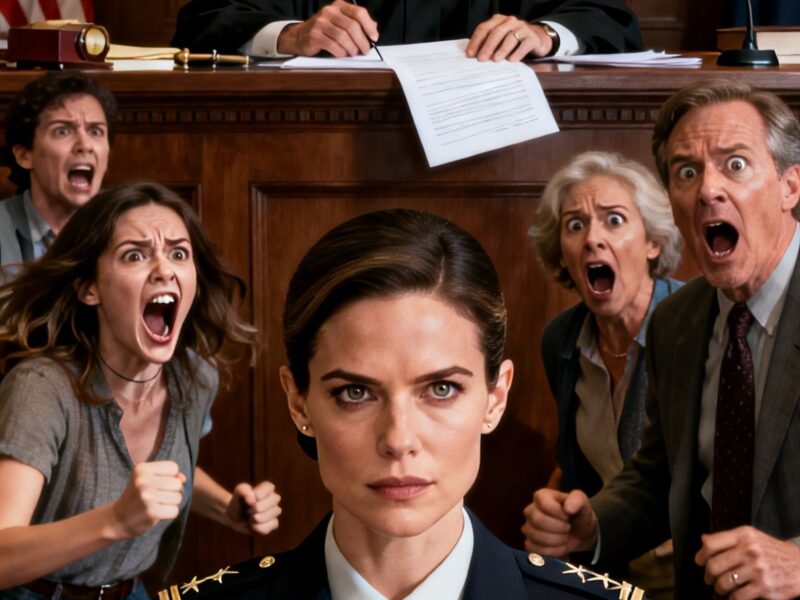
Marcus Sterling, a lawyer known as ‘The Butcher of Greenwich,’ tried to paint me as a disgruntled, unstable spouse who fabricated evidence. He sat at the plaintiff’s table with Paige and Eleanor, who still wore her pearls like they were armor.
“Your Honor,” Sterling boomed. “Mr. Miller is a man of modest means who orchestrated this ‘scandal’ to extort my client’s family. The incident at the party was a harmless prank, taken out of context.”
Tony stood up. He didn’t say a word. He simply pressed ‘Play’ on the courtroom’s audio system.
The sound of the garden party filled the room. Then, Eleanor’s voice, sharp as a razor: “So everyone knows what he is. Unwanted.”
Then, the sound of Paige’s laughter. High. Cruel.
Then, the small, broken whimper from Leo: “Mommy, please stop.”
The judge, a woman who had seen the worst of humanity, looked at Eleanor and Paige with a disgust so profound it felt physical.
“Mr. Sterling,” the judge said, her voice trembling with suppressed rage. “In thirty years on the bench, I have seen many things. But I have rarely seen such a casual display of emotional depravity. This wasn’t a joke. It was an assault on a child’s soul.”
The ruling was swift. I was granted sole legal and physical custody. Eleanor and Richard were slapped with permanent restraining orders. Paige was granted supervised visitation for two hours a week at a state-run facility—no more, no less. She was also ordered to complete 500 hours of community service and a mandatory parenting course.
As we walked out of the courthouse, the Vanguards were surrounded by a swarm of reporters. Eleanor tried to shield her face with a Chanel bag. Richard was being led away in handcuffs for a separate federal hearing.
I held Leo’s hand tightly. He was wearing his favorite dinosaur t-shirt. He looked up at the sun, not at the cameras.
“Is it over, Dad?” he asked.
“It’s over, Leo. We’re going home.”
Two years later.
We lived in a small, cozy house in Vermont. No iron gates. No marble foyers. Just a big backyard and a golden retriever named Buster.
Leo was thriving. His speech impediment was gone, replaced by a confident, inquisitive voice. He was the star of his soccer team and a chess prodigy. The Vanguards were a dark memory, a chapter in a book we had long since finished reading.
Paige reached out occasionally, sending letters from the modest apartment she now occupied. She had lost the estate, the cars, and the social standing. She worked as a receptionist for a dental office. Her letters were filled with apologies, but they were the apologies of someone who missed the lifestyle, not necessarily the husband. I kept them in a box for Leo to read when he was eighteen. It would be his choice to forgive.
One Saturday morning, I found Leo at the kitchen table. He was drawing. He had a black marker in his hand.
My heart skipped a beat. A flash of trauma surged in my chest.
“What are you drawing, bud?” I asked, trying to keep my voice steady.
He looked up and smiled. He had written a word on a piece of construction paper. He had used a black marker, but he had decorated the letters with bright yellow suns and blue stars.
The word was: WANTED.
“I’m making a sign for my room,” he said. “So I remember.”
I sat down next to him and pulled him into a hug. The “Unwanted” boy was gone. In his place was a child who knew his worth was not measured in real estate or bank balances, but in the fierce, unyielding love of a father who was willing to burn down a kingdom to save him.
I looked out the window at the Vermont woods. The Vanguards had tried to label my son a liability. But in the end, he was the greatest asset I ever had.
The coup was complete. And for the first time in my life, the silence was beautiful.