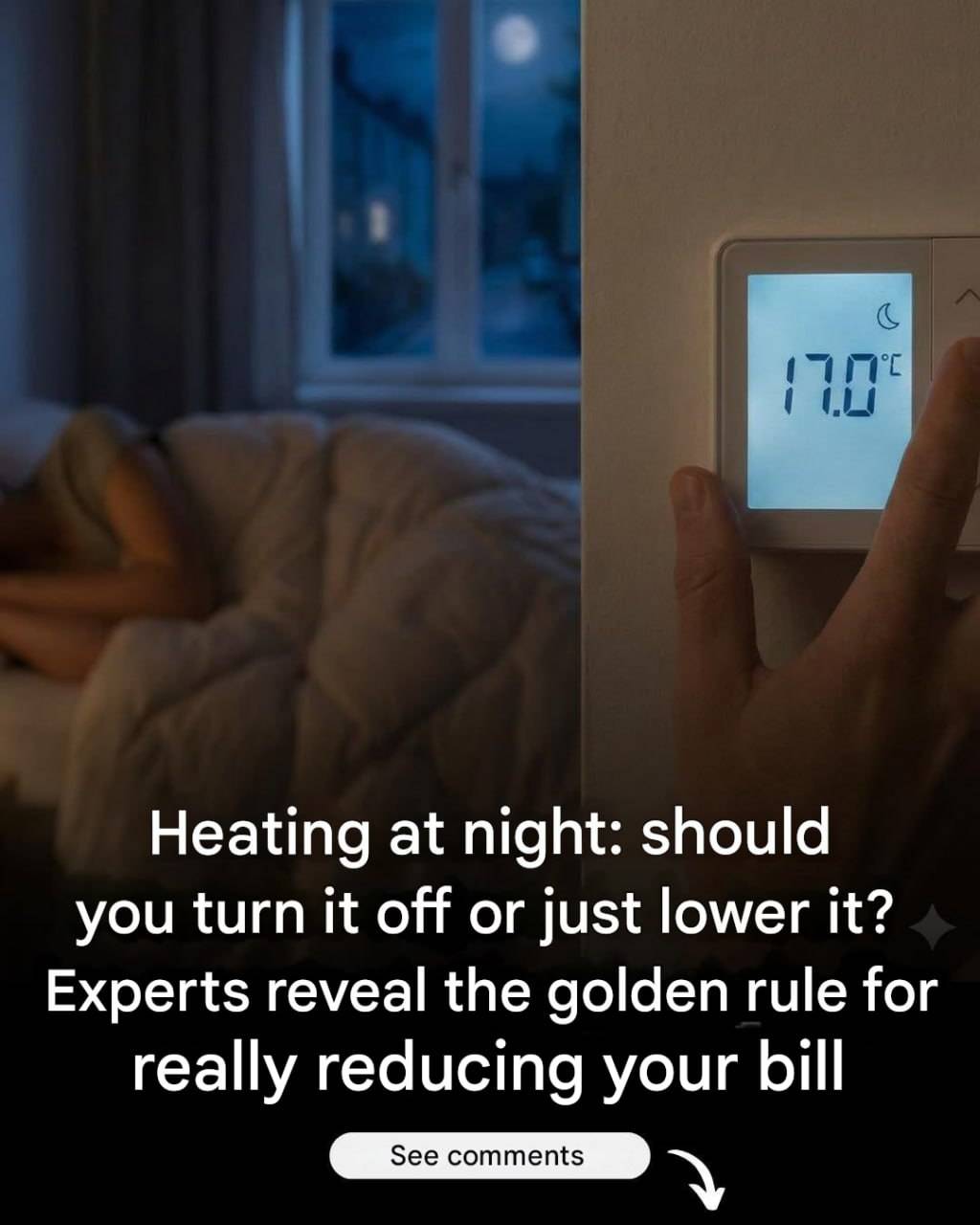
Experts reveal the golden rule for truly reducing the bill
Every winter, the same question arises in millions of homes: should you turn off the heating completely at night or simply lower it?
Between fear of being cold, fear of a high bill and deeply ingrained misconceptions, it is difficult to know what the best solution is.
However, the experts’ answers are now clear, measured, and above all, based on concrete data. Here’s what you really need to do to save money without sacrificing your comfort.
✅The experts’ golden rule: never turn everything off.
According to recommendations from ADEME (French Agency for Ecological Transition), turning off the heating completely at night is not the best solution in the majority of homes.
👉The golden rule is simple:
The temperature should be lowered by 2 to 4°C compared to the daytime heating, but not turned off completely.
Concrete example:
Daytime temperature: 19 to 20°C
Ideal nighttime temperature: 16 to 17°C
This slight decrease allows:
✅Immediate energy savings.
✅Improved thermal comfort upon waking.
✅Protection of the system against humidity and frost.
❌Why switching off the heating completely can cost more.
Contrary to what many believe, completely switching off the heating can lead to:
Contrary to what many believe, completely turning off the heating can lead to:
1. Increased energy consumption upon restarting:
When the house is completely cold, the boiler or radiators must operate at full power in the morning to raise the temperature.
👉As a result, the savings made overnight are often negated upon waking.
2. Increased humidity in the home.
A cool home promotes:
Condensation,
mold,
wall deterioration
, and humid air are more difficult and expensive to heat.
3. Thermal discomfort that is dangerous to health.
According to the recommendations of the World Health Organization, the indoor temperature should not fall below 16°C, particularly for:
The elderly
, children,
and vulnerable individuals:
💡How much can you actually save by lowering the heating at night?
Experts agree on a simple figure:
🔥Lowering the temperature by 1°C results in approximately 7% energy savings.
SO :
Lowering the temperature by 3°C at night can save up to 20% on nighttime heating costs.
Over a full season, this represents several tens, or even hundreds, of euros depending on the property.
🏠The right temperature for each room:
Experts recommend:
Bedrooms: 16–17°C
Living room in the evening: 19–20°C
Bathroom (when in use): 21–22°C
Hallways / rooms rarely used: 15–16°C
🔧The crucial role of the thermostat
A programmable thermostat is now the most effective weapon against waste: Bathroom furniture
It automatically lowers the temperature at night.
It restarts the heating just before waking up.
It prevents forgetfulness and excesses.
👉Result: more comfort, less stress, and a reduced bill without thinking about it.
⚠️In what situations can you really turn everything off?
There are a few exceptions where turning it off might be considered:
Very recent and perfectly insulated housing.
Absence of several days.
Region with a very mild climate.
But in the majority of conventional housing, lowering the temperature remains more profitable than cutting it.
✅Good habits to adopt at night
to maximize savings:
Close shutters and curtains completely.
Avoid turning the heating up too high in the morning.
Ventilate briefly (5 to 10 minutes), even in winter.
Never block radiators.
🔚Conclusion: The true balance between comfort and savings.
👉Turning off the heating completely at night is a bad idea in most cases.
👉Lowering the temperature by a few degrees is the best compromise between:
Energy savings,
thermal comfort,
home protection,
and occupant health:
By simply applying this golden rule, you can significantly reduce your bill without shivering under the covers.