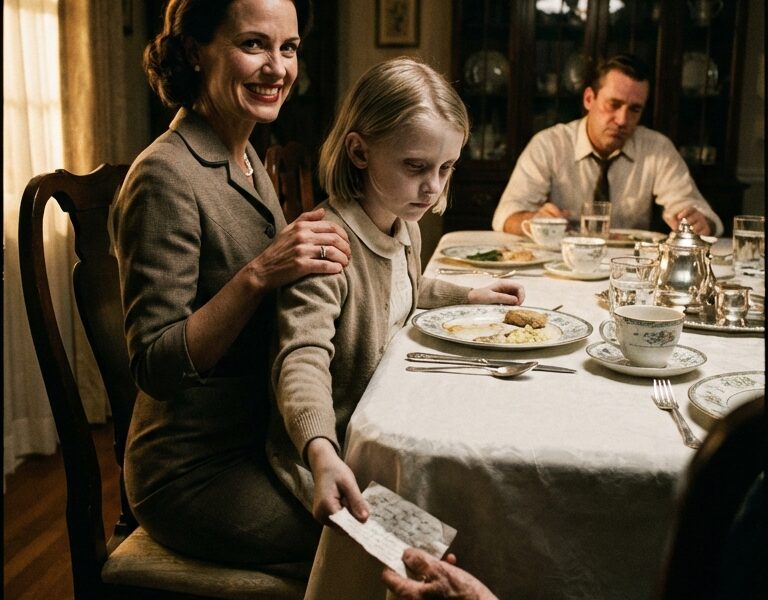
My name is Susan Mitchell, and for twenty years, I have been the architect of everyone’s stability but my own. When our parents died, I was twenty; I didn’t just become a sister to my younger siblings, I became a human shield. I absorbed the shocks of the world—the debt, the grief, the hunger—so they wouldn’t have to. I worked double shifts, skipped every vacation, and hoarded every spare cent in a savings account that grew with agonizing slowness. Six months ago, I finally bought a house. It wasn’t a mansion, but it was mine—the physical manifestation of two decades of deferred gratification.
The night of my housewarming party was supposed to be my coronation. My living room hummed with the warmth of conversation and the clinking of wine glasses. I stood near the mantle, feeling a rare, fragile sense of peace, until my brother Kevin detached himself from the crowd. He approached me with a plate in his hand and a smile that was a fraction too wide, his movements uncharacteristically rigid.
“Eat up, sis,” he said, extending a large slice of chocolate cake. “We made this especially for you.”
It was a simple gesture, yet a cold prickle of instinct raced down my spine. I had raised this boy. I knew his lying face and his greedy face, but this was different. This was the face of a predator watching a trap. His eyes were fixed on my hands, tracking my fork with an intensity that felt like a physical weight. The air around us suddenly felt charged with a silent, unnamed threat.
“Thanks,” I said, my voice steady despite the alarm bells. I pretended to stumble slightly, adjusting the hem of my dress to break his line of sight. In one fluid motion—a sleight of hand born from years of managing chaotic family dinners—I switched my plate with the one sitting on the side table. It belonged to Connie, my sister-in-law, who was standing beside me, lost in a joke. No one noticed. Kevin’s shoulders dropped an inch; he thought the deed was done.
I took a bite from the new plate. It was harmless, sweet, and moist. Three minutes later, Connie picked up her fork and took a large bite of the slice originally meant for me.
The reaction was terrifying because it wasn’t immediate. It started as a subtle vibration in her hand that traveled up her arm. Then, the color drained from her face as if someone had pulled a plug. She pressed a hand to her diaphragm, her voice slurred and broken as she tried to call for Kevin. Her pupils blew wide, and her knees buckled. As she sank into an armchair, gasping for air, the room plunged into a suffocating silence.
Kevin froze. He looked at me—not with concern, but with a jarring, naked confusion. Then he scrambled to his wife’s side. “She must have had an allergic reaction,” he announced to the stunned guests, hoisting her up and almost dragging her toward the door. He didn’t call an ambulance. He didn’t ask for help. He just wanted her out of my house.
As his taillights disappeared into the darkness, I locked my door and leaned against it, the silence pressing against my eardrums. That wasn’t an allergy. That was a dose. My mind raced back to a spring afternoon when Kevin sat at my kitchen table, eyeing my empty living room and offering to “manage everything” if I ever got too tired. At the time, it sounded like love. Tonight, it sounded like a prelude to an execution.
I went into my home office and opened the bottom drawer of my filing cabinet. I pulled out a manila folder labeled “Kevin – POA.” I had signed it years ago, trusting him when he said a Durable Power of Attorney was “standard procedure” for single homeowners. I read the fine print now with new, cold eyes: “Effective immediately upon the determination of incapacity by a single attending physician…”
If I had eaten that cake and collapsed, slurring and incoherent in front of witnesses, Kevin would have gained absolute control. He could have sold my house, drained my accounts, and dictated my medical care. They hadn’t tried to kill me; they had tried to erase me.
The next morning, I was at the office of my attorney, Scott Evans. He read the document and looked up with a grave expression. “Susan, this is a nuclear weapon. If triggered, Kevin becomes you, legally speaking. And the trigger is dangerously subjective.”
“Revoke it,” I commanded. “Immediately.”
We spent the hour fortifying my legal defenses. I appointed my youngest sister, Donna—the only one who had ever worked as hard as I did—as my new medical proxy. But the legal wall was only half the battle. I drove straight to my bank and demanded an audit from Renee Patel, the branch manager.
“I need to know every transaction Kevin Mitchell has authorized on my accounts,” I said.
Renee’s face went pale as she scrolled through the screen. “Susan… there have been monthly auto-transfers for three years. Twelve hundred dollars a month categorized as ‘Family Support.’ There are also cash advances and a payoff for a car loan in his name.”
The numbers swam before my eyes. Thousands of dollars—money I had scraped together by couponing and denying myself every luxury—had been siphoning away into Kevin’s lifestyle. While I was skipping meals to save for this house, he was furnishing his own with my labor.
“Freeze everything,” I told her, my jaw set. “If he tries to buy a pack of gum with my money, I want sirens to go off.”
Two weeks of high-alert paranoia followed. I changed the locks and installed cameras, living in a fortress of my own making. Then, Donna showed up. She looked wrecked, clutching her phone like a lifeline. She told me she had gone to Kevin’s house and left her phone recording in the kitchen while she slipped away to the bathroom.
“I’m so sorry you have to hear this,” she whispered, handing me the phone.
I pressed play. The audio was grainy but unmistakable.
“The dose was too high, Kevin!” Connie’s voice was sharp, recovered but panicked. “I nearly stopped breathing. If Susan had taken that, the paramedics would have been called instantly.”
“It was supposed to just make her confused,” Kevin’s voice hissed back, cold and devoid of the brotherly warmth he had faked for years. “A few months of ‘early-onset dementia’ and the house would have been ours. We’re drowning in debt, Connie. That house is the only way out. We just need her out of the way for a little while.”
I turned off the recording. The betrayal was complete, documented in their own voices. They hadn’t just stolen my money; they had planned to steal my mind and my freedom. I looked around my quiet, hard-earned home. I had spent my life being a shield for them, but the shield was gone. I wasn’t going to hide anymore. I took the recording, the bank audits, and the legal revocations, and I picked up the phone to call the police. It was time for Kevin to learn that when you push a shield too far, it becomes a sword.