The Inheritance of Integrity
Chapter 1: The Stranger in the Gallery
I’m Haley, thirty-two years old. My mother, Diane, rolled her eyes the second I walked into that courtroom. It wasn’t a subtle eye roll, either. It was the kind that screams, “Here we go.” The kind that implies I am the inconvenience in her perfectly crafted victim narrative. She adjusted her silk scarf, leaned over to my father, Scott, and whispered something that made him smirk.
They looked at me not as a daughter, but as a defendant. A barrier between them and the money they believed was their birthright.
But then, Judge Marcus Brennan entered the room. The bailiff called for all to rise. We stood. The judge sat, adjusted his robes, and picked up the case file. He scanned the paperwork, his expression bored, professional. Then, he looked up to see who was present.
His eyes went from the paperwork to my face. And I watched recognition hit him like a freight train.
He froze. His hand, holding a gold fountain pen, hovered over the docket. He looked at me, then at the name on the file, then back at me. A slow, almost imperceptible warmth flooded his eyes.
“Wait,” he said slowly, setting down his pen. “These allegations… they are against you?”
My parents, sitting at the plaintiff’s table, straightened up. They sensed a shift in the atmosphere but couldn’t interpret it. They thought perhaps the judge was shocked by my alleged “crimes.”
“Yes, Your Honor,” their shark of a lawyer, Richard Palmer, said smoothly. “We are alleging undue influence and manipulation of a vulnerable senior citizen.”
Judge Brennan looked at Diane. Then he looked at Scott. Finally, his gaze returned to me, and for a split second, I saw the ghost of a smile play on his lips.
“Proceed,” he said. But the tone had changed. It wasn’t the tone of a judge hearing a standard probate dispute. It was the tone of a man watching a trap snap shut.
My parents had no idea who I really was. To them, I was just the girl they abandoned three decades ago. They didn’t know about my career, my reputation, or the man who had raised me. And honestly, that was the best part.
They thought this lawsuit was their victory lap. They had no idea they were about to become the punchline.
Let me back up three months.
My grandfather died. Judge William Parker. Forty years on the Supreme Court bench of our state. The man who actually raised me while my parents were off living their “best lives,” pretending I didn’t exist.
His funeral was massive. Every judge, attorney, and politician in the state showed up to pay respects. The cathedral was standing room only. I delivered the eulogy, my voice shaking only once when I spoke about our Sunday dinners. My parents sat in the back row. They arrived late, wearing oversized sunglasses, and left before the reception. Classic Diane and Scott Morrison behavior.
I hadn’t seen them in over a decade. Not since my eighteenth birthday, when my grandmother died. They showed up for exactly ninety minutes, ate the free food, and disappeared again.
After Grandma Helen passed, it was just Grandpa and me. He was seventy-three then, still sharp, still working, still making sure I had every opportunity he could provide.
Here is the thing about my parents: My mother got pregnant at eighteen and decided motherhood cramped her style. My father was a promising hockey player with big dreams and an ego to match. A baby didn’t fit the aesthetic. So they did what selfish people do. They dropped me at my grandparents’ house when I was three months old and basically vanished.
Oh, they visited. Twice a year, if the stars aligned. Christmas and maybe my birthday. Diane would show up wearing designer clothes paid for by Grandpa, kiss the air near my cheek, and spend the entire visit critiquing how Grandma was raising me. Too soft, she’d say. Too indulgent.
Meanwhile, Scott avoided these visits entirely because Grandpa called him out for being a deadbeat. So, I watched my father on TV instead. Every time the Bruins played, Grandpa had the game on. Not because he cared about hockey—he hated the sport—but because he wanted me to know my father existed somewhere, even if he chose not to exist in my life.
I never felt like I was missing anything, though. Grandma Helen and Grandpa William gave me everything. Real love. The kind that shows up. They were at every school play, every soccer game, every debate competition. They were my parents in every way that actually matters.
When Grandma died suddenly from a stroke, I thought my world had ended. I was eighteen, about to start college, and the woman who raised me was just gone. Grandpa carried both of us through that grief. And somewhere in that darkness, he started really talking to me about his work. About justice. About using power responsibly.
That’s when I decided to follow in his footsteps.
I graduated top of my class from law school. Grandpa was there, beaming in the front row. My parents sent a card with no return address. Grandpa used his considerable influence to help me land a prosecutor position, but I kept it only because I was good. By thirty, I was handling high-profile cases—financial crimes, corruption, things that made headlines.
My parents had no idea. They thought I was probably working some boring office job, if they thought about me at all.
Grandpa retired when I was twenty-seven. He said he’d done his part. But really, he wanted time with me while he could. We had dinner every Sunday. Sacred. He taught me everything about reading people, courtroom strategy, and maintaining integrity when everyone around you is compromised.
When he died at eighty-seven, peacefully in his sleep, I felt that familiar emptiness return. But this time, I wasn’t a lost eighteen-year-old. I was thirty-two, and I had become exactly who he raised me to be.
The will reading happened one week later. I expected maybe his law books, his watch, some personal items.
What I got was everything.
The house. The investment portfolio. The savings. The life insurance. Three million dollars. Everything he spent decades building, he left to me with one very specific provision in a sealed letter.
My dearest Haley, it began. You are reading this because I am gone. But my love for you continues. You are the greatest joy of my life. I leave you everything because you earned it. Not through blood, though you are my blood. But through showing up. Through loving me and your grandmother when others could not be bothered. Your parents made their choice long ago. This is mine. Be strong, my girl.
I cried reading that. Not sad tears. Validation tears.
The attorney handed me another envelope. “Your grandfather anticipated they might contest this,” the attorney said. “He wanted you armed.”
Inside was documentation. Bank statements showing Grandpa gave Diane $3,000 monthly starting when I was a baby, continuing for over twenty years. More than $800,000 total. Emails from her asking for more. Texts promising to visit and then cancelling. Letters from Scott requesting money for failed business ventures.
A paper trail of their neglect and their greed.
Exactly thirty days later, my attorney called. Diane and Scott had filed a lawsuit claiming “undue influence.” They said Grandpa was incompetent, that I manipulated an old man, that they deserved their share.
I actually laughed. I was in court prosecuting a securities fraud case when I got the message. The irony was suffocating. They assumed I was still that abandoned baby, that I’d be easy to intimidate.
They had no idea who was waiting for them.
Chapter 2: The Narrative of Victims
Palmer’s opening statement was a masterclass in fiction. And look, I’ve prosecuted enough liars to recognize talent when I see it. The man was good.
He painted Diane as a devoted daughter cruelly separated from her loving father by manipulative grandparents who poisoned the relationship. He described me as calculating—a siren who isolated an elderly man and positioned herself as his sole caregiver to secure a payout.
“Judge Parker was suffering from profound grief after losing his wife of sixty years,” Palmer argued, his voice dripping with synthetic sympathy. “He was vulnerable. Depressed. And the defendant, Haley Morrison, exploited that vulnerability. She manipulated him into believing she was the only one who cared. This will doesn’t reflect Judge Parker’s true wishes. It reflects her calculated campaign to inherit his wealth.”
I sat at the defendant’s table next to my lawyer, Thomas, keeping my face neutral. But inside, I was cataloging every distortion, sharpening my knives for the cross-examination.
Thomas stood for our opening. He didn’t need dramatics. The facts were damning enough.
“Your Honor, this case is simple. Judge Parker was brilliant, careful, and intentional. He left his estate to the person who earned it through thirty-two years of consistent love and presence. The evidence will show the plaintiffs received over $800,000 from him during his lifetime while barely maintaining contact. Meanwhile, Haley Morrison showed up every single day.”
Judge Brennan looked at Palmer. “Call your first witness.”
“The plaintiff calls Diane Morrison.”
My mother stood, smoothing her conservative black dress. She had dressed for sympathy—minimal makeup, hair pulled back. She looked like the grieving daughter. It was almost convincing if you didn’t know her soul was made of dry ice.
She took the oath and sat down. Palmer approached with practiced gentleness.
“Mrs. Morrison, describe your relationship with your father.”
Diane’s voice wavered perfectly. “He was everything to me. My hero. When my parents died in a car accident when I was eight, he and my grandmother took me in. Raised me.”
True so far. But convenient omissions were coming.
“And when you had Haley, what was your father’s involvement?”
“He was so excited to be a grandfather,” Diane said, dabbing at her eyes with a tissue she had produced from nowhere. “He wanted to help. I was so young, just eighteen, still figuring out my life. When he offered to watch Haley while Scott and I got established, I thought it was temporary.”
Temporary. Nineteen years is a hell of a temporary arrangement.
“But it became permanent?”
“Yes,” Diane said, her voice breaking. “They kept her. Made it seem like Scott and I were bad parents for wanting careers. Made me feel guilty every time I couldn’t visit. They turned my daughter against me.”
I kept my expression blank, but mentally I was shredding every word.
“To this day, we contend Judge Parker was unduly influenced by the defendant,” Palmer concluded. “That she isolated him. Manipulated him.”
Thomas stood. “No questions yet, Your Honor. We reserve for cross.”
We let them parade Scott up there next. He looked bored, checking his watch like he had a tee time to make. He testified that he “respected” Grandpa but felt unwelcomed in the house. He claimed Grandpa was “judgmental.”
Yeah, Grandpa tended to judge people who abandoned their infants. It was a character flaw of his.
Then Palmer called a hired gun—a psychiatrist who had never met Grandpa—to testify that grief could cause cognitive decline. It was weak, and Judge Brennan looked unimpressed.
Finally, it was our turn.
Thomas stood up. “Your Honor, the defense calls Haley Morrison.”
I walked to the stand. The wooden floorboards creaked under my heels. I raised my right hand. I swore to tell the truth. And for the first time in thirty-two years, I looked directly at my parents from a position of power.
“Haley,” Thomas started gently. “Tell the court about your childhood.”
I took a breath. “I was born when my mother was eighteen. She and my father decided they weren’t ready. When I was three months old, they brought me to my grandparents. What was supposed to be temporary became permanent. They left and rarely returned.”
“How often did they visit?”
“When I was young, maybe three or four times a year. As I got older… less. By my teens, twice a year, if I was lucky. Christmas and sometimes my birthday. My father, even less.”
“Did Diane and Scott contribute financially?”
“No,” I said firmly. “My grandparents paid for everything. Clothes, school supplies, college, law school. Diane and Scott took money from my grandfather, but never gave anything back.”
We walked through the history. The missed graduations. The silence. The way Grandpa stepped in to fill every void they left.
Then Thomas asked the big question.
“When did you learn about the will?”
“At the reading, a week after he died. I was shocked. I expected personal items. I had no idea he planned to leave it all to me.”
“Did you ever discuss the will with him?”
“Never. He never told me his plans. I think he wanted me to love him without ulterior motive. Which I did.”
“What would you say to the accusation you manipulated him?”
I looked directly at Diane. She refused to meet my eyes.
“I spent three decades showing up,” I said, my voice steady. “I didn’t manipulate him. I loved him. There’s a difference.”
Then came Palmer’s cross-examination. He tried to rattle me. He asked if I was bitter. He asked if I had poisoned Grandpa’s mind.
“Mr. Palmer,” I said, leaning forward. “My grandfather was a Supreme Court Justice for forty years. He could spot a lie from a mile away. If I had tried to manipulate him, he would have written me out of the will himself. He made his decision based on facts. And the fact is, I was there. They weren’t.”
Palmer had nothing. He sat down, defeated.
But the final nail in the coffin wasn’t my testimony. It was the evidence Thomas presented next.
He projected a photograph on the screen. It was my high school graduation. There was Grandpa, front row, beaming. There was Grandma.
“Where are Diane and Scott?” Thomas asked the empty room. “They aren’t there.”
Then he pulled out the financial records.
“Your Honor,” Thomas said, addressing Judge Brennan. “The plaintiffs claim they deserve a share of the estate. The records show that over twenty years, Judge Parker gave Diane Morrison $842,000 in monthly stipends and emergency loans. He gave Scott Morrison $150,000 for failed business ventures. They have already received their inheritance. They spent it while he was alive.”
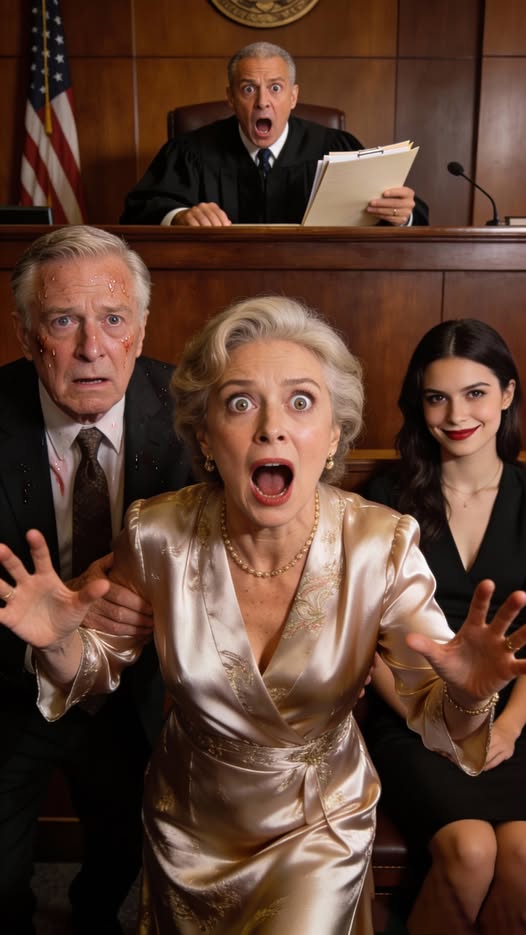
The courtroom went silent. Diane let out a sob—this one real. Scott swore under his breath.
Chapter 3: The Verdict
Judge Brennan called for a recess. We waited in the hallway. My mother paced, her heels clicking nervously. My father stared at his phone. I stood by the window, watching the city traffic, feeling a strange sense of peace. I had said my piece. Grandpa’s legacy was defended.
When we were called back in, the atmosphere was heavy. Judge Brennan took the bench. He didn’t look at his notes. He looked at my parents.
“I have reviewed all evidence and testimony carefully,” he began. “This is a difficult case because it involves family relationships, which are complicated. However, my role is to determine whether Judge Parker’s will should stand as written.”
He paused.
“The plaintiffs argue that Judge Parker was unduly influenced. The evidence does not support this. Multiple witnesses testified to his mental clarity. His attorney confirmed he was methodical. What the evidence does show is a pattern.”
He leaned forward.
“A pattern of absence by the plaintiffs and presence by the defendant. A pattern of financial taking by the plaintiffs and financial responsibility by the defendant. Judge Parker didn’t need to be manipulated into seeing this pattern. He lived it for thirty-two years.”
My chest tightened. This was it.
“The court finds that Judge Parker’s will reflects his true intentions. The will stands as written. The plaintiff’s petition is denied.”
Diane gasped. Scott slammed his hand on the table.
“Furthermore,” Judge Brennan continued, his voice hardening, “I am awarding attorney’s fees to the defendant. The plaintiffs brought this case without merit, causing unnecessary expense and emotional distress. They will bear the costs of this litigation.”
Palmer shot up. “Your Honor, we respectfully request—”
“My ruling stands, Counselor. We are adjourned.”
The gavel cracked down like a thunderclap.
It was over.
I shook Thomas’s hand, tears stinging my eyes. I didn’t cry for the money. I cried because Grandpa had been heard.
As we gathered our things, my mother approached me. Her mascara was streaked. She looked older, smaller.
“Haley,” she said, her voice trembling. “Please. Can we talk?”
I looked at her. Really looked at her.
“There is nothing to talk about, Diane.”
“I’m your mother,” she whispered, reaching for my arm.
I stepped back, out of her reach.
“You’re the woman who gave birth to me,” I said. “My mother was Helen Parker. She earned that title by showing up. You had thirty-two years to be my mother. You chose not to be. You don’t get to claim that title now just because there’s a check attached to it.”
“Please,” she sobbed. “I made mistakes. But I love you.”
“No,” I said firmly. “You love what I can give you. We are done. Don’t contact me again. Don’t show up at my house. We’ve been done since I was three months old. This just makes it official.”
I turned my back on her. Behind me, I heard her weeping, heard Scott shouting at his lawyer. I walked out of the courtroom and into the sunlight.
Chapter 4: The Unsent Letters
Six months after the verdict, life had settled. I was working, investing the inheritance, and living quietly. Then, one Saturday, my doorbell rang.
A woman stood there holding a large manila envelope. Patricia Caldwell, Grandpa’s neighbor for thirty years.
“I should have come sooner,” she said, handing me the package. “I helped your grandfather clean out his study a few months before he died. He asked me to destroy these, but… I couldn’t. I thought you might need them one day.”
I opened the envelope. Inside were dozens of letters. All in Grandpa’s handwriting. All addressed to Diane, but never sent.
I sat on my floor and read them for hours.
Dear Diane, one read, dated twenty years ago. Haley had her dance recital today. She kept looking at the audience, searching for you. I watched her face fall when she realized you weren’t there. How many more times will I have to watch my granddaughter’s heart break because you can’t be bothered?
Another, dated two years before his death: I’ve given you over $600,000. I told myself it was helping, but I realize I’m just enabling you. I’m done with the extra money. I hope someday you’ll understand that the greatest gift I ever gave you wasn’t cash. It was Haley. You gave her to me, and she saved me. I just wish you could see what you’re missing.
I wept. Not out of grief, but out of gratitude. He had seen everything. He had struggled with his love for his daughter versus his duty to me, and he had chosen me.
I called Thomas. “Should I show these to Diane?” I asked. “Maybe she’ll understand.”
“Haley,” Thomas said gently. “She already knows. Deep down, she knows. Showing her these letters won’t change who she is. It will just drag you back into her orbit.”
He was right. I put the letters in a safe box. They were my proof of love, not a weapon for revenge.
Years passed. I worked hard. I built a reputation as a fierce but fair prosecutor. And then, at thirty-three, I was offered a judgeship. One of the youngest in state history.
During my confirmation hearing, a senator brought up the lawsuit. “Ms. Morrison, you sued your parents. Does that show a lack of family values?”
I looked him in the eye. “Family values means valuing the people who show up for you. My grandparents demonstrated true family values by raising a child that wasn’t their responsibility. My biological parents demonstrated the opposite. I stood up for the people who stood up for me.”
The room applauded. I was confirmed.
Chapter 5: The Legacy
Five years later, word came that Diane had died. Heart failure. Scott sent a brief email.
I didn’t go to the funeral. I didn’t send flowers. People called me cold. I called it honest. I didn’t grieve a mother I never had.
I continued my work. I became known as a judge who prioritized the welfare of children over the rights of absent parents. I wrote opinions that changed state law, citing that “biology does not guarantee rights; presence does.”
Twenty years after Grandpa died, the state renamed the Supreme Court building the William Parker Justice Center. I spoke at the dedication.
“He taught me that love is a verb,” I told the crowd. “That family is built through action. That showing up consistently is the greatest gift you can give.”
That night, I sat in my chambers—Grandpa’s old chambers—and looked at a photograph on my desk. It was me, Grandma, and Grandpa at my eighth birthday, covered in frosting, laughing.
They were gone, but they weren’t. They were in every decision I made. They were in the tulip bulbs I planted at their graves every spring. They were in the integrity I carried like a shield.
Scott died a few years later, alone and bankrupt. I found out he had kept Diane’s wedding ring in a box marked “Haley.” I took it, put it in a drawer, and never looked at it again.
People ask if I have regrets. If I wish I had reconciled.
The answer is no. Reconciliation requires two people wanting to bridge a gap. They never wanted a bridge; they wanted a bank transfer.
I am Justice Haley Morrison. I was raised by William and Helen Parker. They weren’t my biological parents. They were my real parents. The ones who chose me.
And that is the only verdict that matters.