“You can’t leave.”
The clerk’s whisper was louder than a scream. It cut through the low hum of the federal building like a razor wire, freezing the air in my lungs.
I stood at the counter, my fingers white-knuckling a crumbled twelve-dollar bill and a crumpled eviction notice. All I wanted was a passport stamp. A simple piece of ink on paper that would allow me to take a janitorial job on a cruise ship—my last-ditch effort to escape a life that felt like it was actively trying to drown me.
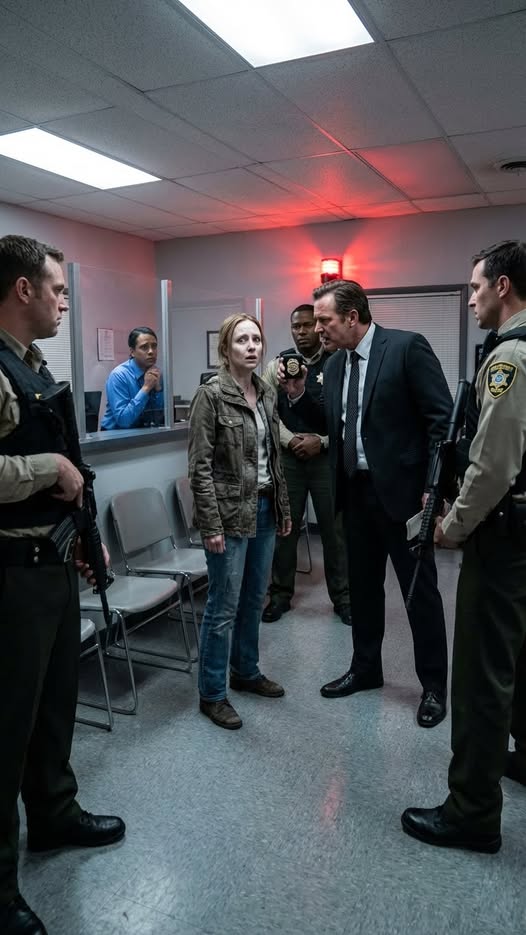
Instead of the thump-thump of a stamp, the space between us flashed a violent, pulsing red.
A silent alarm strobe began to spin on the wall behind her, washing the drab gray office in the color of emergency. The clerk, a woman with kind eyes that were now wide with panic, backed away from the glass partition. Her hands were shaking so hard she knocked over her stapler.
“Ma’am,” she stammered, her voice trembling. “Please… keep your hands where I can see them.”
“What?” I asked, the word sticking in my dry throat. “I don’t understand. It’s just an application.”
“The Social Security number you provided,” she said, her voice dropping to a terrified hush. “It belongs to a child who died in 1991.”
My world tilted on its axis. The floor seemed to liquefy beneath my worn-out sneakers.
Dead.
“I’m standing right here,” I whispered, the absurdity of it choking me. “I’m right here.”
Two armed guards stepped out from the security alcoves, their hands hovering over their holsters. The tension in the room was a physical weight, heavy and suffocating. I was Mara, the woman who scrubbed floors and dodged landlords. I wasn’t a threat. I was a ghost.
But before I could argue, before I could explain that there must be a mistake in their computer system, the elevator doors at the far end of the lobby slid open with a soft chime.
A man in a sharp, tailored black suit stepped out. He didn’t walk; he glided, moving through the armed perimeter with the casual authority of someone who owned the building, the land it sat on, and the air we were breathing. He didn’t look at the guards. He didn’t look at the clerk.
He looked straight at me.
His expression wasn’t one of suspicion. It was one of devastating recognition. It was the look a parent gives a lost child found in a crowd. It terrified me more than the guns.
He stopped two feet away. He smelled of expensive cologne and something sharp, like ozone. He looked into my eyes—eyes I had always been told were too wide, too dark, too intense—and said three words that erased my entire existence.
“Welcome back, Noah.”
The room spun. The red light pulsed. And for the first time in my life, I wondered if I was actually the one who was dead.
If you found out your entire life was built on a lie—a foundation of rot and deceit—would you run, or would you stay to find out who you really are?
I didn’t run. My legs wouldn’t have carried me if I tried.
I didn’t end up in a holding cell. I didn’t get handcuffed to a metal table bolted to the floor. Instead, the man in the suit, Mr. Sterling, led me away from the lobby, past the confused guards, and into a quiet, soundproofed office on the top floor.
The room smelled of mahogany and old paper. It was a sanctuary of silence, far removed from the chaos downstairs. Sterling didn’t read me my rights. He poured a glass of ice water from a crystal carafe and set it down on the desk with a gentleness that felt foreign to me. I was used to things being thrown at me, not offered.
“Drink,” he said softly. “You’re in shock.”
I took the glass. My hands were trembling so violently that the ice cubes rattled against the rim like wind chimes in a storm. I drank, the cold shock of the water forcing me back into my body.
I was thirty-two years old. I had spent the last fourteen years scrubbing toilets, waiting tables at roadside diners, and sleeping in cars when the rent money ran out. I believed I was nothing more than the unwanted stepdaughter of a small-town sheriff. I believed I was Mara, the mistake, the burden, the girl who took up too much space.
Sterling slid a manila file folder across the desk. He didn’t open it immediately. He just rested his hand on the cover, as if preparing me for the impact.
“We’ve been looking for you for three decades, Noah,” he said. The name sounded strange on his tongue, heavy with history I didn’t know.
He flipped the folder open.
Inside wasn’t a mugshot. It wasn’t a criminal record. It was a digital rendering—an age-progression photo of a young woman.
I stared at the image, and my breath hitched.
The woman in the photo had my eyes. She had my jawline. She had the exact crooked slope of my nose that I had always hated. But she didn’t look tired. She didn’t look like she was constantly waiting for the other shoe to drop. She looked vibrant. She looked… loved.
“That is what you would have looked like if you hadn’t been taken,” Sterling said quietly.
“Taken?” I whispered.
“Your name is Noah Hayes,” he continued. “Your family made their fortune in Texas oil, but they would trade every well they own just to see this face again. You were kidnapped from a park in Dallas in 1991. You were three years old.”
I gripped the arms of the leather chair to keep from floating away. Kidnapped.
The word should have terrified me. Instead, it felt like a key turning in a rusty lock I’d been picking at my entire life.
Suddenly, the cruelty made sense.
I thought about Richard, the man I called my stepfather. The sheriff who told me I was trash. The man who made me sleep on a cot in the laundry room while his biological daughter, Bianca, slept in the master suite with a canopy bed.
I thought he hated me because I was difficult. I thought he hated me because I was unlovable.
But he didn’t hate me because I was a bad kid. He hated me because I was a crime scene. I was evidence he had to feed.
Tears started to fall, hot and fast, dripping off my chin onto the polished desk. I wasn’t crying from fear. I was crying from the sheer, overwhelming relief of it.
I wasn’t broken. I wasn’t a burden. I was a stolen treasure that someone had tried to throw away.
Sterling seemed to understand. He didn’t offer a tissue; he offered a lifeline. He pushed a sleek black smartphone across the desk toward me.
“Your parents—your real parents—are on a private jet right now,” he said. “They are landing at the executive airport in twenty minutes. You are safe here, Noah. This is federal territory. No one can touch you.”
I looked at the phone. For the first time in my life, the ground beneath my feet felt solid. I wasn’t the girl with the eviction notice anymore. I was Noah Hayes, and I was going home.
I reached for the phone, my finger hovering over the screen, ready to make the call that would end the nightmare. I finally let my guard down. I finally let myself exhale.
That was my mistake.
The heavy oak door didn’t just open; it exploded inward.
I didn’t even have time to scream.
Two uniformed deputies stormed the room, hands on their weapons, their boots slamming against the floor in a synchronized rhythm of violence. And behind them, striding in like he was walking into his own living room, was Richard.
He wasn’t wearing the stained flannel shirts I was used to seeing him in on weekends. He was in his full sheriff’s dress uniform. The gold star on his chest gleamed under the office lights, a badge of authority that had always been his favorite weapon.
He didn’t look at Sterling. He didn’t look at the deputies. He looked straight at me.
His eyes weren’t angry. They were dead. Flat, shark-like voids that promised nothing but pain.
“Step away from the suspect,” he barked, his voice filling the room.
Sterling stood up instantly, placing his body between me and the deputies. The movement was fluid, practiced. “This is a federal investigation, Sheriff. You have no jurisdiction here.”
Richard didn’t even blink. He walked to the desk and slapped a folded piece of paper onto the mahogany surface. It hit with a sound like a gunshot.
“I have a warrant signed by a county judge ten minutes ago,” Richard announced, his voice dripping with false righteousness. “Grand larceny. Felony charges.”
He pointed a finger at me—a finger that had poked my chest a thousand times growing up, a finger that had left bruises on my soul long before it left them on my skin.
“That woman stole fifty thousand dollars’ worth of diamond jewelry from my wife’s bedroom before she fled this morning,” he lied. Smoothly. Effortlessly. “I am taking her into custody.”
“That’s a lie!” I screamed, the shock finally breaking. I scrambled backward in the chair. “I haven’t been to your house in years! I haven’t seen you in six months!”
“Save it for the judge,” Richard sneered. He nodded to his deputies. “Cuff her.”
One of the deputies lunged past Sterling. He grabbed my arm and twisted it behind my back with enough force to make my shoulder pop. I cried out, the pain blinding and white-hot.
Sterling moved to intervene, his hand going to his own jacket, but Richard stepped in close, chest-to-chest with the federal agent.
“Careful, Agent,” Richard said, his voice low and dangerous, meant only for us. “This is a state crime. Exigent circumstances. Unless you want to obstruct a felony arrest on record—which would end your career—you’ll step aside. You can interview her after we process her at the county jail.”
Sterling hesitated.
I saw the calculation in his eyes. He knew the law. He knew that technically, a local felony warrant with a flight risk claim could pull me out of the building. Richard was weaponizing the bureaucracy. He was using the very system meant to protect people to enslave me again.
“I didn’t steal anything!” I pleaded, looking at Sterling, begging him with my eyes. “Please don’t let him take me. You said I was safe.”
Sterling’s face was tight with fury, a muscle jumping in his jaw, but he didn’t draw his weapon. He couldn’t start a shootout with local law enforcement in a federal building over a property crime warrant.
Richard had played this perfectly.
Richard grabbed my other arm, his grip bruising. He leaned in close, his breath hot against my ear, smelling of coffee and peppermints—the scent of my childhood terror.
“I told you,” he hissed, the sound scraping against my eardrum. “I told you never to dig. I told you to leave it alone. Now you’re going to die in a holding cell, Mara. You’ll hang yourself with a bedsheet before your rich parents even touch the tarmac. Suicide. Tragically unstable.”
The blood drained from my body.
He wasn’t taking me to jail to book me. He was taking me to jail to execute me.
“Move!” he shouted, jerking me toward the door.
The hallway stretched out like a tunnel, the fluorescent lights blurring overhead as the deputies half-dragged, half-marched me toward the elevators. My boots skidded on the polished linoleum.
Richard’s hand was a vice on my bicep, his fingers digging into the tender flesh between muscle and bone. That grip… I knew that grip. It wasn’t the first time he had marched me out of a door.
Suddenly, the federal hallway dissolved.
I was eighteen years old again. I was standing on the porch of the only home I’d ever known, clutching a black garbage bag filled with my clothes. It was raining. I was shivering, not from the cold, but from the terrifying realization that I had nowhere to go.
Inside the house, through the bay window, I could see them eating dinner. Richard and his biological daughter, Bianca. They were cutting into thick, bleeding steaks. The warm yellow light of the chandelier glinted off the crystal glasses.
I had just eaten a cold sandwich made from the heel of a bread loaf because Richard said steak was for “people who contributed.”
I remembered knocking on the glass, begging to come back in just for the night. Richard had opened the door, looming over me just like he was looming over me now.
“You should be on your knees thanking me,” he had said, his voice dripping with that sick, self-righteous poison. “I kept a roof over your head for ten years. I fed you. I clothed you. And you weren’t even my blood. Do you know what a burden you were, Mara? Do you know how expensive it is to keep a mistake?”
And I had believed him. God help me, I had believed him. I had fallen to my knees on that wet concrete and thanked him for the scraps. I had spent the next fourteen years carrying the weight of that debt, believing I was unworthy, believing I owed the universe an apology just for existing.
But that was the trap.
The realization hit me harder than the handcuffs.
It wasn’t charity. It was camouflage.
He hadn’t been raising a stepdaughter. He had been hiding a witness. Every time he made me feel small, every time he told me I was lucky he didn’t throw me in the street, he wasn’t parenting. He was grooming. He was training me to be grateful for my own prison.
He needed me broken so I wouldn’t ask questions. He needed me desperate so I wouldn’t look at my own birth certificate.
He wasn’t my savior. He was my warden.
The fear that had been choking me since I walked into the building evaporated. It didn’t fade; it was incinerated by a white-hot flash of pure, clarifying rage.
He thought he was dragging a scared little girl to jail. He thought he was handling Mara, the burden.
But Mara didn’t exist anymore.
I dug my heels into the floor. I stopped fighting the deputy’s grip and instead went completely limp, dropping my entire body weight toward the ground.
It’s a trick you learn when you’re trying to move heavy furniture alone. Dead weight is impossible to move gracefully.
The sudden drop caught them off guard. The deputy on my left stumbled, his grip slipping on the sweat of my arm. We jerked to a halt ten feet from the elevator bank.
“Get up!” Richard snarled, yanking on my arm so hard I felt the tendons strain. “Stop making a scene!”
I didn’t get up.
I planted my feet and slowly straightened my spine, pulling against the handcuffs until the chain was taut. I turned my head and looked directly into Richard’s eyes.
For the first time in my life, I didn’t flinch. I didn’t look down. I looked right at the man who had stolen my life, and I let him see exactly what he had created.
The victim was gone. The witness was awake. And she was about to burn his world to the ground.
“CHECK THE TIMESTAMP!”
My scream tore through the lobby, echoing off the marble walls like a gunshot. It wasn’t a plea for help. It was a command.
The deputies hesitated, looking down at me. For a split second, the confusion on their faces gave me the opening I needed. I didn’t try to stand up. I locked eyes with Sterling, who was running toward us down the hall, his hand reaching for the radio on his shoulder.
“THE WARRANT!” I yelled, my voice cracking but loud, filling every corner of the atrium. “CHECK THE TIME HE SIGNED IT!”
Richard kicked my leg hard. “Shut her up! Get her in the elevator!”
But it was too late.
Sterling didn’t slow down. He didn’t ask questions. He threw his body weight against the elevator doors just as they were sliding shut, forcing them back open with a screech of metal.
Two uniformed Federal Protective Service officers materialized from the security checkpoint, their hands on their weapons, blocking Richard’s path.
“HOLD IT!” Sterling barked. His voice wasn’t the calm, soothing tone he’d used in the office. It was the voice of a man who commanded federal task forces. “Nobody moves!”
“This is obstruction of justice!” Richard roared, sweat beading on his forehead, his composure cracking. “I am a sheriff, and I am executing a lawful arrest!”
“Let me see the warrant,” Sterling demanded, holding out his hand. He didn’t ask. He waited.
Richard clutched the paper to his chest for a second—a tell. A poker player hiding a bad hand. Then, realizing he had three federal guns pointed in his general direction, he shoved the crumpled paper at Sterling.
“Read it and weep, Agent. Grand Larceny. Signed by Judge Miller this morning.”
Sterling snapped the paper open. He scanned it once. Then he looked up at the digital clock above the security desk. Then he looked at the security monitors behind the guard station.
A slow, terrifying smile spread across Sterling’s face.
“You’re sloppy, Richard,” Sterling said, his voice dropping to a calm that was far scarier than shouting.
He turned the paper around so the deputies could see it.
“This warrant was signed at 8:00 AM sharp,” Sterling announced. He pointed a finger at the security monitor on the wall. “But my building’s cameras logged Noah Hayes entering through the north metal detectors at 7:45 AM.”
The lobby went dead silent.
“She’s been in federal custody since she walked in,” Sterling said, stepping closer to Richard. “Unless she can teleport, Sheriff, she couldn’t have stolen jewelry from your house at 8:00 AM if she was standing in my lobby fifteen minutes earlier.”
The deputies holding me loosened their grip. They looked at each other. Then at Richard.
They realized they weren’t executing an arrest. They were accomplices to a kidnapping in progress.
“It’s a typo!” Richard shouted, spit flying from his mouth, his eyes wild. “The clerk made a mistake on the time! She stole it last night!”
“The warrant says this morning,” Sterling countered, stepping forward. “And if you lied on a sworn affidavit to get this signed, that’s perjury. If you’re trying to drag a federal witness out of here on falsified charges… that’s kidnapping.”
Sterling signaled to his guards. “Release her. Now.”
The deputies let go of my arms like I was on fire. I scrambled backward across the floor, putting distance between myself and the man who had stolen my childhood.
Richard stood alone in the center of the circle.
His face was a mask of purple rage. He looked at his deputies, who were backing away, hands raised in surrender. He looked at Sterling, who was staring him down with cold contempt.
He looked at me.
I was standing up now, rubbing my bruised wrists. I wasn’t looking at the floor. I was looking at him. And he realized, in that moment, that he couldn’t bully his way out of this. His star, his uniform, his loud voice—none of it worked here.
And that’s when he broke.
“I’m not leaving without her!” Richard screamed.
His hand flew to his belt.
He didn’t draw his service pistol. He knew that would get him killed instantly. Instead, he ripped his Taser from its holster, the yellow plastic gleaming under the lobby lights. He leveled it at Sterling.
“BACK OFF!” he yelled, his voice cracking with desperation. “I am taking custody of this suspect! Anyone who interferes gets dropped!”
He was insane. He was holding a federal agent at gunpoint in a federal building.
But I looked at his eyes—wide, frantic, darting—and I realized the truth. He wasn’t trying to arrest me anymore. He knew it was over. He was just trying to survive the next five minutes.
The guards reacted instantly. Three Glock 17s snapped up, trained on Richard’s chest.
“Drop the weapon!” Sterling ordered. “NOW!”
For a moment, it looked like Richard might force them to shoot him out of spite. The air crackled with the potential for violence.
Then, the madness drained from his eyes. He wasn’t a martyr. He was just a bully. And bullies are always cowards when the odds are even.
He tossed the Taser to the marble floor. It clattered loudly in the silence. He raised his hands.
“Fine,” he sneered, regaining a shred of his composure. “Let’s do this properly.”
He reached into his jacket pocket. The guards tensed, fingers tightening on triggers, but he pulled out a folded document, snapping it open with a practiced flair.
“You caught me,” Richard said lightly, a horrific smile stretching his face. “The warrant was fake. I admit it. I knew about the kidnapping. I helped cover it up.”
He looked straight at me, his eyes gleaming with malice.
“I kept you. I hid you. I stole your life.”
Sterling stepped forward with cuffs. “That’s a confession. You’re under arrest.”
Richard laughed. It was a dry, barking sound.
“No, I’m not. Check the calendar, Agent. The kidnapping happened in 1991. The statute of limitations for kidnapping in this state is twenty years. It expired in 2011.”
The room went silent.
Sterling froze.
Richard seized the moment, his arrogance returning in a rush. “You can’t touch me for the kidnapping. You can’t touch me for the fraud back then. I walk. And legally? You’re still incompetent. I control your assets until a court says otherwise.”
He turned for the door, adjusting his jacket. “I’m suing all of you for unlawful detention.”
“You’re right about the statute,” Sterling said calmly.
Richard paused mid-step, looking back over his shoulder.
“But you forgot one rule,” Sterling continued.
Richard frowned. “Which is?”
Sterling walked back to the desk and lifted a thick file. “The Constructive Trust Doctrine.”
Richard looked confused. “What?”
“You don’t own property obtained through fraud,” Sterling explained, his voice hard as iron. “You hold it in trust for the victim.”
He slammed the file onto the bench.
“We traced the ransom payments you intercepted. We traced the foster stipends you pocketed. We traced the investments you made using her identity.”
“That’s my money!” Richard snapped.
“No,” I said, stepping forward. My voice was steady. “You just managed it for me.”
Sterling smiled. “Civil fraud involving a minor doesn’t expire until the victim discovers the fraud. That happened today. Which means, Sheriff, the clock just started.”
Richard paled.
“Your assets are frozen,” Sterling listed off, counting on his fingers. “Your house is seized. Your pension is garnished. Every dime you have spent or saved in the last thirty years belongs to the victim.”
He pointed at me.
“It all belongs to Noah.”
Richard recoiled, terrified. Not of prison, but of poverty. Of being the one with nothing.
“But… I’m the sheriff!”
“You laundered money and filed false tax returns on those ill-gotten gains,” Sterling cut in, signaling the guards. “And tax fraud? Those clocks are still running.”
The guards moved this time. Richard screamed as the cuffs snapped shut on his wrists, forcing him to his knees.
He looked up at me, his eyes pleading now. “Mara… please. I raised you.”
I looked down at him. I saw the man who had made me eat sandwiches while he ate steak. The man who had stolen my name.
“You didn’t raise me,” I whispered. “You just held me hostage.”
The lobby fell quiet as they dragged him away.
Sterling slid a paper toward me. “Asset Transfer Authorization,” it read.
“Sell it,” I said, signing my real name for the first time. “Noah Hayes.” “Sell his house. Sell his car. Sell everything he owns. Just make sure he never goes back there.”
I had nothing left in my pockets but twelve dollars. But as I signed that paper, I was the richest woman in the world. I was free.
Sunlight flooded the lobby as the main doors opened. Two figures rushed in—an older couple, faces lined with grief and hope.
I didn’t need a DNA test. I felt it in my bones. I saw my eyes in his. I saw my nose in hers.
“Noah?” the woman whispered, stopping ten feet away, afraid to break the illusion.
I dropped the pen.
“I’m here,” I choked out. “I’m real.”
They ran to me. They held me like they would never let go, like I was the most precious thing on earth. And for the first time in thirty-two years, I didn’t feel like a burden.
I felt like I was finally home.