This is not merely a story of familial betrayal; it is a chronicle of my own quiet coup d’état. For twelve years, I was the ghost haunting the periphery of the Evans legacy, a spectral figure in the background of gilded portraits and country club galas. My name is Heather Evans, and three weeks ago, at a retirement celebration that was supposed to be the crowning jewel of my father’s career, I chose to incinerate the bridge that connected me to my past.
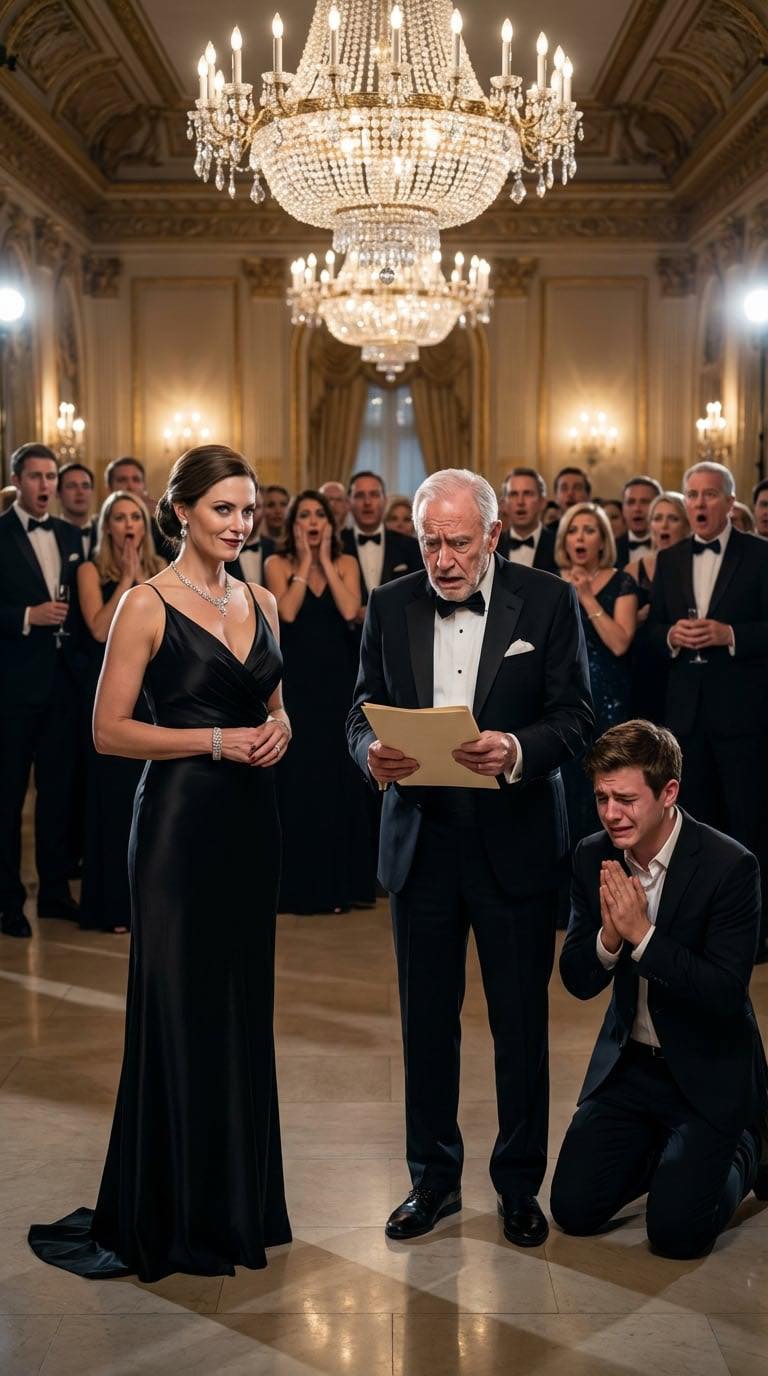
The setting was the Fairfield Country Club, a sanctuary of old money where the chandeliers drip with Swarovski crystals and the air is thick with the scent of gin and unearned privilege. Two hundred guests, the titans of Connecticut industry, sat in rapt attention as my father, Richard Evans, took the stage. He was the quintessential patriarch, the CEO of Ivan’s Logistics, a man who commanded rooms with a practiced, predatory warmth.
When the spotlight finally swung toward me, I felt the familiar prickle of unease. He smiled, that glass-sharp grin that never quite reached his eyes. “And here we have my daughter, Heather,” he announced, his voice booming through the high-fidelity speakers. “A woman of… unique choices. No degree, no discernible future, just a permanent fixture on the family payroll.”
The laughter that followed was not cruel—at least, not to them. It was the polite, condescending tittering of people who viewed me as a minor atmospheric disturbance. I didn’t flinch. I didn’t allow the heat in my cheeks to manifest as tears. Instead, I raised my crystal flute of Dom Pérignon, met his gaze with a terrifying clarity, and spoke into the silence that followed the mirth.
“Cheers, Dad,” I said, my voice carrying with a resonance that surprised even me. “Enjoy this moment. It is the last time any of you will ever look upon my face.”
I walked out of the ballroom, the rhythmic click of my heels against the polished hardwood the only sound in the cavernous space. Behind me, the silence was absolute—a vacuum created by the sudden departure of a woman they thought they knew.
But they didn’t know me. They didn’t know that while they were watching the “failure,” I was busy buying their future.
The Architecture of Invisibility
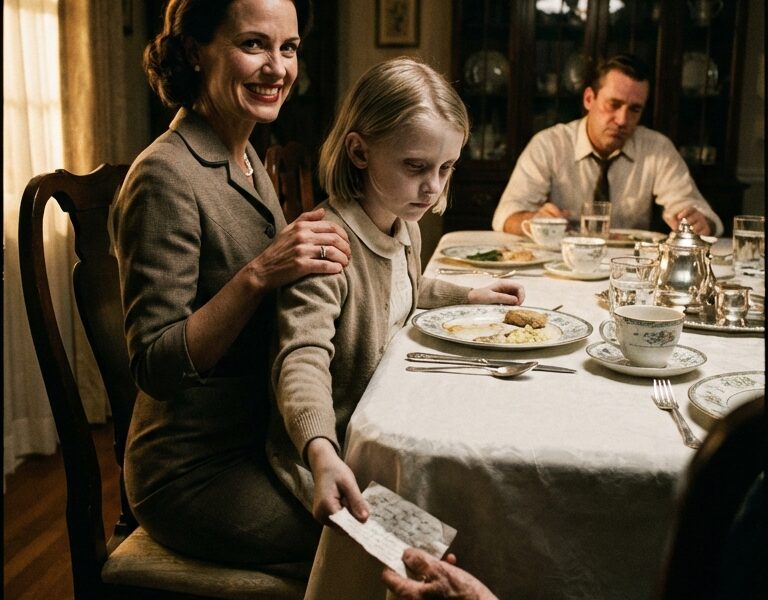
To understand the woman who walked out of that ballroom, you must understand the girl who was erased. The Evans family of Fairfield, Connecticut, was a fortress of respectability. We lived in a six-bedroom colonial anchored to two acres of manicured lawn. My mother died when I was eight, a victim of a cancer so aggressive it seemed to resent her very existence. I remember her hands—soft, smelling of lavender and expensive soap—always reaching for mine.
Two years later, the fortress gained new occupants. Linda, my stepmother, arrived with the calculated grace of a hostile takeover. She brought her son, Marcus, who was three years my senior. Almost overnight, the hierarchy shifted. Marcus became the prince regent; I became the furniture—something to be sat upon or moved aside, but never truly seen.
My father never raised his hand to me. His abuse was far more elegant: he looked through me. I was a window he was trying to see past to catch a glimpse of Marcus’s latest achievement. Marcus got the new BMW at sixteen; I got his hand-me-down sedan that smelled of stale gym socks and arrogance. Marcus was the heir apparent to Ivan’s Logistics. I was just “there.”
The only soul who truly recognized my existence was my grandmother, Margaret Evans. Every Sunday, she would call from her home in Boston, her voice a lifeline of gravel and wisdom. “You remind me of myself, Heather,” she would whisper. “Underestimated. But remember, the quietest person in the room usually owns the keys.”
I didn’t realize then that she was preparing me for a war I hadn’t yet been drafted into.
The Sacrifice at the Altar of Wharton
The day the ceiling finally collapsed on my life was a Wednesday in my sophomore year at UConn. I was a business major with a 3.8 GPA and a scholarship application for a prestigious summer program in London sitting on my desk. My father summoned me home for a “Family Meeting”—a phrase that, in our house, was a harbinger of doom.
I found him in his mahogany-clad study, Linda standing beside him like a silent sentinel. “Sacrifices must be made, Heather,” he began, not even bothering to look up from a spreadsheet. “Marcus has been accepted into the Wharton MBA program. It is a monumental opportunity for the company’s future.”
I felt a cold dread coil in my gut. “And what does that have to do with me?”
“We cannot justify the tuition for both of you right now,” he stated flatly. “You’ll take a hiatus from school. Work a bit. Marcus’s career is the priority for the family estate.”
Linda offered a smile that was pure saccharine. “A girl doesn’t need an MBA to secure a comfortable life, dear. You’ll find a husband. That’s your real degree.”
The betrayal wasn’t the lack of money; I found out later there were millions in liquid assets. The betrayal was the choice. They chose to amputate my future to give Marcus a slight edge. I didn’t scream. I didn’t beg. I simply nodded, walked to my room, and packed a single suitcase.
I left for Boston with two thousand dollars and a burning, singular vow: I would never let another human being determine my value again.
The Silent Empire of Meridian
Boston was not kind, but it was honest. My first sanctuary was a four-hundred-square-foot studio in Allston, situated directly above a laundromat. The walls vibrated with the rhythm of industrial dryers, and I lived on a diet of ramen and day-old bagels.
I secured an entry-level position as an administrative assistant at a boutique logistics firm owned by a man named Walter Barnes. Walter was a grizzled veteran of the industry who didn’t care about my lack of a degree; he only cared that I could solve a routing crisis in ten minutes.
“You’ve got a mind for the machine, Heather,” he’d grumble. “Don’t let it rust.”
I didn’t. I spent my nights immersed in MIT OpenCourseWare. I studied supply chain harmonics, global operations, and business ethics. I didn’t need a diploma to gain the knowledge. While my father was bragging about Marcus’s Ivy League connections, I was building a mental database of every weakness in the Ivan’s Logistics business model.
Four years later, I founded Meridian Consulting. It was a ghost company—no public faces, no flashy LinkedIn profiles. I operated through a legal wall, using my lawyer, Eleanor Smith, as the primary point of contact. Why the secrecy? Because I knew the Evans methodology. If they saw me climbing, they would try to pull the ladder out from under me.
Success, I decided, was a dish best served without a return address.
The Ghost in the Machine
The irony of my life reached a fever pitch three years ago. Meridian Consulting had grown into a powerhouse, specializing in logistics optimization—the very heartbeat of my father’s industry. We were the elite surgeons of supply chains, and as it turned out, Ivan’s Logistics was a patient in desperate need of surgery.
Without ever knowing who he was dealing with, my father signed a five-year contract with Meridian. For thirty-six months, I—the “freeloading” daughter—had been the invisible architect of his company’s newfound efficiency. We managed their routes, their carriers, and their warehouse protocols. We were responsible for nearly 40% of their operational savings.
Every time Richard Evans stood at a podium and praised the “genius” of his consultants, he was unknowingly worshiping at the altar of the daughter he had discarded.
Then, two years ago, Grandmother Margaret passed away. At her funeral in Fairfield, I was treated like a stray cat that had wandered into a garden party. My father gave a eulogy that was a masterclass in hypocrisy, while I sat in the back, clutching a secret that was about to explode.
A week after the funeral, Eleanor Smith called me. “Your grandmother left a separate estate, Heather. A trust fund established eight years ago, specifically for you. She left a letter as well.”
The letter destroyed me. “I know what they did to you, my dearest Heather. I saw the theft of your education. This money—eight hundred thousand dollars—is your armor. Use it to build the life they tried to take. When they finally realize your worth, make sure it’s too late for them to claim a single piece of it.”
I used the capital to turn Meridian from a successful firm into an industry titan. And then, I waited for the invitation that I knew was inevitable.
The Black Valentino and the Country Club Firing Squad
The retirement gala was the perfect stage for the final act. I arrived at the Fairfield Country Club wearing a black Valentino dress that cost more than my father’s first car. I wore Grandmother Margaret’s pearls and a Cartier watch I’d bought with my own dividends.
Linda met me at the door, her eyes immediately scanning my outfit, performing a silent appraisal. “Heather,” she purred, “you look… surprisingly well. Your father was worried you wouldn’t find something appropriate for such a venue.”
“How kind of him to spare a thought for my wardrobe,” I replied, my smile a sharp, polished blade.
Inside, I was relegated to Table 14—the “purgatory table” near the kitchen, populated by distant cousins and family friends who didn’t quite make the inner circle. It was a calculated insult, one that I noted with clinical detachment.
From my vantage point, I watched my father hold court. He was bragging to a major shipping executive about Meridian Consulting. “The backbone of our operation,” he boasted. “The owners are reclusive, but brilliant. They’ve saved us millions.”
I took a slow sip of champagne. My phone buzzed in my clutch. A text from Daniel Reeves, my CFO: “Renewal documents for Ivan’s Logistics arrived. They’re desperate for another five years. Standing by for your command.”
The contract was set to expire in thirty days. If I didn’t sign, Ivan’s Logistics would face an operational heart attack. Their efficiency would plummet, their carriers would desert them, and Marcus’s first year as CEO would be spent presiding over a funeral.
The fuse was lit. All I needed was for my father to provide the match.
The Joke That Cost a Legacy
The humiliation on stage wasn’t a surprise; it was a confirmation. When my father called me a “freeload,” he wasn’t just making a joke. He was reaffirming the lie he’d told himself for twelve years to justify his cruelty.
When I walked out of that ballroom, I didn’t just leave a party; I exited a narrative.
I was halfway to my Tesla when the sound of frantic footsteps echoed across the pavement. “Heather! Stop this instant!” Linda’s voice was a shrill contrast to the evening’s elegance. She caught up to me, her face contorted with fury. “Do you have any idea what you’ve done? You humiliated your father in front of the board!”
I turned, my expression as cool as the autumn air. “I believe he handled the humiliation part himself, Linda. I simply provided the exit.”
My father emerged from the clubhouse, his face a dark shade of mahogany. “Get back inside,” he hissed, his voice trembling with suppressed rage. “You will apologize to the guests. This is a family matter.”
“No, Richard,” I said, using his first name for the first time in my life. “This is a business matter. And as of this moment, I am no longer in the business of you.”
“If you walk away now, you are dead to this family!” he roared. “No inheritance, no support, nothing! You’ll be back on your knees within a month!”
I slid into the driver’s seat and looked up at him through the window. “Dad, you cut me off twelve years ago. The only difference is that tonight, I’m the one making it permanent. Goodbye.”
I drove away, leaving them standing in the glow of the valet lights—three people who thought they were titans, unaware that they were standing on a trapdoor I had just triggered.
The next morning, the real work began. Because walking away was only the beginning. The revelation was the true punishment.
The Boardroom Massacre
Monday morning, 9:00 AM. I sat in my office in Boston, a glass-walled sanctuary overlooking the harbor. I was wearing a power suit and a look of absolute focus. Daniel stood at the door. “The termination notice was delivered to Ivan’s Logistics ten minutes ago.”
“And the personal letter?”
“Attached to the legal filings. Directly to your father’s private desk.”
The fallout was instantaneous. By 10:15 AM, my phone began a rhythmic vibration that wouldn’t stop for three days. Eight missed calls from my father. Twelve from Marcus. A string of increasingly frantic texts from Linda.
At 2:00 PM, my receptionist buzzed through. “Miss Evans, there is a… family group in the lobby. They don’t have an appointment, but they’re refusing to leave.”
“Send them to Conference Room B,” I said. “And make sure the legal team is on standby.”
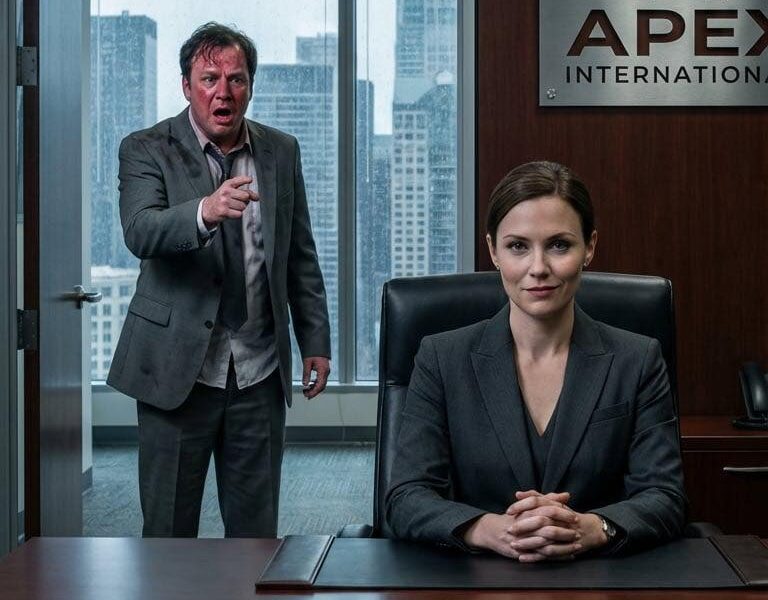
When I walked into the room, the air was thick with the scent of panic. My father looked gray. Marcus looked like he wanted to punch a hole in the glass. Linda was clutching her Chanel bag like a life jacket.
“Heather,” my father began, his voice sounding hollow. “This… this Meridian contract. There’s been a mistake. The termination notice says it’s ‘strategic repositioning.’ Surely we can work this out.”
I sat at the head of the table, the owner of the domain they had just entered. “There is no mistake, Richard. Meridian Consulting is moving in a different direction. One that doesn’t involve propping up a company that views me as a ‘freeload.’”
Marcus slammed his hand on the table. “You can’t do this! You’ve been our consultants for three years! You know our entire operation! This is petty, vindictive—”
“It’s business, Marcus,” I interrupted, my voice dropping an octave. “I built this company from nothing while you were busy spending the tuition money our father stole from me. I am the genius you’ve been praising at your dinner parties. I am the reason your stock price hasn’t bottomed out.”
The silence that followed was visceral. My father stared at me, the realization finally dawning in his eyes. He looked at the registration papers I had laid out on the table. Heather Margaret Evans: Sole Proprietor.
“You… you owned it the whole time?” he whispered.
“I built it in the silence you gave me,” I replied. “And now, I am taking that silence back. You have thirty days to find a new firm. Good luck. In this market, you’ll need it.”
Linda tried to play the “family” card, her voice trembling. “Heather, dear, we’re blood. You can’t destroy your father’s legacy over a joke.”
“Blood is just a biological fact, Linda,” I said, standing up. “Loyalty is a choice. You chose Marcus. You chose the company. You chose to erase me. I am simply finishing the job.”
I walked out of my own conference room, leaving them to the mercy of the efficiency experts they had just lost. But the true betrayal was yet to be unmasked.
The Ghost of my Mother’s Legacy
The final blow didn’t come from me; it came from Uncle Robert, my father’s younger brother and the perennial black sheep. He called me a week after the boardroom confrontation, his voice thick with a decade’s worth of guilt.
“Heather,” he said, “I heard what you did. I heard about the contract. It’s time you knew the whole truth about why Margaret left you that money.”
“I know why,” I said. “Because she saw what happened with my tuition.”
“No,” Robert sighed. “It goes deeper. Your mother… before she died, she set up a dedicated education fund for you. It was nearly half a million dollars, intended to ensure you never had to ask Richard for a dime. She knew him better than any of us.”
My heart stopped. “What happened to it?”
“Richard drained it,” Robert whispered. “He used your mother’s death-bed gift to pay for Marcus’s Ivy League prep and Wharton tuition. He didn’t just ‘choose’ to support Marcus over you; he stole the path your mother had already paved for you.”
The room tilted. I thought of my mother’s soft hands. I thought of the laundromat in Allston and the day-old bagels. The theft wasn’t just financial; it was an act of profound spiritual desecration. Grandmother Margaret had discovered the theft too late to stop it, so she had built the trust fund as a counter-strike—a hidden cache of weapons for a granddaughter she knew would eventually have to fight.
I didn’t call my father to scream at him. I didn’t send a legal summons. I did something much more devastating.
I sent a single email to the entire board of Ivan’s Logistics, BCC’ing the major industry press. It wasn’t an accusation of theft; it was a “Case Study in Operational Transition.” I detailed exactly how Meridian had salvaged the company, and I included a brief, factual history of the company’s ownership. I mentioned the “reallocation of educational trusts” as a footnote in the founder’s biography.
I didn’t have to call him a thief. I simply let the world see the math.
The Fall of the House of Evans
Reputation is a fragile thing in Fairfield. Within two months, the “titans” were pariahs. The board of Ivan’s Logistics, terrified of the PR nightmare and the sudden loss of operational efficiency, forced Richard into a true, non-celebratory retirement. Marcus was demoted, his “prince regent” status revoked by a board that no longer trusted his judgment.
The company didn’t fold, but it shriveled. It became a cautionary tale in the very country clubs where my father used to hold court. I heard through the grapevine that at the latest gala, Richard Evans sat at Table 14—the far corner, near the kitchen.
I, however, was not there to see it.
I spent that evening on a terrace in Beacon Hill, sharing a bottle of wine with Logan, my lead developer, and Uncle Robert. We weren’t talking about logistics or revenge. We were talking about the future.
“Do you regret it?” Robert asked, looking at the city lights. “Bringing it all down?”
I thought about Grandmother Margaret’s photo on my desk. I thought about the girl who once felt invisible. “I didn’t bring it down, Robert,” I said, feeling a profound sense of peace. “I just turned the lights on. They were the ones standing in the ruins.”
I am no longer the “freeload.” I am no longer the disappointment. I am the architect of my own life, built on the foundations of women who loved me from the grave and a strength I had to forge in the cold.
The Evans legacy is a heap of ashes, but from those ashes, I built an empire of my own. And for the first time in thirty-two years, when I look in the mirror, I am the only person I need to see.
Epilogue: The Value of Truth
Six months later, I received a final letter from my father. It wasn’t an apology. Men like Richard Evans don’t apologize; they negotiate. He asked for a meeting to discuss “consulting opportunities” for a new venture Marcus was trying to start.
I didn’t reply. I didn’t even shred it. I simply placed it in a file labeled “Resolved.”
I have learned that the greatest victory is not the destruction of your enemies, but the total irrelevance of their existence. My father thought he was teaching me a lesson in humility that night at the country club. Instead, he gave me the final piece of evidence I needed to realize I was already free.
Today, Meridian Consulting is a global leader. I have a degree now—one I earned through sweat, late nights, and the quiet fire of a woman who refused to stay erased. But more importantly, I have a name that I own completely.
My mother’s hands are still reaching for mine, but now, I’m the one holding them steady.
If you’ve ever been told you’re not enough, if you’ve ever been made to feel like a guest in your own life, remember this: the people who try to dim your light are usually just afraid of what you’ll see when the room is finally bright.
I am Heather Margaret Evans. And I am finally, beautifully, free.