The bailiff called the case number like he was reading a grocery list—monotone, bored, utterly detached from the devastation about to unfold.
“Estate of Arthur J. Vale. Petition for Emergency Probate.”
My sister, Alyssa, stood up before the last syllable had even landed in the stale air of the courtroom. She didn’t rise because she was eager to honor our grandfather; she rose because she was eager to consume him. She wore a tailored cream coat over a black sheath dress—the kind of quiet, understated luxury that screams “old money” to people who don’t know any better. Her hair was a geometric miracle of spray and precision. Her face was dry. When she looked at me across the aisle, I didn’t see a flicker of shared grief. I saw calculation. I saw a predator assessing a particularly stubborn obstacle.
Her attorney, a man in a slick charcoal suit with a watch that cost more than my car, walked to the counsel table. He carried a thin stack of papers and slid them forward across the mahogany like a blade.
“Your Honor,” he said, his voice smooth as oil. “We are moving for the immediate transfer of the estate to my client, effective today.”
Behind him, my parents nodded in unison, a synchronized gesture practiced in front of mirrors. My mother, Linda, had her hands folded solemnly in her lap, mimicking the pose of a grieving saint. My father, Grant, stared straight ahead, his jaw set in a line of rigid determination. To him, this wasn’t a funeral procession; it was a hostile takeover, and I was the minority shareholder refusing to sell.
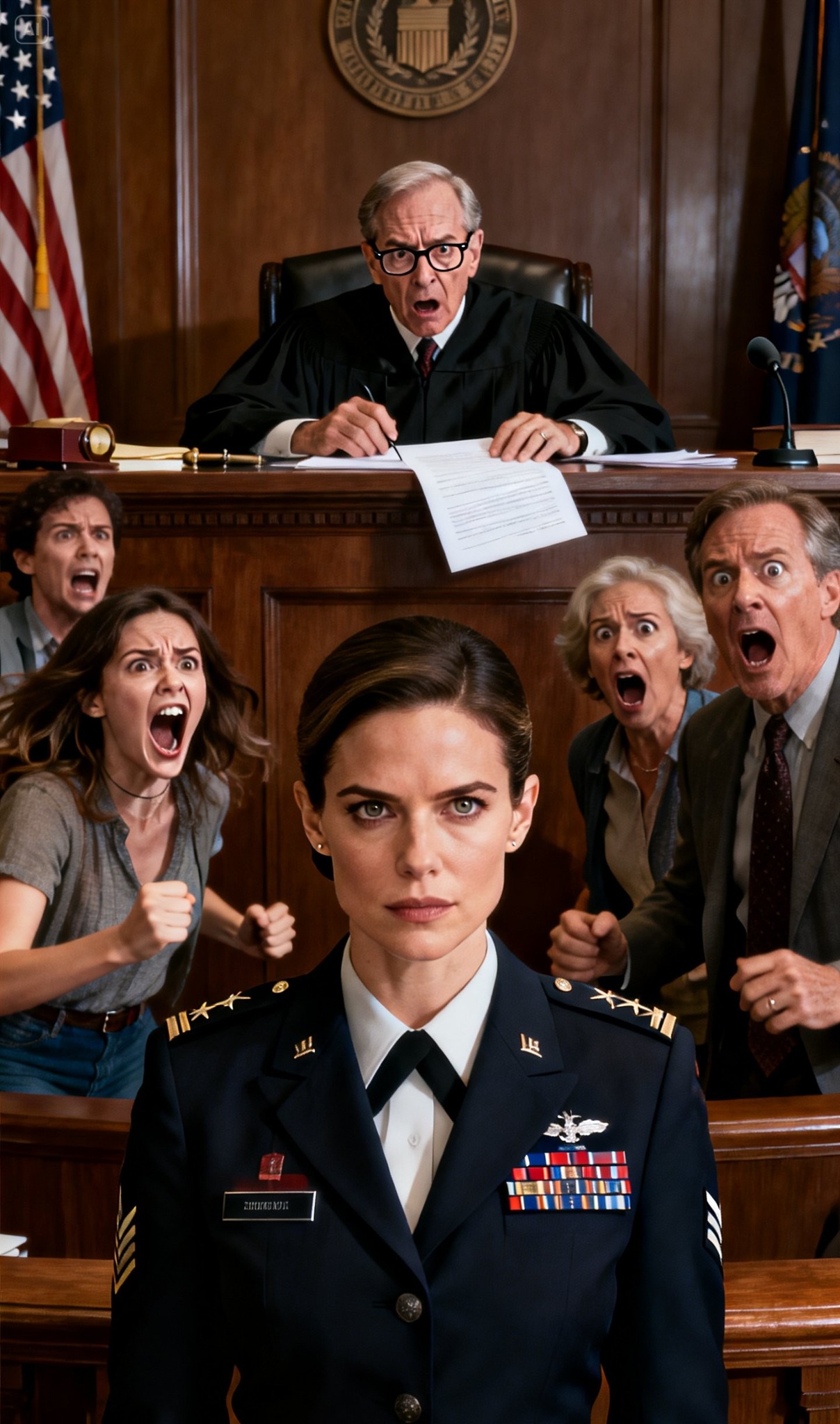
The Judge, a man with graying temples and eyes that had seen every variety of human greed, didn’t look at them. He looked at me.
“Ms. Vale,” he said, his voice flat. “Do you object?”
Alyssa’s lips twitched at the corner. She was waiting for me to stammer, to cry, to beg for a compromise. That’s what I had always done. I was the soft one. The artist. The disappointment.
But grief does strange things to the spine. It stiffens it.
I sat up straighter, placing my hands on the cold table to ground myself. “Yes, Your Honor,” I said. “I object.”
Alyssa’s attorney smiled, a faint, patronizing expression. “On what grounds?” he asked, turning his body slightly to box me out, confident he would walk right through me. “I haven’t even given my argument yet.”
“Not yet,” I whispered.
“I want to wait until the last person arrives,” I said to the Judge.
The Judge blinked once, lowering his reading glasses. “The last person?”
“Yes, Your Honor.”
Alyssa let out a small, sharp laugh that held zero humor. “This is ridiculous,” she hissed, loud enough for the stenographer to glance up. “There is no one else. He’s stalling.”
My father finally turned his head. He looked at me the way he used to when I was sixteen and had ruined a dinner party by having an opinion. “You always do this, Marine,” he muttered. “Stop embarrassing the family.”
The Judge leaned back, the leather of his chair creaking in the silence. “Ms. Vale,” he said to me. “This is Probate Court, not a theater. If you have an objection, it needs to be legal.”
“It is legal,” I said, my heart hammering against my ribs like a trapped bird. “But it isn’t mine to explain.”
Alyssa’s attorney stepped closer to the bench. “Your Honor, we are requesting emergency appointment because Ms. Vale has been uncooperative. There are significant assets that require protection—real estate, portfolios, vintage vehicles. My client is the responsible party.”
Responsible.
That word was the weapon my family had bludgeoned me with for decades. In the Vale lexicon, “responsible” meant “compliant.” It meant giving them control and asking zero questions.
My mother sighed softly, a sound designed to signal long-suffering patience. “She’s grieving,” she told the Judge, her voice trembling with manufactured sympathy. “She doesn’t understand how these things work. We’re just trying to keep everything from falling apart.”
I stared at her. I thought about how quickly they had found this lawyer. I thought about the mobile notary they had tried to force into Grandpa’s hospice room three days before he died. I thought about the bruises on Grandpa’s arm from where my father had grabbed him, trying to force a pen into his hand.
“The petition requests full authority,” the Judge noted, scanning the file. “It alleges the respondent—Ms. Marine Vale—is unfit to participate and may interfere with asset collection.”
“Correct,” the attorney said.
“And you want me to grant this today? Effective immediately?”
“Yes, Your Honor.”
The Judge looked at me again. “Ms. Vale. What is your specific objection?”
I took a breath. “My objection is that they are asking you to act without the full record. And that if you sign that order, you will be aiding a fraud.”
Alyssa laughed again, sharper this time. “There is no hidden record!” she snapped. “He’s dead, Marine. This is what happens. We take over.”
“Ms. Vale,” the Judge warned, his eyes narrowing at my sister. “You will not speak out of turn.”
“Your Honor,” her attorney interjected, trying to smooth the waters. “If Ms. Vale wants to delay, we object. The estate cannot wait.”
“It won’t be a delay,” I said, checking the clock on the wall. “It will be minutes.”
The Judge exhaled, a long, weary sound. He glanced toward the heavy oak doors of the courtroom. “Who are we waiting for?”
I answered with the simplest truth I possessed. “The person who actually controls the inheritance.”
Alyssa’s face tightened. “That’s me,” she said automatically, then clamped her mouth shut as the Judge’s gaze flicked toward her like a whip.
“If this is a tactic…” the Judge began.
“It isn’t,” I replied.
A heavy silence descended. My father drummed his fingers on his knee. My mother adjusted her pearls. Alyssa stared at the table, radiating fury.
Then, the double doors pushed open.
There was no dramatic swing, no fanfare. Just a clean, controlled movement. A man stepped inside. He wore a black suit so plain it looked like a uniform—no flashy tie, no cufflinks, no visible branding. He held a thick manila envelope in his hand and wore an expression of absolute, terrifying neutrality. He didn’t look at my parents. He didn’t look at Alyssa. He walked straight to the clerk’s desk.
He held up the envelope and spoke two words.
“Ms. Vale.”
He wasn’t speaking to Alyssa. He was speaking to me.
The Judge reached for his glasses again, watching the man with intense curiosity. “State your business,” the Judge commanded.
The man didn’t raise his voice. He placed the envelope on the clerk’s desk with one hand. “This is for the Court,” he said. “From the Trustee.”
The Judge took the envelope. He read the return address. His eyebrows shot up, and his mouth moved as if he had spoken before he meant to.
“That… that can’t be.”
The Judge didn’t open the envelope like it was routine mail. He treated it like unexploded ordnance. He held it between two fingers, inspecting the seal, then tore it open with a sharp zip.
The courtroom was so quiet I could hear the fluorescent lights humming overhead. My sister’s attorney shifted his weight, his expensive shoes squeaking against the linoleum.
The Judge pulled out a single folded document first. It was heavy stock, cream-colored, with an embossed seal in the corner. He scanned the top line, and his jaw tightened visibly. Then, he read the sender out loud.
“Hawthorne National Bank. Trust Department.“
Alyssa’s face flickered. For a microsecond, the mask slipped, revealing pure, unadulterated panic. She had built her entire identity on being the “finance girl,” the one who understood money. Hearing a major bank named in open court should have made her feel powerful. Instead, she looked like a deer caught in the headlights of a semi-truck.
“This is a Notice of Trust Administration,” the Judge said, his voice echoing slightly. “It states that the decedent’s assets were placed into a Revocable Living Trust three years ago, and that the trust became irrevocable upon death.”
Alyssa’s attorney stood up, his movements jerky. “Your Honor, we are in Probate. There was no record of—”
“Sit down,” the Judge ordered, not looking up. He turned a page. “And this,” he added, his voice dropping an octave, “is a Certification of Trust identifying the Successor Trustee.”
He paused, looking at my parents. They had stiffened, their posture rigid. They had been aiming for control—emotional, physical, financial. But a bank doesn’t care about family dynamics. A bank cares about compliance.
“Successor Trustee: Hawthorne National Bank, Corporate Fiduciary Division.”
My father’s face went gray.
“Your Honor,” the attorney tried again, desperation creeping into his tone. “Even if there is a trust, Probate still has jurisdiction over the personal effects and—”
The Judge finally looked up. “Counsel,” he said, ice in his tone. “Your motion requested all of the inheritance. Effective immediately.” He tapped the paper. “This certification states in plain language that the probate estate is minimal—less than ten thousand dollars. The bulk of the assets—the house, the accounts, the portfolio—are held in Trust.”
He turned to the clerk. “Mark this as received.”
Then he looked at Alyssa. Not as a sister, not as a grieving daughter, but as a petitioner who had just tried to deceive his court.
“Ms. Vale, did you know your grandfather established a trust with a corporate trustee?”
Alyssa lifted her chin, defying gravity and logic. “He was influenced,” she said, her voice trembling with suppressed rage. “He didn’t understand what he was signing. He was old. He was confused.”
The Judge didn’t argue. He simply held up the next page. “This notice includes a copy of the execution affidavit. It includes a list of three independent witnesses. It also includes a certification from a neurologist stating the decedent signed with full capacity.”
My mother’s eyes darted around the room, looking for an exit.
“And then,” the Judge said, his eyes landing on a specific paragraph, “we have this.”
He read it slowly.
“No Contest Clause: Any beneficiary who petitions to seize trust assets contrary to the terms of this Trust, or who challenges the validity of this Trust without probable cause, shall forfeit their entire distribution as if they had predeceased the Grantor.“
The air left the room.
Alyssa’s attorney looked like he might be sick. Alyssa’s eyes widened, then narrowed into slits. She was trying to bully the paper into changing its words.
“Counsel,” the Judge said to her lawyer. “You filed a motion for immediate transfer of all inheritance. You understand that by filing this motion, you may have just triggered your client’s disinheritance?”
The attorney swallowed hard. “Your Honor… we dispute the validity of the document.”
“You can dispute it,” the Judge said. “But you can’t pretend it isn’t there.”
He turned to me. “Ms. Vale. You asked to wait for the last person. Was this the person?”
“Yes,” I said, my voice steady despite the adrenaline flooding my system. “The Trust Department controls distribution. Not her.”
The Man in Black, still standing by the clerk like a sentinel, spoke for the first time. “Your Honor,” he said. His voice was calm, precise, devoid of emotion. “I am not here to argue. I am here to deliver notice. The Trustee does not recognize the petitioner’s request. The Trustee will not distribute assets to anyone based on today’s motion. We are requesting the Court dismiss this attempt to seize trust-controlled assets through probate.”
“You can’t just—” Alyssa snapped.
“Ms. Vale!” the Judge barked. “One more outburst and you will be held in contempt.”
Alyssa shut her mouth, but her breathing was ragged. Her chest heaved.
Her attorney stood again. He knew he was sinking, but he had to try to salvage something. “Your Honor, at minimum, we move to compel production of the full Trust. We question whether my client was improperly removed or whether there is… undue influence.”
He looked at me. The accusation hung in the air, ugly and heavy.
“Undue influence,” the Judge repeated. “That is a serious allegation. Do you have evidence?”
“We have witnesses,” Alyssa said suddenly, turning to the bench with practiced urgency. “I need to put something on the record.”
“What?” the Judge asked.
Alyssa looked straight at me, her eyes burning with a hatred so pure it felt like a physical blow. She played her final card. The one word my parents had been saving like a bullet.
“Elder abuse.“
The courtroom shifted. The energy changed from bureaucratic boredom to the sharp, metallic tang of scandal.
“Elder abuse,” Alyssa repeated, louder this time. She seemed to think volume could transmute a lie into truth.
My mother’s face softened instantly into a mask of tragic victimhood. My father leaned back, crossing his arms. This was the narrative they had crafted over dinners I wasn’t invited to.
“Your Honor,” her attorney said, seizing the lifeline. “We request an immediate inquiry. The respondent—Marine Vale—isolated the decedent. She controlled access. She coerced him into signing documents that benefit her to the exclusion of his own children.”
The Judge didn’t gasp. He didn’t look shocked. He looked at them with the weary scrutiny of a man who had heard every lie in the book. “Counsel,” he said. “Those are career-ending allegations if false. What evidence do you have today?”
“Witnesses,” Alyssa said, gesturing behind her.
Two relatives—an aunt and a cousin I hadn’t spoken to in five years—stood awkwardly in the back row. They looked terrified. They wouldn’t meet my eyes.
“Witnesses can testify,” the Judge said dismissively. “But I want documentation. Medical reports? Police reports? Adult Protective Services?”
“He didn’t want to embarrass the family!” Alyssa cried out. “He was scared of her!”
The Judge stared at her. “He was scared? Then explain why he called emergency services himself.”
Silence.
Alyssa blinked. “He… he was confused.”
“The capacity affidavit says otherwise,” the Judge reminded her.
He turned his attention to the Man in Black. “Sir. Does the Trustee have any documentation of concerns regarding undue influence or abuse?”
“No, Your Honor,” the man replied smoothly. “The Trustee conducted standard intake. The decedent met privately with independent counsel. He confirmed his intent. The Trustee also received a letter of instruction and supporting materials to be held in escrow.”
“Supporting materials?” the Judge asked.
“Yes. A log. And a personal statement. The decedent wanted them preserved specifically for this scenario.”
Alyssa’s head snapped up. “What statement?”
“Provide it,” the Judge ordered.
The Man in Black reached into a second, thinner envelope. He handed a single sheet of paper to the clerk, who passed it up to the bench.
The Judge put on his glasses. He read silently for a long minute. His face remained impassive, but his eyes stopped moving and fixed on a specific paragraph. He looked up at me, not with warmth, but with a heavy, solemn understanding.
“Ms. Vale,” he said to me. “Did you know your grandfather prepared a written statement anticipating today’s allegations?”
“He told me he wrote something,” I whispered. “But I never saw it.”
The Judge looked at the paper. “I will read the relevant portion into the record.”
He cleared his throat.
“If you are reading this in court, it means my son Grant and his daughter Alyssa have tried to seize my estate by accusing my granddaughter Marine. Let the record show: Marine moved in because I asked her to. She saved me from a nursing home. On the night of October 14th, my son brought a mobile notary to my home to force new signatures while I was on pain medication. I refused. I called the police myself to have them removed. If they call this elder abuse, they are projecting their own sins.“
The silence in the room was absolute. It was the silence of a tomb.
My mother made a sound like she had been stabbed. My father’s face went rigid, his skin taking on the pallor of wet clay. Alyssa’s attorney sat down slowly, collapsing into his chair as if his strings had been cut.
“That’s a lie,” Alyssa whispered. But the venom was gone, replaced by horror.
“It is a sworn statement consistent with police dispatch logs,” the Judge said. “This Court is not going to entertain a malicious counter-narrative used to bypass a Corporate Trustee.”
He looked at the attorney. “You can’t withdraw consequences, Counsel. But you can stop digging.”
He turned to the clerk. “Dismiss the motion. Set an Order to Show Cause hearing regarding sanctions for the bad faith filing. And deny the petition for immediate transfer.”
“So she gets everything?” Alyssa snapped, her voice cracking.
“The Trust gets everything,” the Judge corrected. “And as for you…”
He looked at the Man in Black. “Does the Trustee have a position on the No Contest clause?”
“The Trustee considers the clause triggered,” the man said simply. “We will suspend all distributions to the petitioner pending court confirmation.”
“No!” Alyssa screamed. “You can’t—”
“Ms. Vale!” The Judge slammed his gavel. “You walked into this courtroom acting like you owned it. Now you leave with nothing. And Mr. Vale?”
He looked at my father. “Remain seated.”
My father froze. “Why?”
“Because,” the Judge said, his voice dropping to a terrifying calm. “I have just been informed that there is a Deputy in the hallway with paperwork for you. And it isn’t from this court.”
The double doors opened again. A uniformed Sheriff’s Deputy walked in. He held a packet of papers with a red stripe down the side.
“Grant Vale?” the Deputy asked.
My father didn’t stand. He looked at the badge, then at the papers.
“You have been served,” the Deputy said. “Criminal complaint. Attempted coercion, fraud, and filing a false instrument.”
My father stared at the papers. He looked at Alyssa. He looked at my mother. Then, for the first time in his life, he looked at me with fear.
The gavel hit the wood, dismissing the session, but nobody moved for a solid ten seconds.
Then, chaos.
My father’s attorney was whispering frantically in his ear. My mother was weeping—ugly, loud sobs that echoed off the high ceilings. But Alyssa… Alyssa went quiet.
She turned her back to the gallery. She pulled her phone from her purse. She didn’t make a call. Her thumbs flew across the screen with desperate speed. Then, she placed the phone face-down on the table.
My own lawyer, Elliot, leaned in close to me. “Don’t look at them,” he murmured. “Walk. Now.”
We exited through the side door, bypassing the spectacle of my father being read his rights in the aisle. The air outside the courthouse was sharp and cold, biting my cheeks. It smelled of exhaust and freedom.
“It’s over,” I breathed, leaning against the brick wall. “Elliot, it’s actually over.”
Elliot looked at me, his face grim. “The hearing is over,” he said. “The war isn’t.”
“What do you mean? The Judge dismissed them. The No Contest clause is triggered.”
“Desperate people do desperate things,” Elliot said. “Did you see your sister?”
“She was crying.”
“No,” Elliot said. “She was texting. But she wasn’t looking at a message app. She was looking at a browser.”
Suddenly, Elliot’s phone buzzed in his pocket. A sharp, insistent vibration. He pulled it out.
His eyes widened.
“What?” I asked, dread coiling in my stomach.
Elliot held up the screen. It was an automated notification.
Official Alert: Hawthorne National Bank Trust Dept.
Security Warning: Attempted Access Blocked.
Reason: Failed Multi-Factor Authentication.
“They’re doing it right now,” Elliot whispered. “She wasn’t hiding her shame in there. She was trying to hack the accounts before the freeze order hit the system.”
I stared at the screen. Even now. Even after the Judge humiliated them. Even after her father was served with criminal charges. She was still trying to steal it.
“Call them,” I said. “Call the Trustee.”
Elliot dialed the number on the alert immediately. We stood on the curb, the wind whipping my hair across my face, while my parents were presumably falling apart inside the building behind us.
“This is Elliot Lane, counsel for Marine Vale,” he said into the phone. “I have a security alert. I need details. Now.”
He listened. His jaw tightened.
“Did she get in?”
A pause.
“Good. Freeze it. Total lockdown. No portal contact changes, no email updates, no transfers. Flag it as fraud.”
He hung up and looked at me. “She tried to access the Beneficiary Portal. She tried to change the routing number to an offshore account.”
“How?” I asked. “She doesn’t have the passwords.”
“She tried to reset them using your grandfather’s social security number,” Elliot said. “But because the Trustee had already flagged the account as ‘High Risk’ this morning, the system auto-blocked it.”
“And?”
“And,” Elliot said, a grim smile touching his lips, “the attempt was logged. It came from a device registered to Alyssa Vale. She just created a digital fingerprint of attempted grand larceny minutes after a Judge warned her to stop.”
We drove to Elliot’s office in silence. We didn’t celebrate. We worked.
We signed the final directives. We routed all communication through the firm. We ensured that my family could never, ever contact me directly again.
An hour later, the video call came through. It was the Man in Black—the Hawthorne representative. He sat in an office that looked as sterile as he did.
“Ms. Vale,” he said. “I want to confirm the current status.”
“Please,” I said.
“Due to the petition filed today, and the attempted unauthorized access recorded at 11:42 AM, the Trustee has formally determined that Alyssa Vale has triggered the No Contest clause. Her interest in the Trust is forfeited.”
“And my parents?” I asked.
“Grant and Linda Vale were contingent beneficiaries,” the man said. “However, given their named participation in the petition, and the pending criminal charges against your father regarding the coercion of the Grantor, the Trustee is exercising its discretion to withhold distribution pending the outcome of the criminal case.”
He paused, then looked at me with something that almost resembled respect.
“The estate is yours, Ms. Vale. All of it. The house, the portfolio, the legacy. We will begin administration immediately.”
Six months later.
I sat at the kitchen table in Grandfather’s house. The house they wanted to sell. The house they wanted to turn into a condo development.
It was quiet. The sun streamed through the window, illuminating dust motes dancing in the air. On the table sat a folder—the same folder my grandfather had prepared years ago.
I opened it. Inside, there was a copy of the Trust, the letters, and the log of that terrible night in October. But there was also a handwritten note I hadn’t seen before, tucked into the back pocket.
Marine,
If you are reading this, it means the vultures came. I’m sorry I had to put you through a war to give you peace. But know this: You don’t fight greed with kindness. You fight it with ink. You fight it with records. You fight it with the truth.
Be happy. Be free. And change the locks.
Love, Grandpa.
My sister is currently facing sanctions that will likely bankrupt her. My father is awaiting trial; his high-priced lawyers are trying to plead it down to a misdemeanor, but the recording of his 911 call is damning. My mother sends me letters sometimes, begging for “reconciliation.” I don’t open them. I send them to the Trustee, and the Trustee files them away.
I looked out the window at the garden my grandfather loved.
They thought they could erase me with a story. They thought they could shout “elder abuse” and watch me crumble. They forgot that courts don’t rule on stories. They rule on proof.
I took a sip of my coffee. The house was silent, but it wasn’t empty. It was filled with the weight of the truth. And for the first time in my life, that weight didn’t feel heavy.
It felt like armor.